8 min read
Your Ultimate Guide to Trending Job Skills in 2026
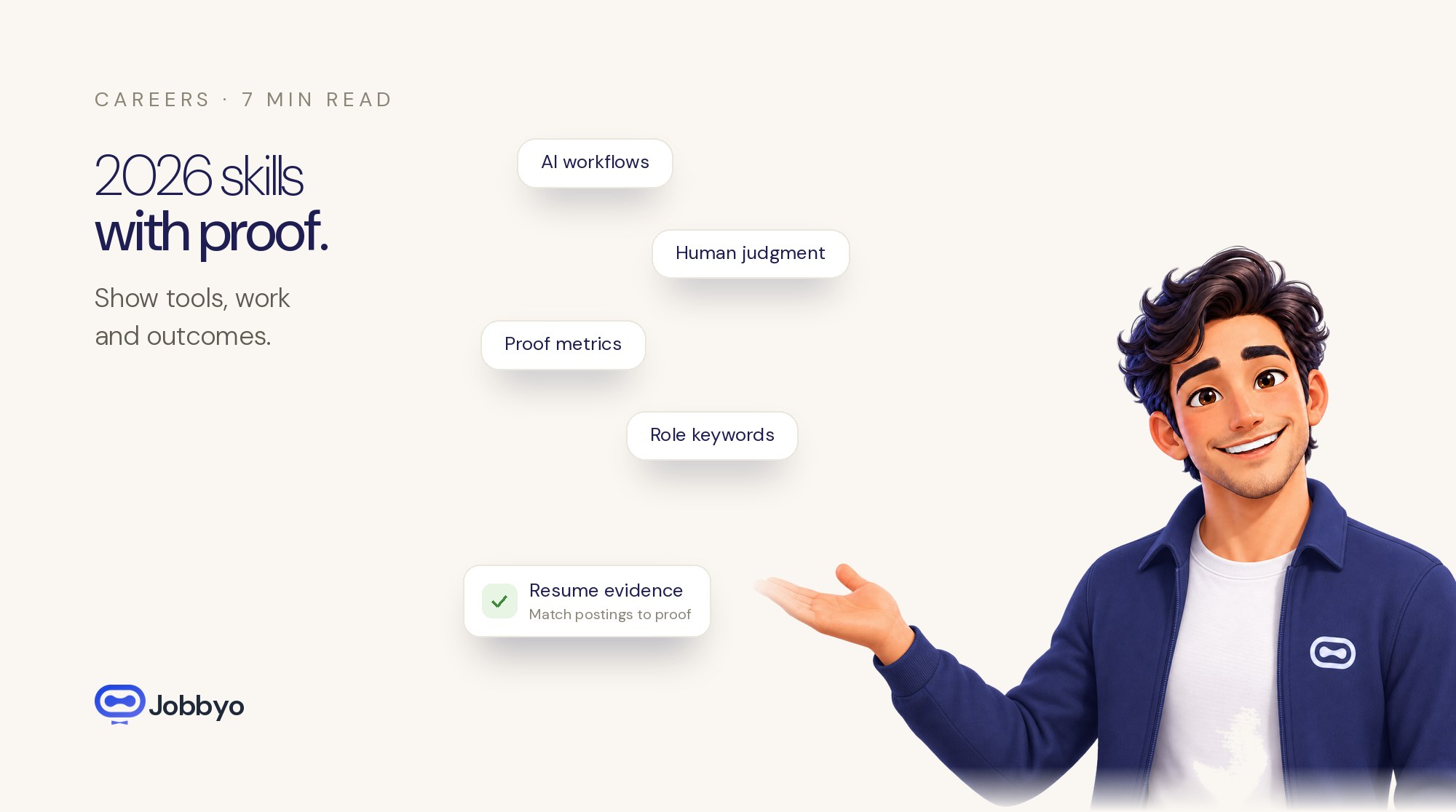
The 2026 skills employers are signaling now — and how to reposition your resume around proof, not buzzwords.
If your resume says “AI-savvy,” “strong communicator,” or “strategic thinker,” it is probably not helping you.
Those phrases are too easy to claim and too hard to verify. In 2026, hiring teams are looking for proof: the tool you used, the problem you worked on, the people involved, and what changed because of your work.
That applies whether you are changing careers, coming back after a layoff, or applying in a market where hundreds of people can submit a resume before lunch.
Sample size and scope
This guide is not a ranked labor-market report.
No disclosed dataset, sample size, geography, or collection window was provided for this article, so it would be dishonest to say “X% of employers want this skill” or “these are the top 10 skills by demand.”
Use this as a practical resume-positioning guide based on patterns employers tend to reveal in job descriptions, recruiter screens, interview prompts, and keyword filters.
The method is simple: compare the language in your target postings with the proof on your resume. If the posting asks for automation, customer retention, risk awareness, stakeholder management, or AI-assisted work, your resume needs evidence of that work — not a loose skills list.
2026 skill map by role family
Use this chart as a sorting tool, not a ranking. Do not paste every phrase into your resume. Pull the signals that appear repeatedly in the jobs you actually want.
| Role family | Skill signals employers may screen for | Tools or proof they may expect | Strong resume evidence |
|---|---|---|---|
| Software engineering | AI-assisted development, system design, debugging, secure coding habits | GitHub, CI/CD, cloud platforms, test frameworks, LLM coding tools | Shipped features, improved performance, reduced defects, strengthened reliability, worked closely with product or design |
| Data analytics / data engineering | Data modeling, automation, dashboards, business interpretation, governance | SQL, Python, dbt, Snowflake, BigQuery, Tableau, Power BI | Changed a decision, reduced manual reporting, improved dashboard accuracy, clarified business risk |
| Product management | Customer discovery, prioritization, experimentation, AI product judgment | Roadmaps, analytics tools, A/B testing, user research, Jira, Linear | Made tradeoffs, launched features, improved adoption, influenced retention or revenue, reduced user friction |
| B2B SaaS marketing | Positioning, lifecycle campaigns, demand generation, content strategy, AI-assisted execution | CRM, marketing automation, analytics, SEO tools, campaign reporting | Influenced pipeline, improved conversion, sharpened audience insight, aligned with sales, tested messaging |
| Customer success / account management | Retention, onboarding, escalation handling, customer judgment, commercial awareness | CRM, support tools, product usage data, QBRs, renewal workflows | Saved accounts, improved adoption, resolved escalations, expanded customer value |
| Cybersecurity / risk | Threat awareness, access control, compliance support, incident response, secure systems thinking | IAM, SIEM, SOC workflows, cloud security, audit documentation | Reduced risk, supported response work, improved policy, prepared audit evidence, trained teams on security habits |
| UX / UI / product design | Research synthesis, accessibility, prototyping, design systems, business-aware design | Figma, usability testing, analytics, component libraries | Improved flows, reduced drop-off or friction, used research to guide decisions, worked across product and engineering |
| Operations / project management | Process improvement, automation, vendor coordination, change management | Asana, Jira, Notion, Airtable, ERP/CRM tools, AI workflow tools | Cut cycle time, reduced handoffs, improved reporting, lowered costs, kept launches cleaner |
| Sales / revenue roles | Consultative selling, account strategy, pipeline quality, industry knowledge | CRM discipline, outreach tools, enablement materials, forecasting | Showed quota context, managed complex deals, worked defined customer segments, supported retention or expansion |
| Executive / senior leadership | Transformation, judgment, people leadership, confidential search positioning | Board materials, operating plans, KPI systems, market strategy | Made strategic decisions, led teams through constraints, improved operating metrics, handled sensitive change |
Three findings worth acting on
1. AI is becoming a work habit, not a personality trait
Hiring teams do not need another resume that says “generative AI.” They need to know how you used it.
Better evidence looks like this:
- Used AI-assisted research to summarize competitor messaging, then manually checked claims before turning the findings into sales enablement notes.
- Built prompt templates for recurring support documentation, improving consistency while keeping final review with subject-matter experts.
- Used AI coding assistance for test-case ideas and documentation, then reviewed outputs for accuracy, security, and maintainability.
The weak version is “Used ChatGPT.” The stronger version explains the workflow, the human review, and the business reason.
2. Human judgment is more valuable when tools do more of the drafting
Automation can produce a first pass. It cannot own the tradeoff.
That is why employers still screen hard for judgment: handling an angry customer, noticing when a dashboard is misleading, pushing back on a bad roadmap idea, translating vague executive feedback into a workable plan, or deciding when speed is more dangerous than delay.
For career changers, this is good news. A teacher moving into customer success may already have evidence of de-escalation, documentation, learning design, and stakeholder communication. A finance analyst moving into revenue operations may already have evidence of forecasting, reporting, data cleanup, and executive-ready summaries. A project manager moving into product operations may already have evidence of prioritization, launch coordination, process design, and cross-functional follow-through.
The resume problem is usually translation, not absence of skill.
3. Task lists are losing
“Managed reporting.”
“Worked with customers.”
“Supported projects.”
These bullets make the reader do the work. Most recruiters will not.
Turn responsibilities into evidence:
Weak: Managed reporting for internal teams.
Stronger: Built recurring performance reports that helped sales, finance, and customer success identify bottlenecks and make faster operating decisions.
Weak: Worked with customers to solve issues.
Stronger: Resolved customer escalations by diagnosing root causes, coordinating internal stakeholders, and turning repeated issues into process fixes.
Weak: Used AI tools.
Stronger: Used AI-assisted drafting and research workflows to speed documentation while maintaining human review for accuracy, tone, and compliance.
You do not need to exaggerate. You need to remove the fog.
Job-seeker takeaway: audit the resume before you apply
Before sending another application, do this:
- Pick one target role. “Product marketing manager in B2B SaaS” is useful. “Marketing jobs” is too broad.
- Collect several current postings that match that target.
- Mark repeated language across the postings: tools, outcomes, customer type, collaboration patterns, compliance needs, AI usage, data requirements.
- Compare those patterns with your resume.
- Rewrite the top third first: headline, summary, core skills, and most recent role bullets.
Look especially for proof of:
- AI-assisted workflows
- Data interpretation
- Customer or stakeholder judgment
- Process improvement
- Revenue, retention, cost, risk, or speed impact
- Clear communication across teams
- Security, compliance, or privacy awareness where relevant
Cut vague claims such as:
- Strategic thinker
- Results-oriented professional
- AI-savvy
- Strong communicator
- Fast learner
Replace them with concrete evidence:
- Led a reporting rollout across sales, finance, and customer success.
- Automated a manual tracking workflow used in leadership reviews.
- Converted customer feedback into product and support recommendations.
- Summarized complex operational data for executive decision-making.
A resume does not need to shout. It needs to answer the screen: “Can this person do the work we are hiring for?”
A sharper approach for laid-off professionals
If you were laid off, the pressure to move fast is real. The trap is sending a generic resume to every open role and calling that momentum.
Start with the roles that actually fit. Then scan for repeated signals:
- Are the postings asking for automation or AI-assisted workflows?
- Are they focused on retention, revenue, cost control, or risk?
- Do they mention dashboards, data storytelling, or reporting tools?
- Do they expect remote collaboration, documentation, or async communication?
- Are compliance, security, or audit readiness part of the job?
Update your resume around those signals before you increase application volume. Speed helps only after the positioning is right.
How Jobbyo can help
Jobbyo helps turn job-posting language into tailored resumes and cover letters, so you are not rewriting the same application from scratch every time.
Use it to compare your resume against the skills your target roles keep asking for, customize materials by role, and apply across company career pages and job boards. Depending on your workflow, you can review before submission or use automated applying.
The point is not to blast applications at every listing. It is to apply to better-fit roles with evidence that matches the screen.
In 2026, the stronger search is targeted, specific, and proof-based. Start with the skill map above. Audit your resume. Then tailor each application so the right experience is visible before a recruiter has to hunt for it.
Put this to work
Let Jobbyo find your
best matches for you.