9 min read
Top AI Screening Tools for ATS Integration in 2026
AI screening now shapes who gets seen. Learn top ATS-integrated tools and how to tailor your resume for fit before applying.
If you apply online in 2026, assume your resume may be parsed, matched, summarized, and routed before a recruiter opens the file.
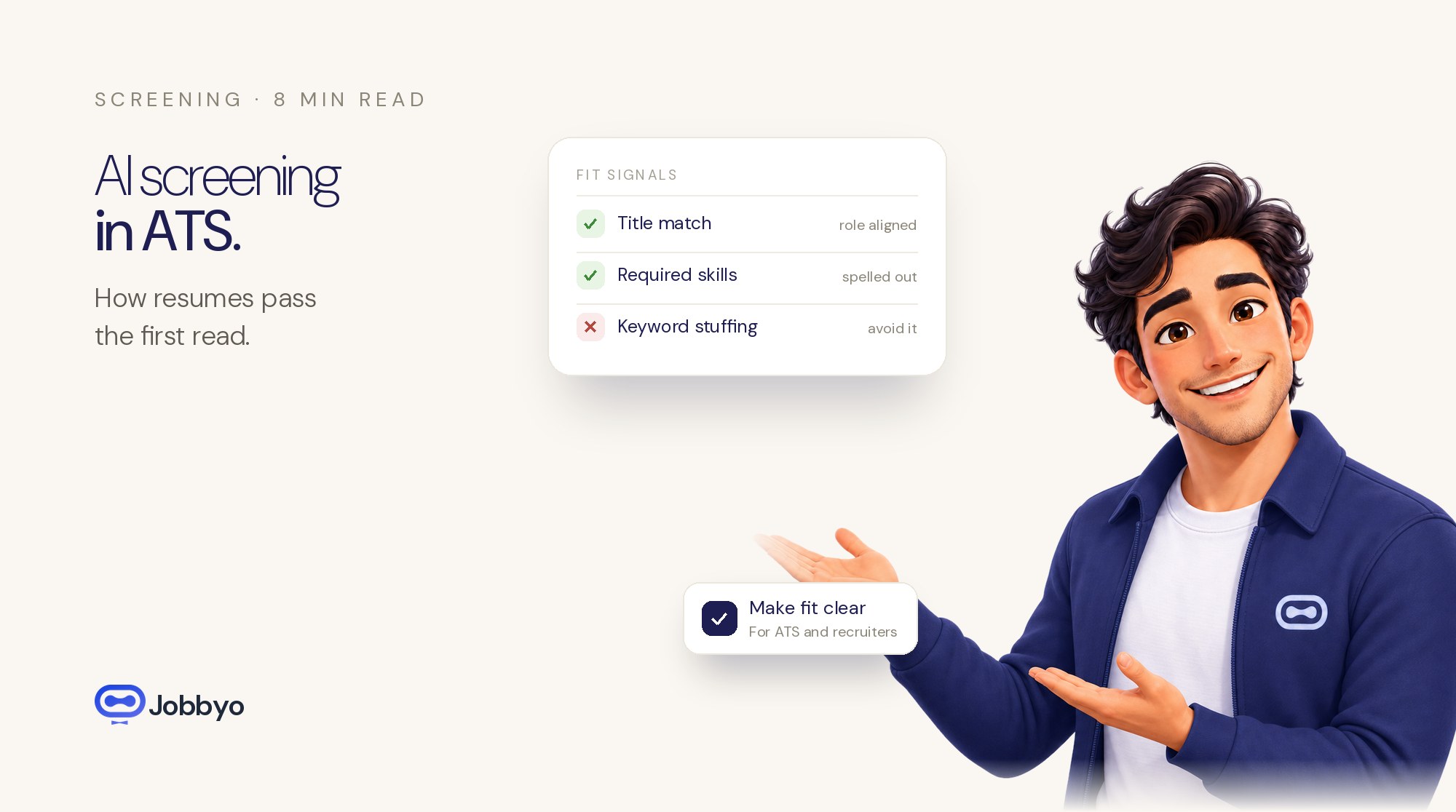
That does not mean a robot “rejects everyone.” It means your resume has to make the fit obvious inside the hiring system: title match, required skills, industry context, location, work authorization, certifications, tools, seniority, and measurable results.
Do not stuff keywords. Do not paste the job description into white text. Do not turn your resume into a bag of buzzwords.
Do this instead: write a resume that gives the screening layer and the recruiter the same answer — this person fits the role.
The AI screening tools job seekers should recognize in 2026
The most important tools are not always the loudest AI brands. They are the platforms and add-ons sitting in the employer’s recruiting stack, usually connected to an applicant tracking system, HR system, career site, assessment workflow, or recruiter dashboard.
This is not a universal ranking. A Fortune 500 employer can configure Workday one way, while a mid-market company using Greenhouse or SmartRecruiters may use only a few automation features. The tool matters. The setup matters more.
| Platform or tool | Where it shows up in hiring | What job seekers should assume |
|---|---|---|
| Workday + HiredScore | Workday-centered recruiting environments, with HiredScore used for AI-powered talent orchestration and matching | Your resume may be compared with role requirements before a recruiter reads it closely |
| Eightfold AI | Talent intelligence, skills inference, candidate matching, and ATS-connected workflows | Adjacent skills and career path may be interpreted, not just exact job titles |
| iCIMS Talent Cloud / iCIMS AI features | Candidate matching, recruiting automation, and recruiter workflow support for employers using iCIMS | Recruiters may see AI-assisted recommendations instead of a simple first-applied list |
| Greenhouse AI and Greenhouse integrations | AI-assisted recruiting features plus screening, sourcing, and assessment integrations | Clean resume structure and obvious role alignment help more than clever formatting |
| SmartRecruiters / Winston AI | Recruiting automation and AI assistance inside SmartRecruiters hiring workflows | Your profile may be prioritized or summarized against job criteria before human review |
| SAP SuccessFactors Recruiting / SAP Business AI | Enterprise recruiting and HR workflows with AI-assisted talent features | Large employers may lean heavily on structured job history, skills, and internal rules |
| Oracle Recruiting / Oracle Cloud HCM AI features | Recruiting workflows inside Oracle Cloud HCM | Standard formatting and direct fit language matter in enterprise systems |
| Phenom | Career site personalization, talent experience, candidate matching, and recruiter workflows | Your career-site behavior and profile data may affect routing or visibility |
| HireVue | Structured interviews, assessments, and ATS-connected screening workflows | Screening may move beyond the resume into recorded responses, tests, or structured interview data |
| Paradox | Conversational screening, chatbot workflows, scheduling, and ATS connections | Knockout questions such as location, availability, work authorization, and shift fit may filter candidates early |
These systems are not all doing the same thing. Some summarize. Some rank. Some match skills. Some handle assessments. Some route candidates. Some only help recruiters move faster.
For job seekers, the practical risk is the same: if your resume makes the system guess, you lose control of the first read.
What happened
On February 27, 2024, Workday announced an agreement to acquire HiredScore, a company focused on AI-powered talent orchestration.
That announcement mattered because Workday is already a major HR and recruiting platform for large employers. When a core HCM provider brings AI matching and orchestration closer to the recruiting workflow, AI review is no longer a side experiment bolted onto hiring. It is moving into the systems where applications already live.
Regulation moved too.
New York City Local Law 144 began enforcement on July 5, 2023. The law applies to certain uses of automated employment decision tools and includes audit and notice requirements.
In Europe, the European Parliament approved the EU AI Act on March 13, 2024. Employment-related AI is treated as a high-scrutiny use case.
So the hiring-tech story is not “AI is coming.” It is already in the stack, and lawmakers are reacting because hiring decisions affect people’s income, mobility, and careers.
Why it matters
The first screen may happen before a recruiter reads your resume line by line.
That does not mean every rejection came from “the ATS.” That excuse is too neat. A job may have an internal candidate. The posting may be stale. The recruiter may be buried under 600 applicants. The hiring manager may change the requirements after the role goes live.
But ATS-connected AI adds another filter. If the job asks for SQL, Salesforce, healthcare revenue cycle, hybrid availability in Chicago, and three years of analyst experience, your resume needs to show those facts clearly if they are true.
A human might infer that “owned monthly reporting automation” involved analytics work. A screening layer may need the nouns spelled out: SQL, dashboards, forecasting, Salesforce reports, data quality, stakeholder reporting, revenue metrics, or whatever the posting actually names.
You are not writing for a machine instead of a human. You are writing so the machine does not bury the resume before the human sees it.
What job seekers should do
Tailor the resume to the role’s real requirements. Not the vibe of the role. Not the company’s brand language. The requirements.
Look for these fit signals in the posting:
- Required skills: tools, platforms, programming languages, methodologies, certifications
- Target title: whether your current or recent title maps to the job title
- Seniority: associate, manager, senior manager, director, VP, individual contributor
- Industry context: SaaS, healthcare, fintech, cybersecurity, retail, manufacturing, government
- Function: sales operations, product marketing, data engineering, UX research, compliance, finance
- Location: city, state, time zone, remote eligibility, hybrid schedule
- Work authorization: sponsorship, clearance, citizenship, or eligibility requirements when stated
- Education and certifications: degree, license, security certification, HR certification, project management credential
- Assessment data: tests, recorded interviews, chatbot answers, structured interview scores
- Recency: whether the relevant work appears in your last role, five years ago, or buried near the bottom
The common mistake is assuming the match is obvious.
Example: if you are moving from finance into a tech operations role, “managed forecasting” is weak. A sharper version would be: “Built Excel and SQL revenue forecasting dashboards for SaaS pipeline planning and weekly leadership reporting.”
Same experience. Better signal.
How to write for AI screening without sounding like a keyword spammer
Use the employer’s language only when it is true.
A better process:
- Pull the must-haves from the job description. Separate required skills from nice-to-haves.
- Match each requirement to proof. A skill without a project, tool, metric, or responsibility looks thin.
- Rewrite bullets with tools and outcomes. “Improved onboarding workflow using Salesforce reports and weekly QA checks” beats “responsible for onboarding.”
- Use standard section headings. Use “Experience,” “Skills,” “Education,” and “Certifications.” Do not make the parser decode your creativity.
- Avoid fragile formatting. Columns, icons, text boxes, graphics, and unusual layouts can break parsing or bury important details.
- Translate transferable work. If the job says “customer success operations,” do not hide behind “client support.” Connect the experience to renewals, onboarding, CRM hygiene, reporting, or escalation workflows.
- Make constraints clear when they matter. If the role requires a state, time zone, clearance, or work authorization status, do not make the employer hunt for it.
The point is not to trick Workday, Greenhouse, iCIMS, SmartRecruiters, SAP SuccessFactors, Oracle, Phenom, Eightfold, HireVue, or Paradox.
The point is to remove doubt.
Which tool should you worry about most?
Do not obsess over one vendor.
Worry about the pattern: employers are using software to sort large applicant pools faster. One company may use AI only to summarize resumes. Another may combine knockout questions, skills matching, assessments, recruiter ranking, and automated scheduling.
That is why the same resume can perform differently across two similar jobs. The job descriptions differ. The recruiter settings differ. The knockout questions differ. The employer’s internal priority differs.
A generic resume is a weak bet because every role has its own screening logic.
Pre-application checklist for 2026
Before you submit, check the resume against the posting:
- Does my target title closely match the job title?
- Are the required skills visible in the top half of the resume?
- Are the strongest bullets attached to my most recent relevant role?
- Did I include the tools, systems, certifications, or methods named in the posting?
- Did I translate transferable experience into the employer’s terms?
- Is my location, time zone, remote eligibility, clearance, or work authorization clear if the posting makes it relevant?
- Does the resume still sound like a person wrote it?
- Is the posting current, or does it look like a stale or ghost job?
That last question saves time. AI screening is frustrating enough without spending your best resume customization effort on a role that may not be actively hiring.
How Jobbyo helps
Jobbyo is built for this version of the job search: fewer blind submissions, more role-specific applications.
It analyzes the posting, identifies the likely fit signals, customizes your resume and cover letter for that role, and can either apply automatically or let you review before submission depending on your plan.
That is the right response to ATS-connected AI screening: not panic, not keyword stuffing, and not mass applying with one static resume.
Use Jobbyo to tailor each application before it enters the employer’s system, especially if you are changing careers, applying while employed, recovering from a layoff, targeting remote roles, or competing for technical jobs with strict filters.
Source notes: This article is grounded in public hiring-tech developments including Workday’s February 27, 2024 announcement of its agreement to acquire HiredScore, New York City Local Law 144 enforcement beginning July 5, 2023, and the European Parliament’s March 13, 2024 approval of the EU AI Act.
Put this to work
Let Jobbyo find your
best matches for you.