9 min read
8 Predictions for 2026 Recruitment: Why Targeting Beats Volume
2026 hiring looks more competitive. Here are 8 recruitment predictions and how job seekers should adjust targeting, positioning, and applications.
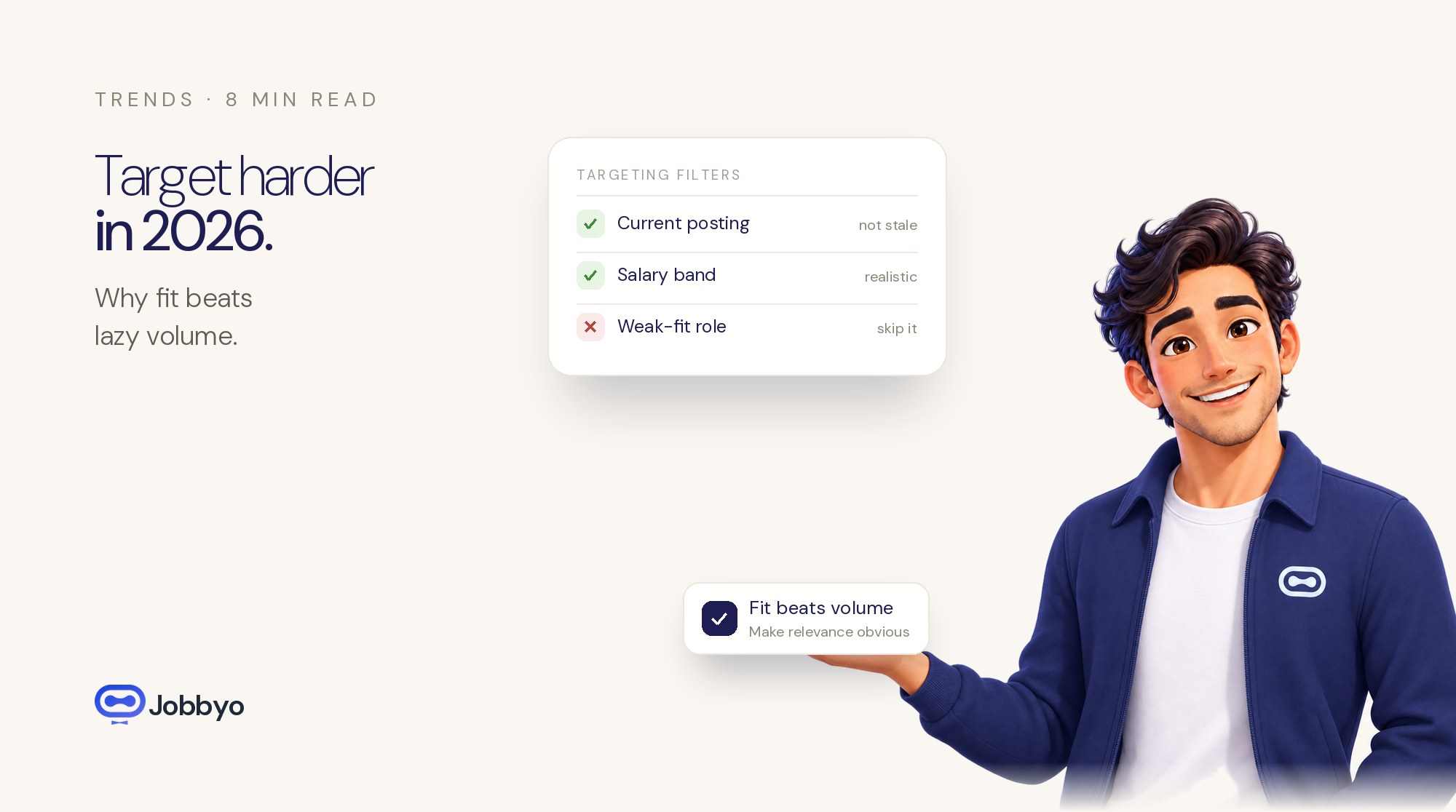
The 2026 job search will punish lazy volume.
That does not mean applying to five jobs a week and calling it strategy. It means sending more applications to roles that actually fit: current postings, realistic salary bands, eligible locations, and job descriptions where your experience is easy to understand.
Indeed Hiring Lab’s public labor-market signals point to a tougher setup for candidates: weaker online listing activity compared with the pre-COVID baseline, plus more available candidates. In plain English: fewer obvious openings, more people chasing the good ones.
So the old advice — “just apply more” — is incomplete. You still need volume. But volume without targeting is just rejection at scale.
Why will the 2026 job search feel harder?
Because many candidates will be searching in a market that looks active but feels clogged.
Employers will still hire in 2026. People quit. Teams miss targets. Budgets open. Security, revenue, operations, engineering, healthcare, and customer-facing work still need people.
The friction is in the path from posting to offer. Hiring teams may take longer to approve backfills. Recruiters may sit on a role while managers revise requirements. A job may stay online even after urgency drops.
For candidates, that creates a nasty pattern: more applications, fewer replies, and a growing feeling that every resume is falling into a hole.
The fix is not panic-applying. The fix is making your fit obvious before a recruiter has to work for it.
What does the labor-market data suggest?
Hook: If your search feels slower than the last market cycle, that is not just nerves. Public data from Indeed Hiring Lab points to a market where candidates need tighter filters and sharper positioning.
Sample size and scope: This section uses public labor-market intelligence from Indeed Hiring Lab. The source context covers online job listing activity compared with the pre-pandemic benchmark and signals of candidate availability. Geography: United States, unless Indeed Hiring Lab specifies otherwise. Time window: pre-pandemic benchmark through the latest public Indeed context provided for this article. This is not Jobbyo proprietary data. No exact posting counts or percentages are included because they were not provided in the source material.
Chart: job-search signals to watch in 2026
| Signal from Indeed Hiring Lab context | Directional read | What it means for candidates |
|---|---|---|
| Online job listings versus the pre-COVID benchmark | Weaker than job seekers may expect | Fewer visible openings in some fields; less room to waste time on bad-fit roles |
| Candidate availability | Moving higher | More applicants may be competing for the roles that are genuinely open |
| Recruiter attention | More strained | A vague resume is easier to skip when the applicant pool is larger |
Three findings that matter:
- Each application has to carry more weight. When strong postings are harder to find, applying to stale, vague, or mismatched jobs is not harmless. It burns hours you could use on better targets.
- “Qualified” is too weak a claim. In a larger candidate pool, your resume has to show why you fit this role, this company, and this set of requirements.
- Effort alone will not save a messy search. More applications can help, but only when they are aimed at real openings with a plausible match on title, skills, salary, and location.
Job-seeker takeaway: In 2026, you need enough applications to create chances. You also need the discipline to avoid roles that were never likely to move.
Soft CTA: Jobbyo helps job seekers find current openings, tailor resumes and cover letters by role, and apply at higher volume without spending hours on weak postings.
The 8 recruitment predictions for 2026
1. Employers will still hire, but approvals will be slower
Hiring will not stop. But more companies will treat headcount like a risk decision.
That means longer internal approvals, more cautious shortlists, and more hiring managers waiting for a candidate who matches the brief closely. A role may be real and still move slowly.
Your response: do not send a resume that looks interchangeable. If the job asks for Salesforce reporting, healthcare operations, Series B SaaS experience, or SOC 2 work, those terms should not be buried on page two.
2. A larger candidate pool will make plain “qualified” less persuasive
When recruiters have more applicants, basic eligibility loses power.
This hurts career changers first. A finance manager trying to move into SaaS operations cannot assume a recruiter will translate the background. The resume has to do the work: budget ownership, stakeholder management, reporting cadence, process improvement, risk controls, forecasting, and the tools used.
Do not make the reader infer your relevance. Spell it out without inflating it.
3. Bland AI resumes will get easier to ignore
AI has made it simple to produce a clean resume. It has also flooded recruiters with resumes that sound the same.
Phrases like “cross-functional leader,” “results-driven professional,” and “leveraged data to optimize outcomes” do not prove anything by themselves. They are filler unless tied to a project, system, metric, customer, tool, or business problem.
Use AI like an editor, not a disguise. Feed it the job description, then make it sharpen the evidence: projects, tools, scope, outcomes where available, industry context, and the language the employer actually uses.
4. ATS alignment will matter, but keyword stuffing will backfire
Applicant tracking systems still matter. Job titles, certifications, tools, licenses, systems, and required skills should appear where they are true.
But an ATS-friendly resume still has to survive a human reader.
The better move is clean alignment: use the employer’s language for real experience, put the most relevant bullets higher, and remove clutter that competes with the job’s core requirements. Do not claim tools, credentials, or industries you do not have.
5. Stale and ghost postings will waste more candidate time
A cautious market creates ugly posting behavior.
Some jobs stay online after urgency fades. Some are refreshed for pipeline building. Some are open in theory but stalled in budget review. Some listings are so vague that no candidate can tell what the company actually needs.
Filter harder before you tailor anything. Check posting age, company career pages, role specificity, recruiter activity, salary information, and whether the job has a clear business purpose. A real role usually reads like a team has an actual problem to solve.
6. Salary fit will become an earlier filter
Late-stage compensation mismatch is expensive.
Candidates lose interview time. Recruiters lose trust. Hiring managers lose momentum. Nobody wins when the salary band was never close.
In 2026, treat compensation as part of targeting. If the role is far below your range, skip it unless there is a clear strategic reason: a new industry, a better title, equity upside, location flexibility, or a company you specifically want.
This matters even more for senior leaders and executives running confidential searches. The wrong process can create exposure without creating opportunity.
7. “Remote” will come with more fine print
Remote will not always mean anywhere.
Employers may restrict hiring by state, country, time zone, tax setup, work authorization, or team overlap hours. A job can be remote and still unavailable to you.
Make location eligibility an early filter. Before you spend time tailoring a resume, check whether the company can hire where you live. This is especially important for candidates limited by state, visa status, caregiving needs, or relocation constraints.
8. Niche specialists will still have leverage, but only if they show context
A tougher market does not flatten every skill set.
Technical specialists, data engineers, UX/UI professionals, Salesforce experts, InfoSec candidates, and B2B SaaS product or marketing professionals can still stand out. But niche skills do not explain themselves.
A stronger resume shows the environment and the outcome. “Salesforce administrator” is thin. Better: the systems owned, workflows improved, users supported, integrations touched, dashboards built, and revenue or operational process affected.
Specific beats impressive-sounding.
How should job seekers change strategy in 2026?
Separate motion from progress.
Submitting applications is motion. Getting recruiter screens, hiring-manager conversations, referrals, and interviews is progress.
A better 2026 search should include:
- Defined targets: Pick the titles, industries, company stages, tools, and responsibilities where your background is credible.
- Posting filters: Avoid old, vague, underpaid, geographically ineligible, or unrealistic roles when stronger options exist.
- Role-specific resumes: Adjust the summary, skills section, and bullet order for each job description.
- Transferable-skill translation: If you are changing industries or functions, connect the dots directly.
- Enough volume: Do not hide behind perfection. Apply consistently, but stop feeding bad postings.
- Networking in parallel: Use saved time for referrals, warm introductions, recruiter follow-ups, and interview prep.
Most candidates are not lazy. They are leaking time into the wrong roles.
Is high-volume applying still useful in 2026?
Yes, if the volume is targeted.
A tiny batch of handcrafted applications can be too slow. A huge batch of generic applications can be useless. The middle path is targeted volume: more applications than you could comfortably do by hand, but with filters and tailored materials.
That means excluding roles that are stale, fake-looking, outside your salary range, outside your location eligibility, or far from your actual experience.
AI can help here. It should not turn your search into spam. It should help you find better-fit roles faster, adapt your resume honestly, and reduce repetitive form-filling.
How can Jobbyo help?
Jobbyo is built for the job search this market demands: more competition, more noise, and less patience for wasted effort.
Jobbyo helps candidates:
- Find openings across company career pages and job boards
- Screen out stale, ghost-like, and poor-fit postings
- Tailor resumes and cover letters for specific roles
- Apply automatically or with review, depending on preference
- Increase application volume without spending the week copying the same information into forms
The 2026 job search is not about applying everywhere. It is about applying to enough of the right roles with a resume that makes the match obvious.
Use Jobbyo to find real openings, sharpen your positioning, and apply at higher volume without burning hours on postings that were never worth your time.
Put this to work
Let Jobbyo find your
best matches for you.