11 min read
Why AI Is a Massive Job-Creation Technology, Despite the Panic
AI is compressing some roles and expanding others. Learn where job seekers should aim next.
If your work is mostly repeatable text, basic reporting, simple ticket handling, data cleanup, or low-context research, AI is already putting pressure on that lane.
If your work helps a company choose AI tools, connect them to old systems, control risk, train employees, explain products, secure data, or turn prototypes into usable workflows, the story is different.
That difference matters for job seekers. A bigger application count will not save a search aimed at roles employers are trying to shrink. A sharper target list will.
The surprising fact
AI does not hit the labor market like a meteor. It hits task by task.
Observed fact: employers are already posting AI-adjacent jobs across product, engineering, data, operations, security, legal, marketing, sales, customer success, and enablement.
Forecast: the best labor-market upside will likely go to people who can make AI useful inside a real business: lowering risk, speeding work, improving decisions, supporting customers, or building revenue. That does not mean every AI-related job will pay more. It does not mean every worker benefits. It means the upside is concentrated around people who move toward the work AI makes more important.
The panic version is easy: AI writes, codes, summarizes, analyzes, designs, and automates, so fewer people are needed.
The business version is messier. Once a company buys an AI tool, it inherits a new pile of work:
- picking the right tool instead of the loudest vendor
- connecting it to CRM, HRIS, ticketing, finance, data, and security systems
- checking outputs for accuracy, bias, privacy, and compliance
- rewriting workflows so employees actually use it
- training teams that do not want another dashboard
- explaining AI features to buyers who are skeptical for good reason
- protecting company data from leakage and misuse
- moving a demo into production without breaking trust
That is work. It may not be the same work that existed five years ago. It may not go to the same people. But it is real work, and job seekers should be watching it closely.
What the sources actually say
The useful sources do not say AI simply erases occupations in one clean sweep. They point to a shift in tasks, skills, and hiring priorities.
The World Economic Forum’s Future of Jobs research treats AI as both a source of displacement and a source of new demand. Its reports keep returning to the same employer needs: analytical thinking, AI and data literacy, technical fluency, cybersecurity, resilience, and adaptability.
The U.S. Bureau of Labor Statistics is more cautious. Its Occupational Outlook Handbook is not written for hype cycles. But it continues to show long-term demand in areas tied to digital transformation: software, data, cybersecurity, healthcare, infrastructure, and technical implementation. AI does not remove the need for systems, clean data, privacy controls, security, documentation, and compliance. In many companies, it exposes how weak those foundations are.
LinkedIn’s labor-market research and Jobs on the Rise reporting also show employers creating or emphasizing roles around AI, automation, revenue operations, enablement, data, and product growth. Some titles will age badly. Some will get renamed. The signal still matters: companies are reorganizing work around AI capability.
So the question is not whether AI affects jobs. It already does.
The better question is: which roles become more valuable because AI exists, and which roles become easier to squeeze?
Why some roles grow and others get thinner
AI adds demand when it creates complexity, accountability, or a new way to make money. It cuts demand when a task can be standardized, generated quickly, and reviewed by fewer people.
Roles become more valuable when a human still has to:
- define the problem before a tool touches it
- decide what good output looks like
- handle messy exceptions
- manage stakeholders who disagree
- own the result when the model is wrong
- verify claims, numbers, sources, and logic
- navigate privacy, regulation, procurement, and legal review
- turn technical capability into revenue, retention, or cost savings
Roles become more exposed when most of the job is:
- generic content production
- basic data entry or cleanup
- templated reporting
- low-context admin processing
- simple support scripts
- shallow sourcing or resume screening
- routine QA with no investigation
- research summaries with little judgment
- coding tasks without ownership of the system
That is the practical job-search filter.
Do not ask only whether AI can do part of the job. In many roles, the answer is yes.
Ask whether AI makes the role more central to the business, or makes the company believe one person can now do the work of several.
Where AI is adding hiring pressure
Implementation and operations
Companies do not get value from buying AI software. They get value when the software is wired into a workflow people actually use.
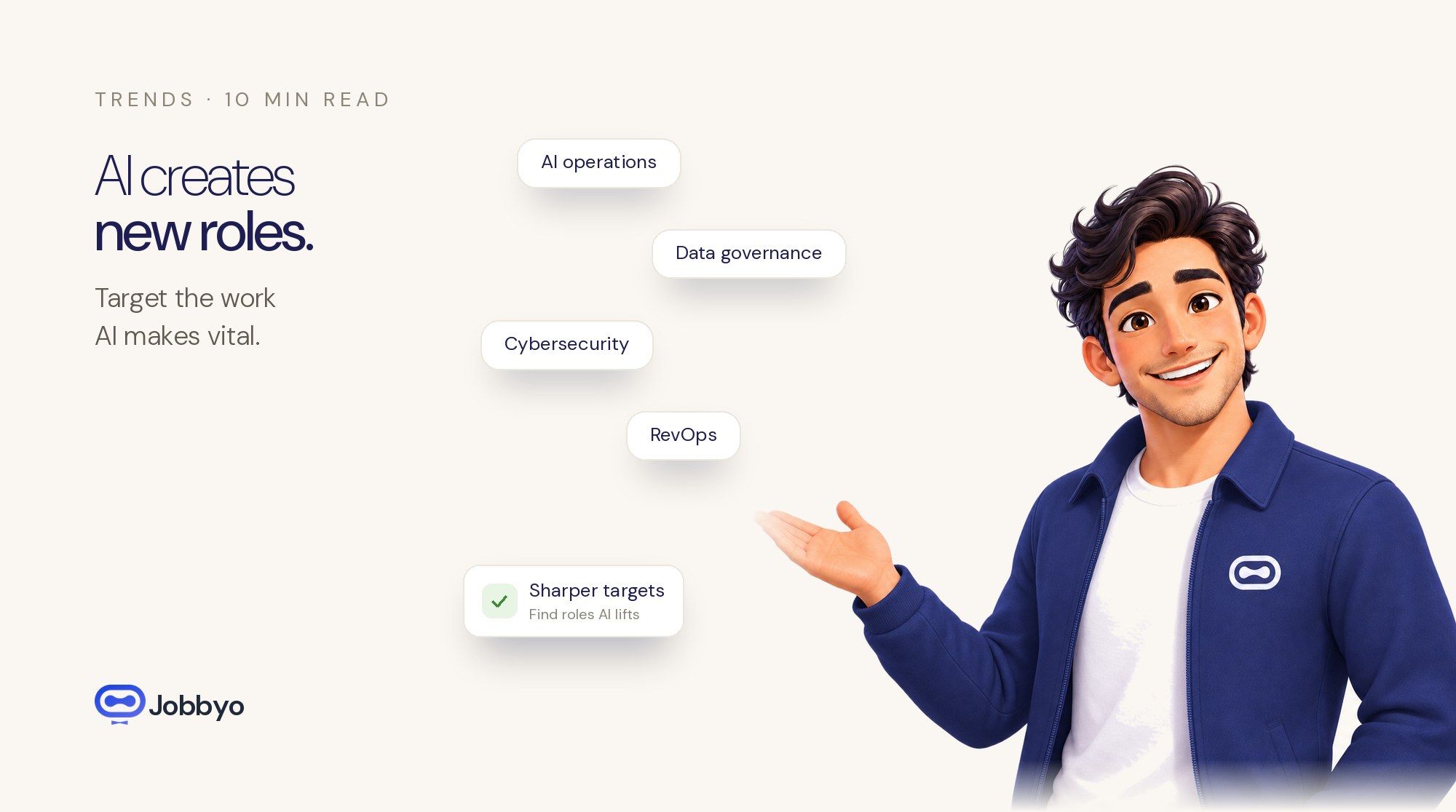
That creates demand for people who can map processes, compare tools, manage rollout plans, write documentation, train teams, and measure whether the tool helped. Search terms and titles may include AI operations, automation specialist, business systems analyst, RevOps, workflow consultant, internal tools, business operations, and process improvement.
You do not need to be a machine learning engineer for many of these jobs. Domain knowledge often matters more. A person who understands how support tickets move, how sales teams forecast, how finance closes the books, or how recruiters manage pipelines can be valuable if they can translate that workflow into an AI-assisted process.
Data quality and decision support
AI makes bad data move faster.
That is why data engineering, analytics engineering, business intelligence, data governance, and data stewardship matter more, not less. Employers need people who understand pipelines, metric definitions, dashboards, privacy limits, reporting logic, and the business context behind the numbers.
This is a strong lane for career changers with finance, operations, marketing, product, or customer experience. The move is not to claim you are an AI expert. The move is to show that you understand decisions, data quality, and the cost of bad inputs.
AI product, product marketing, and customer education
AI features still need packaging, pricing, onboarding, competitive positioning, help docs, demos, renewal support, and buyer education.
That creates room for product managers, product marketers, UX researchers, technical writers, solutions consultants, sales engineers, enablement leads, and customer success teams who understand both the product and the customer’s risk.
The market does not need more vague AI storytellers. It needs people who can explain what the product does, what it does not do, where humans remain in the loop, and why a buyer should trust it.
Security, compliance, and risk
AI creates new failure points: data leakage, prompt misuse, hallucinated outputs, vendor exposure, intellectual property questions, audit gaps, bias, and regulatory risk.
That puts more weight on information security, privacy, compliance, governance, legal operations, vendor risk, procurement, and internal audit. If you already work in banking, healthcare, insurance, education, government, or another regulated environment, this may be your cleanest path into AI-related work.
You already know the rules, the approvals, the audit trails, and the consequences when a company gets sloppy. That context is hard to fake.
Human-centered roles that use AI well
Plenty of valuable roles will never have AI in the title.
Recruiters, sales reps, customer success managers, consultants, designers, marketers, financial analysts, and project managers can all use AI to move faster. But the valuable version is not the person pasting generic prompts into a chatbot.
The valuable version is the person who uses AI to draft, compare, summarize, test, and prepare while still owning judgment, context, ethics, and outcomes.
That distinction belongs in interviews. Employers do not need to hear that you use AI. They need to hear where it improved speed, quality, decision-making, or customer experience without lowering the standard.
Where AI is squeezing opportunity
Higher-risk lanes share one trait: employers believe the work can be produced cheaper, reviewed quickly, and standardized.
That does not mean these jobs disappear tomorrow. It means openings may thin out, entry-level paths may get rougher, and generic applicants will have a harder time proving value.
Be careful with roles built mostly around:
- generic content writing with little subject expertise
- basic administrative coordination
- simple data entry
- spreadsheet cleanup without analysis
- template reporting
- low-complexity customer support
- junior research based mostly on summarizing public information
- commodity design production
- basic coding tickets with no system ownership
The threat is not only automation. It is funnel compression.
If a company once hired five people for repetitive production work and now expects two AI-assisted employees to handle it, the job category still exists. The odds are worse.
That is where spray-and-pray applying falls apart. More applications into a shrinking funnel usually means more silence, not more interviews.
What this means for your job search
Build your search around expansion signals, not old job titles.
Look for job descriptions that mention:
- AI adoption
- workflow automation
- systems integration
- data governance
- analytics
- technical implementation
- customer enablement
- risk management
- security and compliance
- process improvement
- change management
- product operations
- cross-functional stakeholder management
Be more cautious when a posting has:
- vague entry-level duties
- heavy repetitive output
- no decision-making authority
- no ownership of a metric, customer, system, or process
- task lists that read like an AI tool menu
- a stale posting date
- pay that does not match the required skill level
Then reposition your background in plain business language.
If you are in finance, do not lead with trying to break into AI. Lead with forecasting, controls, risk, reporting, and performance management. Show how that helps teams make better decisions around AI products or operations.
If you are in marketing, do not compete as a generic content producer. Lead with customer insight, lifecycle strategy, product messaging, experimentation, segmentation, and campaign execution.
If you are an engineer, do not dump a tool list on the page. Show that you can build reliable systems, manage data flows, evaluate tradeoffs, and ship AI-adjacent features without creating avoidable risk.
If you are in customer success, lead with adoption, onboarding, renewal risk, workflow change, enablement, and translating technical features into customer value.
AI rewards candidates who can explain their leverage. It punishes candidates who sound interchangeable.
How career changers should talk about transferable skills
Stop leading with what you lack. Lead with the business problems you already know how to solve.
Employers do not only need tool users. They need people who understand the environment where the tool will be used.
Useful transferable skills include process mapping, stakeholder communication, risk assessment, data interpretation, customer discovery, systems thinking, compliance awareness, change management, documentation, experiment design, and quality control.
The resume fix is usually translation, not reinvention.
Weak version: Managed reporting for finance team.
Stronger version: Built recurring reporting workflows that improved visibility into business performance, reduced manual analysis, and supported faster leadership decisions.
Weak version: Handled customer issues.
Stronger version: Identified recurring customer friction, translated patterns into product and support recommendations, and improved adoption through clearer workflows.
You are not pretending to be someone else. You are making the connection obvious for a hiring manager who is scanning fast.
Where Jobbyo fits
Jobbyo helps you spend less time applying blindly and more time aiming at roles where your background fits the market.
That matters more now because AI has lowered the cost of generic applications. If every candidate can generate a passable resume and cover letter in minutes, the advantage shifts to fit, timing, relevance, and positioning.
Jobbyo is built to help with that:
- find stronger-fit roles instead of chasing raw volume
- tailor resumes and cover letters to the actual posting
- make transferable skills easier to see
- filter out stale or low-quality listings
- apply automatically or let you review first
- keep your effort away from roles where the funnel is likely getting tighter
AI will not magically get you hired. No tool can promise that.
But a better search system can help you aim at the work AI is adding, not the work it is squeezing.
The smart move
Observed fact: AI is already changing job descriptions, workflows, skill requirements, and hiring priorities.
Forecast: candidates who position themselves around implementation, judgment, risk, data quality, product value, customer outcomes, and operational improvement will have a stronger path than candidates chasing roles built around repeatable tasks.
So do not apply harder into the wrong market.
Aim at roles where AI creates more need for human judgment, accountability, and execution. Use Jobbyo to find those roles, tailor your positioning, and stop wasting applications on jobs that were already moving against you.
Put this to work
Let Jobbyo find your
best matches for you.