10 min read
Why Job Posts Suddenly Ask for New Certifications—and What to Do
Seeing unfamiliar tools or certifications in job posts? Don’t panic-buy courses. Separate real skill gaps from resume keyword gaps.
A job post asks for Salesforce, HubSpot, SQL, Tableau, Jira, a cloud certification, and “AI workflow experience.” You have done the actual work. You have managed reports, cleaned pipeline data, shipped projects, handled stakeholders, or run campaigns. But you have not used the exact tool in the bullet.
That is where too many qualified people self-reject.
Do not treat every unfamiliar certification as a stop sign. Treat it as a sorting problem. Some requirements are real. Some are recruiter keywords. Some are manager wish-list items. Some are copied from the last job description and never questioned.
Your job is to separate a real skill gap from a wording gap before you spend money on a course or talk yourself out of applying.
The surprising fact
People are not waiting until they are fully trained to start searching. They are applying, learning, revising resumes, testing tools, and closing gaps at the same time.
The source note behind this topic says candidates and people actively planning skill changes are using multiple resources to move their careers forward. Translation: job search and skill-building are now happening in parallel.
That does not mean every applicant needs a new certificate by Friday. It means the market is louder, more tool-specific, and more keyword-heavy than it used to be.
What is actually happening
Observed fact: job seekers are seeing more job descriptions packed with named tools, platforms, certifications, and skill labels. Posts mention Salesforce, HubSpot, SQL, Python, AWS, Azure, Tableau, Power BI, Jira, Workday, ServiceNow, Google Analytics, cybersecurity frameworks, and role-specific software.
Forecast: this will probably continue as employers adopt new AI tools, security systems, CRM platforms, data stacks, HR software, and compliance processes faster than job titles can adjust. That is a forecast, not a guarantee.
The practical problem is already here: employers use tool names as shorthand for ramp speed. Candidates read those names as proof they are not qualified.
That is a bad trade. Employers write messy job posts. Candidates pay the price in confidence.
Why job posts now look like software inventories
Most job descriptions are not clean statements of what the job actually requires. They are assembled from several sources:
- the hiring manager’s daily pain points
- the recruiter’s keyword checklist
- compliance language from HR
- tools currently used by the team
- tools the team wants to adopt
- copied bullets from an older posting
- “preferred” items that should not be treated as hard requirements
So a revenue operations role may list Salesforce, HubSpot, Excel, SQL, Looker, Gong, Outreach, and forecasting experience. Does that mean the person must be expert-level in all eight? Usually no.
It may mean the team needs someone who can keep CRM data clean, build pipeline reports, spot broken handoffs, and explain numbers to sales leaders.
Those are outcomes. The tools are delivery methods.
Do not buy a course every time a job post names a tool
Panic-learning is expensive. It also feels productive, which makes it dangerous.
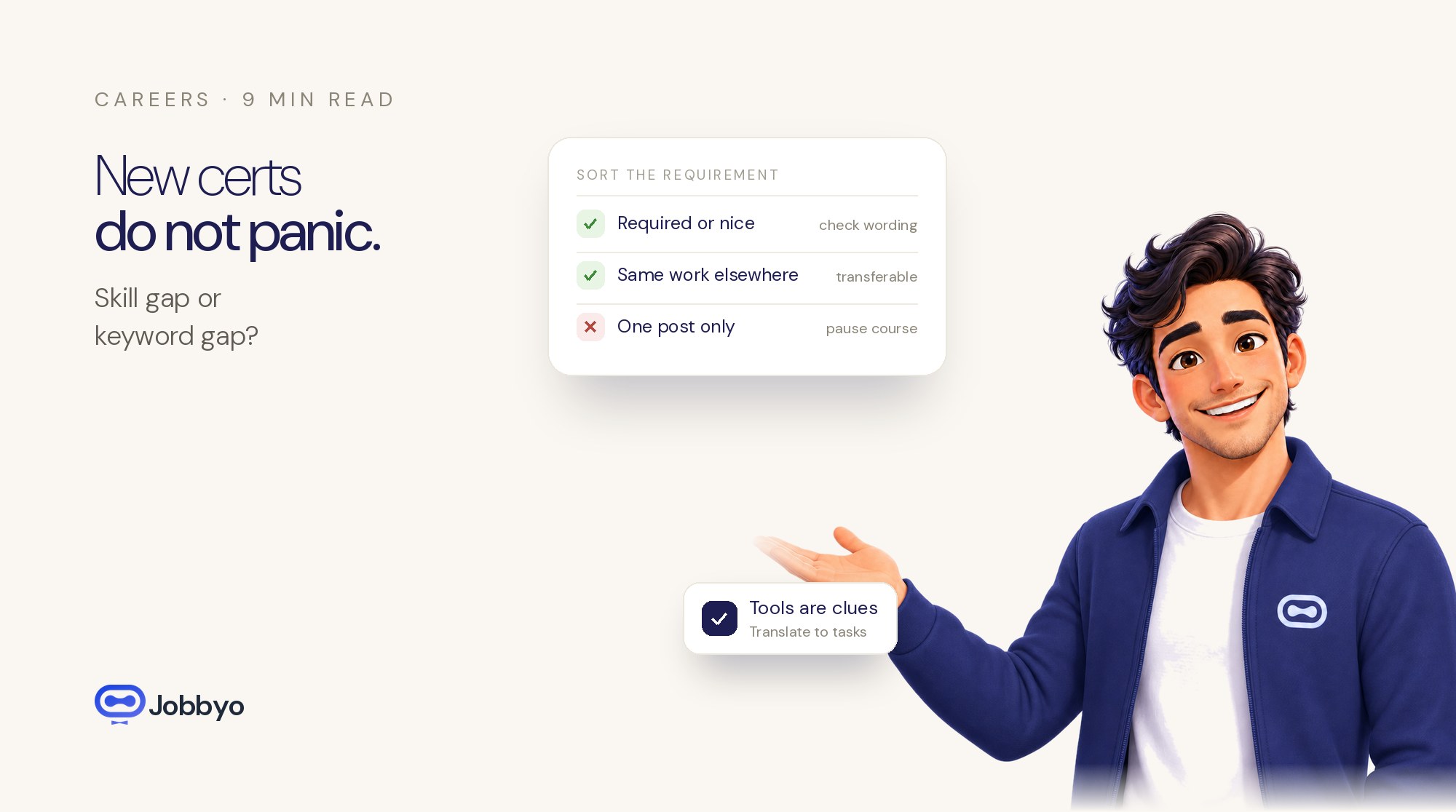
Before paying for a certification, answer these questions:
- Is the tool central to the job, or is it one bullet in a long list?
- Does the post say “required,” “certified,” “preferred,” “familiar with,” or “nice to have”?
- Have you done the same kind of work in another system?
- Does the skill appear across ten target roles or only one posting?
- Would the certification create proof employers recognize, or just another line at the bottom of your resume?
A Salesforce administrator role needs Salesforce. A revenue operations role that mentions Salesforce alongside Excel, HubSpot, and dashboards may care more about CRM logic, data hygiene, handoffs, and reporting.
A cybersecurity analyst role may genuinely require Security+, CISSP, access control knowledge, or incident response experience. A general operations role that mentions “security documentation” may only need someone who can follow process, maintain records, and coordinate approvals.
Same keyword. Different stakes.
Real skill gap or keyword gap?
A real skill gap means you cannot yet perform a core part of the job.
A keyword gap means you can do the work, but your resume does not use the language in the posting.
Examples:
- If a job requires SQL and you have never queried a database, that may be a real gap.
- If a job asks for dashboard reporting and you have built recurring reports in Excel, Looker, Tableau, or Power BI, that may be a wording gap.
- If a job asks for Agile experience and you have joined sprint planning, standups, backlog reviews, launch meetings, or cross-functional delivery cycles, you may need better phrasing.
- If a job asks for HubSpot and you have run campaigns in Marketo, Pardot, Mailchimp, or Salesforce Marketing Cloud, you may have transferable marketing operations experience.
- If a job asks for Jira and you have managed deadlines, tickets, owners, dependencies, and status updates in Asana, Trello, Monday, or Smartsheet, the underlying skill may be project coordination.
The question is not “Have I touched this exact logo?”
The better question is: “What work is this tool supposed to support?”
Translate the tool into the task
When a posting names a platform, strip it down to the job underneath.
Salesforce may mean pipeline reporting, CRM hygiene, account tracking, sales forecasting, or customer lifecycle management.
Tableau, Looker, or Power BI may mean dashboard building, data storytelling, performance reporting, or stakeholder analysis.
Jira, Asana, Monday, or Trello may mean sprint tracking, project coordination, issue management, or delivery visibility.
HubSpot, Marketo, Pardot, or Mailchimp may mean lifecycle marketing, lead nurturing, segmentation, campaign reporting, or email operations.
ServiceNow or Zendesk may mean ticket workflows, incident routing, SLA tracking, customer support operations, or internal service management.
Workday, Greenhouse, or Lever may mean HR data, recruiting operations, workflow tracking, compliance documentation, or candidate pipeline management.
Once you name the work behind the tool, you can make a sane decision: apply, tailor, learn, or skip.
Career changers need translation, not disguise
Career changers get hit hardest by tool-heavy postings because their proof often sits in the wrong vocabulary.
A finance analyst moving into SaaS operations may have forecasting, reporting, stakeholder management, and data cleanup experience. But if the resume only says “monthly reporting support,” it will not match a posting that asks for RevOps, pipeline visibility, CRM hygiene, and forecast accuracy.
An educator moving into customer success may have onboarding, facilitation, documentation, issue resolution, and relationship management experience. But if the resume only says “supported students,” the employer may not see customer enablement, adoption, or retention work.
An agency marketer moving into B2B SaaS may have campaign execution, segmentation, analytics, client communication, and performance reporting experience. But if the resume is written around agency deliverables instead of lifecycle marketing, demand generation, or attribution, the match gets buried.
This is not permission to fake credentials. Do not claim Salesforce certification if you do not have it. Do not write “advanced SQL” because you watched two tutorials. Do not pretend you have administered Workday if you only exported a report once.
But do stop hiding relevant work under old industry language.
Weak:
Managed projects and supported reporting.
Stronger:
Coordinated cross-functional reporting workflows, gathered stakeholder requirements, maintained recurring dashboards, and improved visibility into operational performance.
That version gives the employer concrete evidence. No costume required.
When a certification is worth it
A certification can help when it is tied to a clear target. It is usually a waste when it is a fear purchase.
A credential may be worth your time if:
- the same certification appears across many roles you actually want
- the field requires formal proof, such as cloud, cybersecurity, HR, finance, compliance, or technical administration
- the course produces a portfolio project, lab, dashboard, GitHub repo, case study, or other visible proof
- you already have adjacent experience and need a recognized signal for a new market
- the certification is named in required qualifications, not buried under “preferred”
A credential is probably not the move if:
- one random posting mentioned it once
- you are collecting badges instead of applying
- the course will not be recognized by target employers
- you already have stronger work examples
- you are using training to avoid rejection
That last one matters. Over-preparing can look responsible while quietly becoming avoidance.
How to tailor without lying
Use the employer’s language where it is truthful. Do not inflate. Do not invent. Do not hide the match either.
Instead of vague claims, write the overlap plainly:
- “Maintained CRM records, pipeline reports, and sales activity dashboards.”
- “Built recurring performance reports in Excel and BI tools for monthly leadership review.”
- “Coordinated Agile-style delivery cycles across product, design, operations, and marketing.”
- “Documented access-control steps, approval workflows, and compliance records.”
- “Completed Python fundamentals coursework and built small data-cleaning scripts for practice projects.”
- “Managed campaign segmentation, email QA, reporting, and handoffs across marketing and sales teams.”
Notice the difference. “Expert in Salesforce” is a lie if you have never used Salesforce. “Maintained CRM records and pipeline reporting” may be true if you did that work in another system.
Specific beats inflated.
A fast scan before you apply
Before you decide a posting is out of reach, mark it up.
First, circle repeated skills. If SQL appears in the job title, responsibilities, and required qualifications, it probably matters. If a tool appears once in a “nice to have” list, do not give it the same weight.
Second, separate tools from outcomes. Asana may point to project coordination. Looker may point to reporting. HubSpot may point to lifecycle marketing or CRM workflows. ServiceNow may point to ticketing, escalation, or operations support.
Third, match your proof. Pull examples from your actual work: reports built, systems maintained, customers supported, campaigns launched, tickets resolved, audits prepared, dashboards updated, stakeholders managed.
Then tailor your resume to the overlap.
If the employer says “stakeholder management,” use “stakeholder management” if that is what you did. If the employer says “lifecycle marketing,” do not bury your email segmentation and nurture campaign work under “marketing support.”
A resume written for your last job often fails the next job. That is not a character flaw. It is an editing problem.
Where Jobbyo fits
Skills-heavy postings create two kinds of waste.
Good candidates skip jobs because a tool name scares them off. Other candidates apply with generic resumes that never surface the relevant proof.
Jobbyo helps reduce that waste by tailoring resumes and cover letters to the actual requirements in a posting, without inventing skills or credentials. It can help align your experience with the employer’s language, filter out stale or low-quality postings, and keep the application process focused instead of turning it into spray-and-pray volume.
The goal is not fake fit. The goal is making real fit obvious.
The right response: audit before you panic
When a posting lists a certification or tool you did not expect, slow down and ask:
- Is it required or preferred?
- Is it central to the job or one item in a pile?
- Have I done the same work in another tool?
- Can I prove the outcome with a project, report, workflow, campaign, ticket queue, dashboard, or process example?
- Does this skill show up across many target roles?
- Am I learning because it is strategic, or because applying feels uncomfortable?
Some certifications are worth earning. Some tools are worth learning. Some bullets are noise.
Do not let a messy job description decide your value for you. Read it like an editor. Identify the real requirement. Translate your experience. Close the gaps that matter. Ignore the padding.
Put this to work
Let Jobbyo find your
best matches for you.