11 min read
AI Resume Screening: How It Works in 2026 (Recruiter’s Guide)
How AI resume screening works in 2026, what recruiters see, and how to rewrite your resume for match quality—not keyword stuffing.
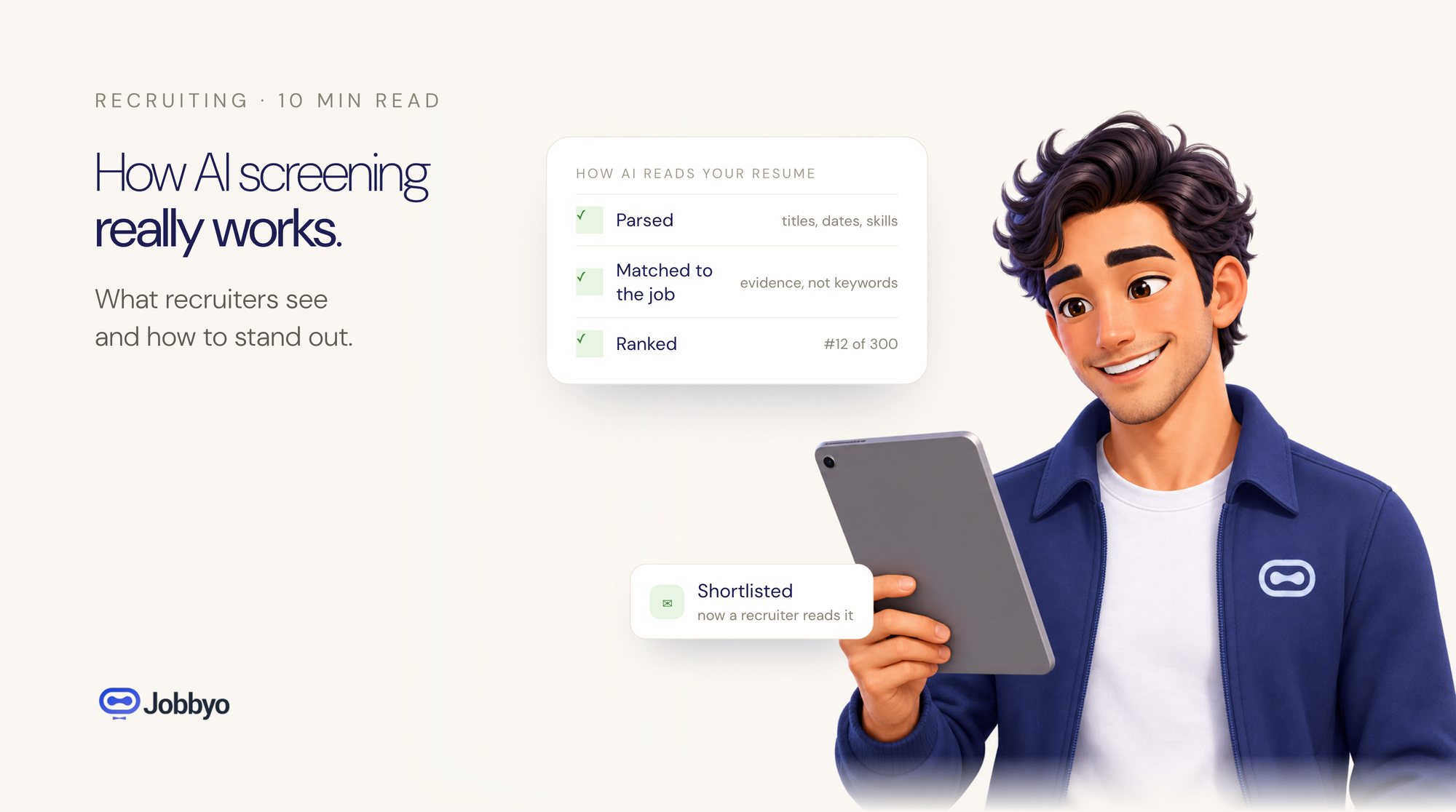
AI resume screening is blunt. It reads a file, pulls out structured details, and checks whether the evidence on the page lines up with the job.
In 2026, that usually means some mix of resume parsing, language analysis, skills extraction, knockout questions, recruiter-set filters, and ranking inside or connected to an applicant tracking system.
Your job is not to outsmart the software. Your job is to stop forcing the software and the recruiter to infer basic facts.
If the role asks for Salesforce administration, SOC 2 compliance, Python, Medicaid billing, HubSpot, renewal ownership, or enterprise sales into banks, those words need to be easy to find when they are true. Not hidden in a paragraph. Not implied by a past title. On the page.
What AI resume screening means in 2026
AI resume screening is software-assisted review before, during, or alongside recruiter review. It can sort, structure, flag, rank, or filter applications.
Common functions include:
- Pulling out job titles, employers, dates, education, certifications, tools, and skills
- Turning resume text into a candidate profile inside the ATS
- Comparing the profile with the job description or recruiter criteria
- Marking required qualifications as present, unclear, or missing
- Ranking applicants inside a large pool
- Showing recruiters extracted skills and possible matches
- Filtering candidates through knockout questions such as work authorization, location, license, degree, or schedule requirements
The important limitation: the system does not know your career the way a strong recruiter might after a real conversation. It reads evidence.
That hurts qualified people all the time. Career changers use old-industry language. Senior leaders write so broadly that key operating details disappear. Technical specialists assume a title will carry the meaning. Laid-off candidates send one general resume to 40 unrelated roles because speed feels safer than precision.
It is not safer. It is usually just noisier.
How AI resume screening usually works
Most screening workflows follow four steps.
1. The system extracts your information
The software reads your resume and tries to identify fields: current title, previous employers, dates, skills, tools, degrees, certifications, projects, and sometimes locations or industries.
Clean formatting matters because a resume is not being admired as a design file. It is being converted into data. Standard headings such as Experience, Education, Skills, Certifications, and Projects make that easier.
2. The system standardizes what it found
A screening tool may connect related terms. For example, CRM, customer relationship management, and Salesforce may be treated as related depending on the tool and the employer’s setup. The same can happen with AWS and cloud infrastructure, account management and customer retention, or Tableau and business intelligence.
Do not rely on that. Spell out the specific tool, process, market, or method when it matters.
3. The resume is checked against the role
The hiring team may define requirements such as:
- Required license, degree, or certification
- Minimum years of experience
- Specific tools or platforms
- Industry background
- Seniority level
- Location or time zone
- Work authorization
- Compensation range
- Travel availability
- Required answers to application questions
Some criteria are hard gates. Others influence ranking. Either way, missing evidence creates drag.
4. The recruiter sees an output
The output may be a match score, a ranked list, extracted skills, qualification flags, or a dashboard showing why the candidate appears relevant. The recruiter still makes decisions, but the order and visibility of resumes can change who gets read first.
That is why a vague resume is expensive. If the job says B2B SaaS lifecycle marketing and your resume says owned campaigns, you are asking the system and the recruiter to fill in the blanks. They may not.
What recruiters may see after screening
There is no single recruiter view. It depends on the ATS, the screening vendor, and the employer’s configuration. But recruiters may see:
- Parsed candidate profile
- Original resume text
- Application answers
- Extracted skills
- Required qualification flags
- Knockout question results
- Work authorization field
- Location or remote eligibility
- Compensation or availability field
- Match indicators
- Rank order within the applicant pool
- Notes showing which criteria appear to be met
A recruiter under pressure will usually spend more time on the resume that makes the match easy to verify. That is not unfair. That is workload.
The mistake candidates make is thinking qualification is self-evident. It is not. A resume has to prove fit in the language of the target job.
The AI hiring rules job seekers should know
AI hiring tools are getting more scrutiny. That does not make them harmless, and it does not make them irrelevant.
News item 1: EEOC technical assistance
What happened: On May 18, 2023, the U.S. Equal Employment Opportunity Commission released technical assistance titled Assessing Adverse Impact in Software, Algorithms, and Artificial Intelligence Used in Employment Selection Procedures Under Title VII.
Why it matters: The EEOC made clear that employers can be responsible when algorithmic or AI-assisted selection tools produce discriminatory outcomes under Title VII. Automated hiring tools do not sit outside employment law.
What job seekers should do: Do not assume the tool is neutral just because it is automated. Control the pieces you can control: answer application questions accurately, state required qualifications plainly, and use formatting that lets the system read the resume without guessing.
News item 2: New York City Local Law 144
What happened: New York City began enforcing Local Law 144 on July 5, 2023. The law covers certain automated employment decision tools used for hiring or promotion and includes bias audit and candidate notice requirements.
Why it matters: A major U.S. hiring market put enforceable rules around some automated decision tools. Employers face more pressure to document how these systems are used.
What job seekers should do: Treat automated screening as a real gate. Build for two readers at once: the software that extracts the evidence and the recruiter who decides whether the evidence is credible.
Why qualified candidates still get rejected
Qualified candidates get screened out when the resume does not show the right evidence fast enough.
Common causes:
- One generic resume is used for unrelated roles
- Required tools or licenses are missing from the top half of the resume
- Transferable experience is described in the old industry’s language
- Bullets list duties but skip scope, systems, customers, or outcomes
- Creative formatting breaks parsing
- Dense paragraphs hide important skills
- Job titles do not match the target market and the resume gives no context
- Senior resumes stay at strategy level and omit operating details
- Applications fail knockout questions
- The resume does not address must-have requirements in the posting
For career changers, the problem is usually translation.
A finance professional moving into product operations may have analytics, stakeholder management, process improvement, systems implementation, and documentation experience. But if the resume only says managed reporting workflows, the product operations signal is weak.
For technical specialists, the problem is often lack of precision.
Built data pipelines is thin. Built Python and Airflow pipelines for Snowflake reporting that reduced manual finance reporting work is stronger, if true. Name the stack. Name the environment. Name the business use case.
For senior leaders, the problem is often altitude.
Executive resumes can become so strategic that they stop naming the domains, systems, markets, and operating problems the screening process is checking for. Strategy matters. So do the nouns.
How to write a resume for AI screening
Write the resume for the role in front of you, not for your whole life story.
Start with the job description. Pull out the concrete requirements:
- Function: sales operations, product marketing, data engineering, HR business partner, compliance, customer success
- Level: associate, manager, director, VP, individual contributor, team lead
- Tools: Salesforce, Workday, Python, SQL, Tableau, HubSpot, Jira, ServiceNow, AWS
- Domain: healthcare, fintech, SaaS, manufacturing, education, government, cybersecurity
- Workflows: renewals, onboarding, forecasting, incident response, close process, clinical documentation, procurement
- Customers or stakeholders: enterprise buyers, patients, developers, executives, regulators, teachers, franchisees
- Outcomes: revenue, retention, risk reduction, cycle time, adoption, cost, quality, audit readiness
- Constraints: remote work, travel, licensing, security clearance, work authorization, time zone
Then revise the resume so the best matching evidence appears early.
A stronger AI-ready resume usually does the following:
- Uses standard section headings
- Places the most relevant skills in the top third
- Uses the target role’s terms when they truthfully match your experience
- Names tools, platforms, methods, industries, and certifications
- Connects skills to proof in the experience bullets
- Includes clear titles, employers, and dates
- Avoids tables, graphics, text boxes, icons, and unusual layouts when applying through an ATS
- Shows scope with numbers when you can use them honestly
- Removes or compresses old experience that does not support the target role
If the role requires Salesforce administration, Salesforce should not appear once in bullet seven under a job from 2019. If the role requires remote stakeholder management across time zones, say that directly if you have done it.
Clarity is not pandering. It is respect for the review process.
Keyword stuffing is still a bad strategy
Keyword stuffing looks desperate because it is desperate.
Old ATS advice treated resume writing like word dumping: copy phrases from the posting, paste them into a skills section, repeat the same term five times, and hope for a higher score. That approach can make a resume look fake to a recruiter and shallow to better screening tools.
Use exact terms when they are accurate. Do not decorate the resume with skills you cannot defend.
Better moves:
- Use the employer’s term when it matches your actual work
- Pair each important skill with proof somewhere in the resume
- Prioritize must-have requirements over nice-to-have noise
- Replace vague verbs with specific work: built, migrated, audited, forecasted, trained, negotiated, automated, launched
- Cut unrelated bullets that dilute the signal
- Put the strongest match in the summary, skills section, and most recent experience
Do not just add product analytics to a skills list. Show the work: activation analysis, retention reporting, funnel review, experiment design, customer behavior analysis, roadmap input, lifecycle campaign measurement, or dashboard ownership.
Specific proof beats a pile of terms.
Advice for career changers
Career changers need to translate, not apologize.
Do not lead with the previous industry if it frames you as irrelevant. Lead with the capabilities the target role needs.
Examples:
- Finance to tech: forecasting, business cases, SQL or Excel modeling, systems implementation, stakeholder influence, performance dashboards
- Teaching to customer success: onboarding, training, adoption, communication, retention risk, documentation, complex stakeholder support
- Operations to product operations: process design, tooling, metrics, cross-functional execution, release coordination, knowledge management
- Retail management to sales operations: pipeline hygiene, staffing models, revenue reporting, CRM discipline, process improvement, field enablement
A career-change resume should answer one question quickly: what evidence from the old path reduces risk in the new role?
If the answer is buried, the reader may never find it.
Advice for niche specialists
Specialists need enough detail to be searchable and credible.
A data engineer, UX researcher, Salesforce architect, InfoSec analyst, compensation analyst, or clinical documentation specialist should name the tools, environments, frameworks, regulations, and business problems that matter for the target role.
Weak: Supported security reviews.
Stronger: Supported SOC 2 evidence collection, vendor risk reviews, access control audits, and incident response documentation for a B2B SaaS environment.
Weak: Improved dashboards.
Stronger: Built Tableau dashboards for renewal forecasting, expansion pipeline, and customer health reporting used by customer success and revenue leadership.
Do not make expertise generic. Generic experts look interchangeable.
What to check before the next application
Before you apply, run the resume against the posting like a skeptical recruiter.
Use this checklist:
- Does the resume show the must-have requirements from the posting?
- Are the most important skills visible in the top third?
- Are required tools, certifications, licenses, and industries spelled out?
- Do recent bullets include scope, systems, customers, outcomes, or risk?
- Have you translated old experience into the target role’s language?
- Is the layout simple enough for an ATS to parse?
- Do application answers match the resume?
- Would a busy recruiter understand the fit in under 60 seconds?
If the answer is no, revise before you apply. Speed does not help if every application is weak.
This is the work Jobbyo is built around: matching you to better-fit roles, tailoring resumes and cover letters per application, and cutting wasted effort on stale or low-quality postings.
AI resume screening is not going away. The better response is not panic. It is precision. Apply to fewer wrong roles. Make the right evidence visible. Give the recruiter less work.
Put this to work
Let Jobbyo find your
best matches for you.