9 min read
ResumeGap: ATS Resume Analyzer & Keyword Gap Prompt for Better Applications
Find missing ATS keywords, separate true skill gaps from wording gaps, and tailor your resume before applying.
Good candidates get screened out for a boring reason: their resume uses the wrong words for the job in front of them.
Not fake words. Not buzzwords. The employer’s words.
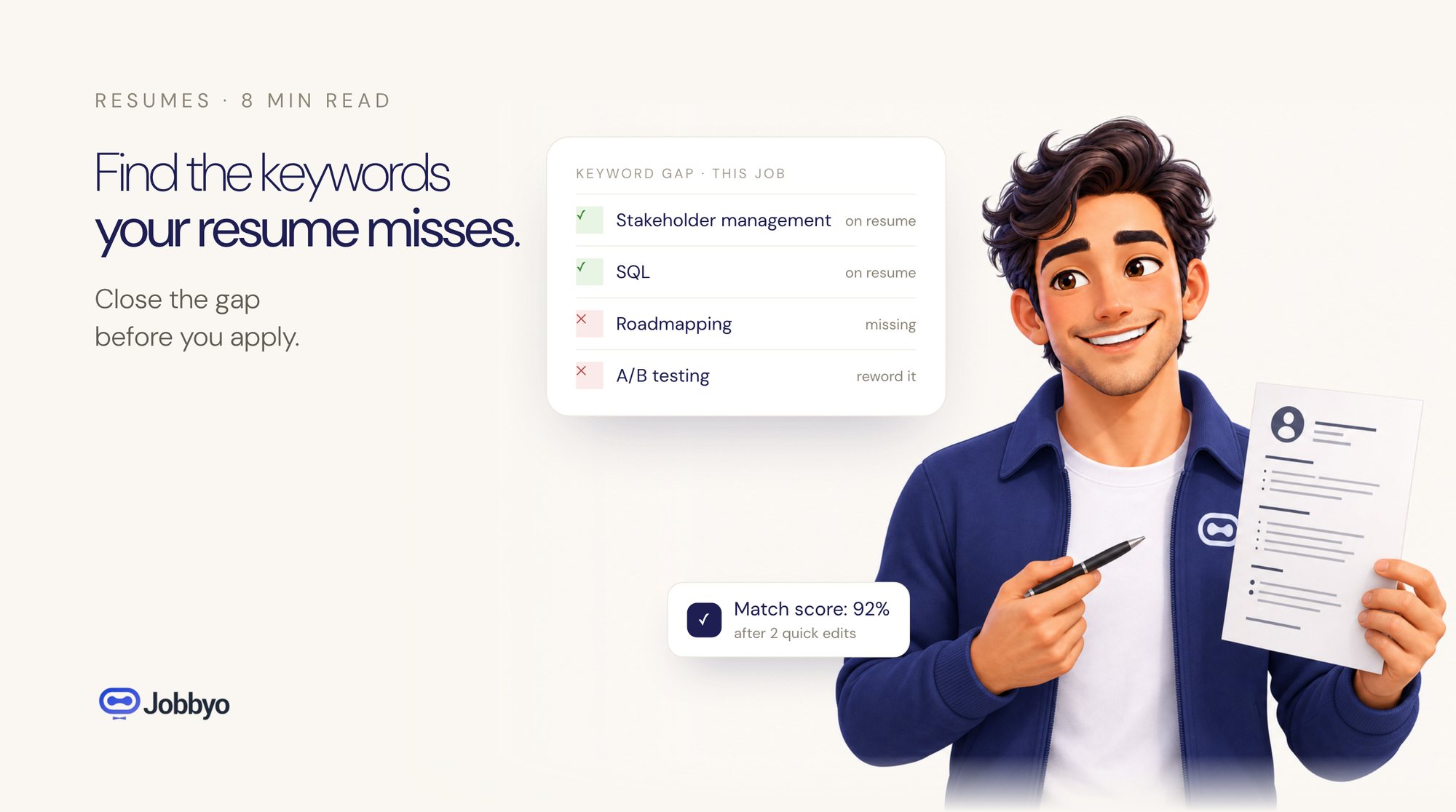
ResumeGap is a one-job, one-resume workflow. You paste a target job description and your current resume, then identify four things before you apply:
- required terms your resume never mentions
- tools, platforms, methods, or credentials that are missing
- experience you have but describe in different language
- skills you should not claim because you do not actually have them
This is most useful if you are changing careers, coming back after a layoff, applying for remote roles, moving into SaaS or tech, or aiming at senior jobs where postings list both strategy and execution requirements.
The point is not keyword stuffing. The point is translation. If you did the work, your resume should say it in language the recruiter, hiring manager, and ATS are already using.
The problem: your resume may be strong and still look like a weak match
An ATS does not read your career like a generous human. It parses your resume, extracts fields, and helps employers search, filter, sort, or rank applicants against job criteria.
That creates a real problem: you can be qualified and still look underqualified.
Example: your resume says:
Managed executive dashboards and monthly reporting.
The job description asks for:
- KPI reporting
- forecasting
- Salesforce dashboards
- revenue operations analytics
- pipeline visibility
Those may describe overlapping work. But if your resume never uses the employer’s language, the match looks thinner than it is.
That is the gap ResumeGap is built to catch.
Who should run this before applying?
Use this when the application actually matters. Do not spend an hour tailoring for every random posting on the internet. Do spend time on roles where the fit, pay, industry, location, or career move is important.
Run ResumeGap when:
- you are moving from finance, education, operations, healthcare, consulting, or another field into tech or SaaS
- you were laid off and are applying quickly across similar roles
- your senior resume talks about leadership but skips tools, systems, and execution details
- your technical resume lists projects but misses the posting’s exact frameworks, platforms, compliance terms, or methodologies
- you are applying for remote roles and the posting stresses async work, distributed teams, documentation, or cross-time-zone collaboration
- one resume is being used for several different job types
A resume that works for Product Marketing Director may miss key terms for Growth Marketing Lead. A business intelligence resume may not be tuned for analytics engineering. A finance operations resume may have real overlap with revenue operations but still fail to use SaaS language.
That is not a moral failure. It is a positioning problem.
The exact ResumeGap prompt
Use this with one resume and one job description. Not five postings. Not “tech jobs.” Not “make my resume better.” One target role.
Act as an ATS resume analyst and job-search strategist.

My target outcome is to get screened for this specific role: [TARGET ROLE TITLE] at [COMPANY OR COMPANY TYPE].

My current positioning is: [CURRENT ROLE / BACKGROUND].
My career move is: [SAME FIELD, PROMOTION, CAREER CHANGE, INDUSTRY PIVOT, OR RETURN AFTER LAYOFF].
My target role type is: [EXAMPLE: B2B SaaS Revenue Operations Analyst, Senior Product Marketing Manager, Remote Data Engineer, Salesforce Administrator, UX Researcher].

Analyze my resume against the job description below.

Your task:
1. Identify keyword and language gaps between the job description and my resume.
2. Separate missing terms into these categories:
   - Critical requirements
   - Role-specific tools and platforms
   - Methodologies, frameworks, or processes
   - Industry or domain language
   - Soft skills and collaboration signals
   - Certifications, education, or compliance terms
3. Tag each gap as:
   - High priority: likely important for screening
   - Medium priority: useful but not central
   - Low priority: optional or nice-to-have
4. Mark each gap as one of the following:
   - Wording gap: I likely have this experience, but my resume uses different language
   - Evidence gap: my resume hints at this but lacks proof
   - True skill gap: I should not claim this unless I actually have it
5. Suggest exact resume edits for the top-priority wording gaps and evidence gaps.
6. Do not invent experience, tools, certifications, metrics, employers, or responsibilities.
7. If a keyword should not be added because it would be misleading, say so clearly.
8. Provide a final Apply Readiness summary:
   - Strong match areas
   - Biggest screening risks
   - Edits to make before applying
   - Questions I should be ready to answer in an interview

Job description:
[PASTE JOB DESCRIPTION]

Resume:
[PASTE RESUME]
Make the prompt specific or the answer will be mush
Bad version:
Improve my resume for tech jobs.
Better version:
My target outcome is to get screened for this specific role: Revenue Operations Analyst at a B2B SaaS company.

My current positioning is: Finance Operations Analyst with experience in forecasting, reporting, CRM hygiene, and cross-functional planning.
My career move is: Industry pivot from finance operations into SaaS revenue operations.
My target role type is: B2B SaaS Revenue Operations Analyst.
That tells the analysis what to look for: pipeline reporting, Salesforce, CRM data quality, forecasting, sales operations, GTM teams, dashboards, and revenue processes.
Without that context, you get generic advice. With it, you get a sharper read on whether your resume matches the role.
Why this works
Most resume advice mixes up three different problems.
1. Wording gaps
You have the experience, but your resume names it differently.
Example: your resume says “monthly sales reporting.” The posting says “pipeline analytics” and “GTM forecasting.” If the work truly overlaps, rewrite the bullet so the employer can recognize it.
2. Evidence gaps
You mention the skill, but you do not prove it.
Example: “stakeholder management” in a skills section is weak. A bullet showing that you worked with Sales, Finance, and Customer Success to improve reporting accuracy is stronger because it gives the reader a setting, a function, and an outcome.
3. True skill gaps
The job asks for something you do not have.
That is not an invitation to lie. It is a decision point. Apply anyway, learn the skill, or pick a better-fit role. But do not stuff Workday, Salesforce, Python, SOC 2, or Kubernetes into a resume if you cannot answer basic questions about it.
Priority labels keep you from wasting time. A required certification is not the same as a nice-to-have phrase near the bottom of the posting. A core tool is not the same as a soft preference.
How to edit the output without making your resume fake
Start with high-priority wording gaps. These are the safest edits because they translate real work into the target role’s language.
If the posting says “customer lifecycle” and your resume says “post-sale account support,” you may be able to connect those ideas in a bullet. Only do it if the work actually involved lifecycle stages, renewals, onboarding, retention, expansion, or another relevant customer motion.
Next, fix evidence gaps. A useful bullet usually includes four pieces:
- the work you did
- the team, customer, system, or process affected
- the tool, method, or data source involved
- the result or business reason
Weak bullet:
Created weekly reports for leadership.
Stronger bullet, if accurate:
Built weekly revenue and pipeline reporting for Sales and Finance leaders, using CRM data to identify forecast risks and improve planning visibility.
Do not use that version if you did not work with pipeline data. The better resume is not the more aggressive resume. It is the more accurate one.
Leave true skill gaps alone unless you can address them honestly. If a role requires Workday and you have never used Workday, do not sneak it into a skills list. Mention adjacent HRIS, finance, or operations systems only if they are real and relevant.
How to avoid keyword stuffing
Keyword stuffing usually looks desperate because it is disconnected from the work.
Bad pattern:
Skills: Salesforce, forecasting, GTM, revenue operations, stakeholder management, lifecycle, pipeline, dashboards, analytics, CRM, KPIs.
Better pattern:
- put Salesforce in the bullet where you used Salesforce
- put forecasting in the bullet where you built, reviewed, or supported a forecast
- put KPI reporting next to the dashboard or reporting process
- put async communication in a remote-team example
- put certifications only in the education or certification section if you earned them
For career changers, this is where transferable experience becomes visible. You are not pretending your old job was the same job. You are showing the overlap clearly enough that a recruiter does not have to decode it.
When ResumeGap is worth the time
Use it before applying to roles that are close fits, competitive, remote-friendly, well-paid, or important to your next move.
Skip it for low-priority applications. Run it for jobs where silence would bother you.
At minimum, use it when:
- the role is in a new industry
- you keep applying and getting no response
- you are changing functions or titles
- the posting names specific tools, frameworks, regulations, or credentials
- you are applying to competitive remote roles
- your current resume is trying to serve too many job types
A tailored resume does not need to be rebuilt from zero. But it should reflect the job description sitting in front of you.
Manual ResumeGap or Jobbyo?
Do ResumeGap manually if you are applying to a small number of carefully chosen roles and want to review every edit yourself.
Use Jobbyo if you want role-by-role tailoring handled across a broader search. Jobbyo customizes resumes and cover letters per role, supports automatic applications or review-before-send, and filters out stale or suspicious postings so you spend less time on dead ends.
The clean move: take one target job description, compare it against your current resume, fix the missing language you can honestly support, and apply with a tighter match.
Or let Jobbyo handle that process across your search, so each application is built around the role instead of the generic resume sitting in your downloads folder.
Put this to work
Let Jobbyo find your
best matches for you.