10 min read
AI Cover Letter Generators: What Works, What Doesn't (2026)
AI cover letters only help when they map your experience to the employer’s exact priorities. Here’s what works — and what to avoid.
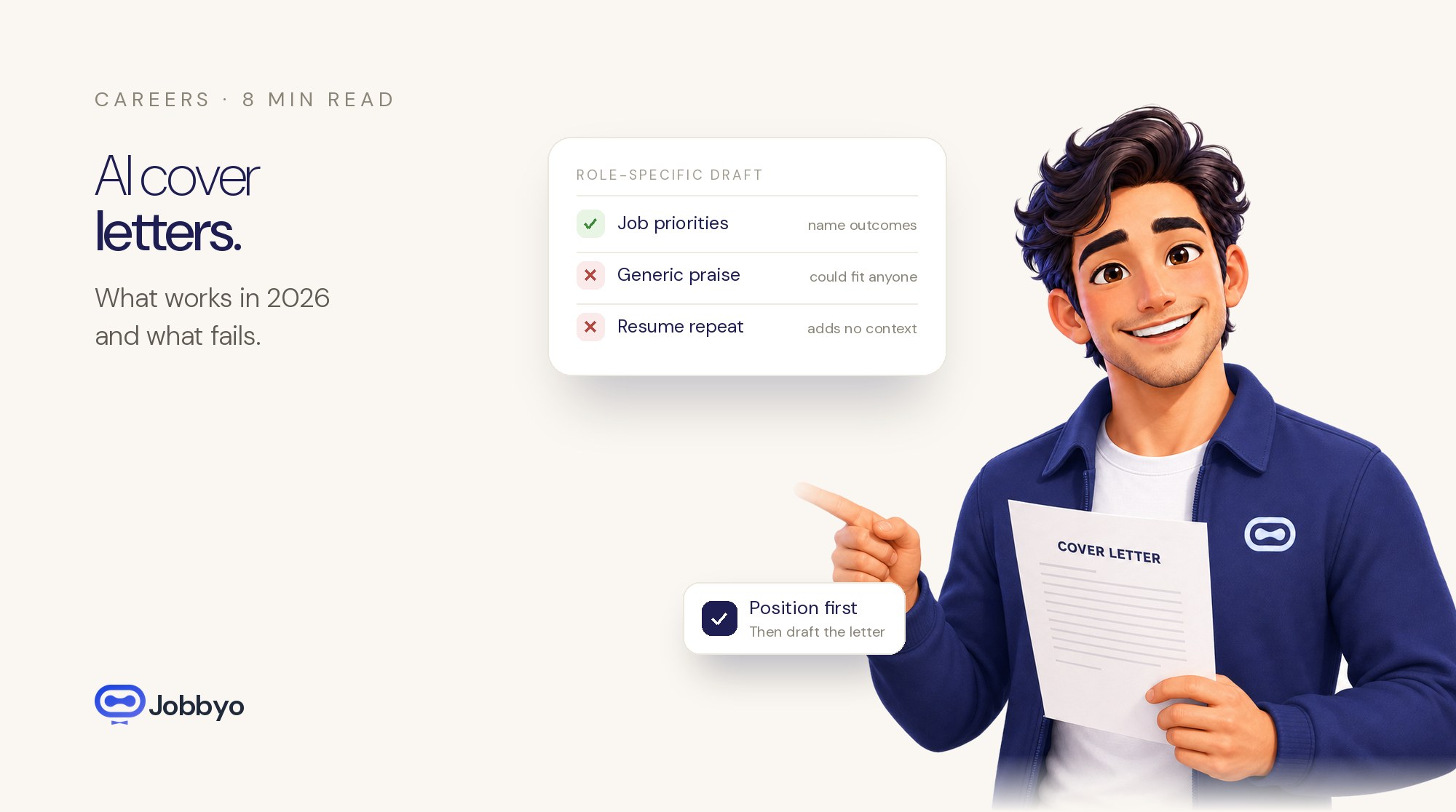
AI cover letter generators help when they turn a job posting and a resume into a clear hiring argument. They fail when they write a polite one-page letter that could be sent to Stripe, a hospital system, a school district, or a 12-person startup with only the company name changed.
A hiring manager is not looking for proof that you can produce paragraphs. They are looking for signs that you understand the work: the revenue target, migration, compliance burden, customer segment, product launch, support backlog, or operating mess behind the job description.
That is the bar. Most AI cover letters do not clear it.
Short answer: what should an AI cover letter generator actually do?
The best AI cover letter tools are not blank-page machines. They are positioning tools.
A useful AI-generated cover letter should:
- Tie your background to the specific requirements in the posting
- Explain why your experience matters for this employer, not employers in general
- Frame a pivot, layoff, niche skill set, or executive search without apology
- Add context to the resume instead of repeating every bullet
A weak AI cover letter uses lines like "I am excited to apply," "I am confident I would be a great fit," and "my skills align with your needs." Those sentences sound harmless. They also give the reader no reason to keep reading.
What AI cover letter generators get right
AI is useful when it speeds up the hard part: deciding which version of your experience belongs in this application.
Here is where it earns its keep.
It can pull priorities out of the job description.
A strong prompt can identify whether the employer is really asking for pipeline growth, customer retention, cloud migration, stakeholder management, SOC 2 readiness, roadmap execution, cost control, or process cleanup.
It can translate transferable experience.
A finance analyst moving into revenue operations does not need to pretend they have spent five years in SaaS. They need to connect forecasting, reporting discipline, data hygiene, and cross-functional planning to the revenue operations role in front of them.
It can get you past the blank page.
Most applicants do have material. The problem is selection. A project that belongs in a product operations letter may be dead weight in a customer success letter.
It can adjust tone for the room.
A startup product role can handle a sharper, more direct letter. A regulated enterprise security role usually needs more restraint, more evidence, and fewer adjectives. AI can help with that if the prompt gives it the role, company context, and desired positioning.
Where AI cover letter generators usually fail
Putting "Acme Corp" in paragraph one is not tailoring. Dropping the job title into the opening sentence is not tailoring. Praising the company's mission is not tailoring unless the rest of the letter connects your experience to the work the team needs done.
The common failures are easy to spot:
- The letter restates the resume instead of interpreting it
- The company praise could apply to any employer with an About page
- The draft leans on words like "passionate," "dynamic," and "results-driven"
- The letter claims fit without naming the relevant project, customer, system, market, or business problem
- The tone sounds cleaner than the candidate's actual writing
- The hardest part of the story gets ignored: a career pivot, layoff, gap, short tenure, confidential search, or senior-level move
The real risk is not that a recruiter detects AI. The real risk is that the recruiter cannot tell why you chose this job.
How to prompt AI for a role-specific cover letter
Use this structure: Problem, prompt, reason, edit. It keeps the draft attached to a hiring decision instead of letting the model wander into filler.
Problem
You need a cover letter for one job. Not a reusable template. The letter has to connect your background to the employer's likely priorities, explain your fit, and make the resume easier to read.
Prompt
Copy this and replace the bracketed sections:
You are drafting a concise, role-specific cover letter for the job below.

Goal: Write a cover letter that explains why my background is relevant to this employer's specific priorities. Do not use generic phrases such as "I am excited to apply," "I am passionate," "results-driven," or "perfect fit." Do not summarize my resume line by line. Use my experience to show how I can help with the outcomes this role appears to require.

Job description:
[Paste the full job description]

Company context:
[Paste useful details from the company website, product page, funding announcement, annual report, press release, or job posting]

My background:
[Paste my resume or the most relevant roles, projects, tools, industries, and achievements]

My target positioning:
[Example: finance professional moving into SaaS operations / laid-off product marketer seeking fast re-employment / senior engineering leader running a confidential search / data engineer with cloud migration experience]

Required structure:
1. Opening paragraph: Name the role and connect my background to the company's likely priorities.
2. Middle paragraph: Use 2-3 specific experiences that map to the job requirements and business outcomes.
3. Optional context paragraph: If useful, frame my pivot, layoff, niche specialization, employment gap, or senior-level move in a confident and non-defensive way.
4. Closing paragraph: Reinforce the value I can bring and invite the next step.

Style:
Clear, specific, professional, and human. No exaggeration. No fake enthusiasm. Keep it under one page.
Why this works
The prompt gives the model the inputs it usually lacks: the posting, the company context, your actual background, and the story you need the letter to tell.
That positioning line matters. A career changer, a recently laid-off marketer, a cloud migration specialist, and a senior executive do not need the same letter. One needs a bridge. One needs clarity and speed. One needs technical depth without a tool dump. One needs discretion and strategic scope.
If you skip that instruction, AI usually defaults to a pleasant template.
How to edit the draft
Do not send the first output. Treat it like a messy junior draft.
Use this edit pass:
- Delete any sentence that could fit another applicant
- Replace vague claims with a concrete project, system, customer type, tool, market, or business problem
- Make the first paragraph point at the role's main outcome
- Cut inflated enthusiasm
- Keep the strongest 2-3 proof points
- Check that the letter explains the resume instead of duplicating it
- Read it out loud and remove anything that sounds like a brochure
Final test: remove the company name and job title. If the letter no longer clearly points to this exact role, it is still too generic.
What a strong AI-generated cover letter should include
A good cover letter makes one claim and backs it up.
The claim usually sounds like this: "This role needs someone who can handle X. My background gives me relevant proof in X, Y, and Z. Here is why that matters for your team."
Examples:
- A SaaS product marketer may need to show experience positioning a technical product in a crowded category
- A data engineer may need to show pipeline reliability, cloud migration, or cost-aware architecture work
- A UX designer may need to show conversion improvement, research synthesis, or reduced user friction
- An operations leader may need to show repeatable systems during growth, restructuring, or handoff-heavy environments
The letter should tell the hiring manager how to read the resume. That is its job.
When you should not use an AI cover letter generator
Do not use AI for a cover letter if you are only willing to provide a job title.
With thin input, AI fills the gaps with generic claims. Generic claims are application sludge.
Be especially careful when:
- The role depends on deep domain credibility
- You are applying for a senior or executive position
- You need to explain a pivot, gap, layoff, or non-linear path
- The company clearly values writing, strategy, or communication
- Your resume has issues that require careful framing
AI can still help in those cases. It should not be the final writer.
How career changers should use AI cover letters
Career changers should use AI to translate, not apologize.
A weak letter says: "Although I do not have direct experience..." That opening teaches the reader to see the background as a problem.
A stronger version says: "My background in financial analysis has trained me to diagnose business performance, build stakeholder-ready reporting, and identify operational risk — the same capabilities your revenue operations role emphasizes."
That sentence does not fake direct revenue operations experience. It builds a bridge from finance work to the target role.
For a pivot, add this instruction to your prompt:
Emphasize transferable skills and adjacent experience. Do not overstate direct experience I do not have. Show how my prior work maps to the outcomes in this role.
That keeps the letter honest. It also keeps it from sounding like a confession.
How Jobbyo makes AI cover letters more specific
Jobbyo is built for job applications that are tailored before they are sent.
Instead of copying a posting into one tool, rewriting a resume in another, drafting a cover letter somewhere else, and tracking the application in a spreadsheet, Jobbyo puts the workflow in one place. The goal is not mass-producing the same letter. The goal is using the job context to create a role-specific resume and cover letter before you apply.
A practical Jobbyo workflow looks like this:
- Add the posting to your tracker
- Generate a cover letter using the saved job context
- Review the matching resume and letter together
- Rewrite any line that sounds robotic or unsupported
- Apply only when the materials clearly fit that role
That is the difference between using AI to create a document and using AI to sharpen the argument behind the application.
The best way to use AI cover letters in 2026
Use AI as a relevance engine. Do not use it as an excuse to stop thinking.
The strongest workflow is simple:
- Start with the full job description
- Identify the employer's likely priorities
- Map your experience to those priorities
- Draft a short letter
- Edit for specificity, accuracy, and voice
- Send it only if it makes your fit easier to understand
A strong AI cover letter does more than say you want the job. It shows why your background belongs in the conversation.
If you want that workflow built into your search, try Jobbyo. It helps create role-specific resumes and cover letters before you apply, so each application has a clearer reason to exist.
Put this to work
Let Jobbyo find your
best matches for you.