11 min read
What Skills Are Slowly Becoming Obsolete But Still Valuable?
Some skills are declining, not dying. Learn how to translate legacy experience into current employer demand signals.
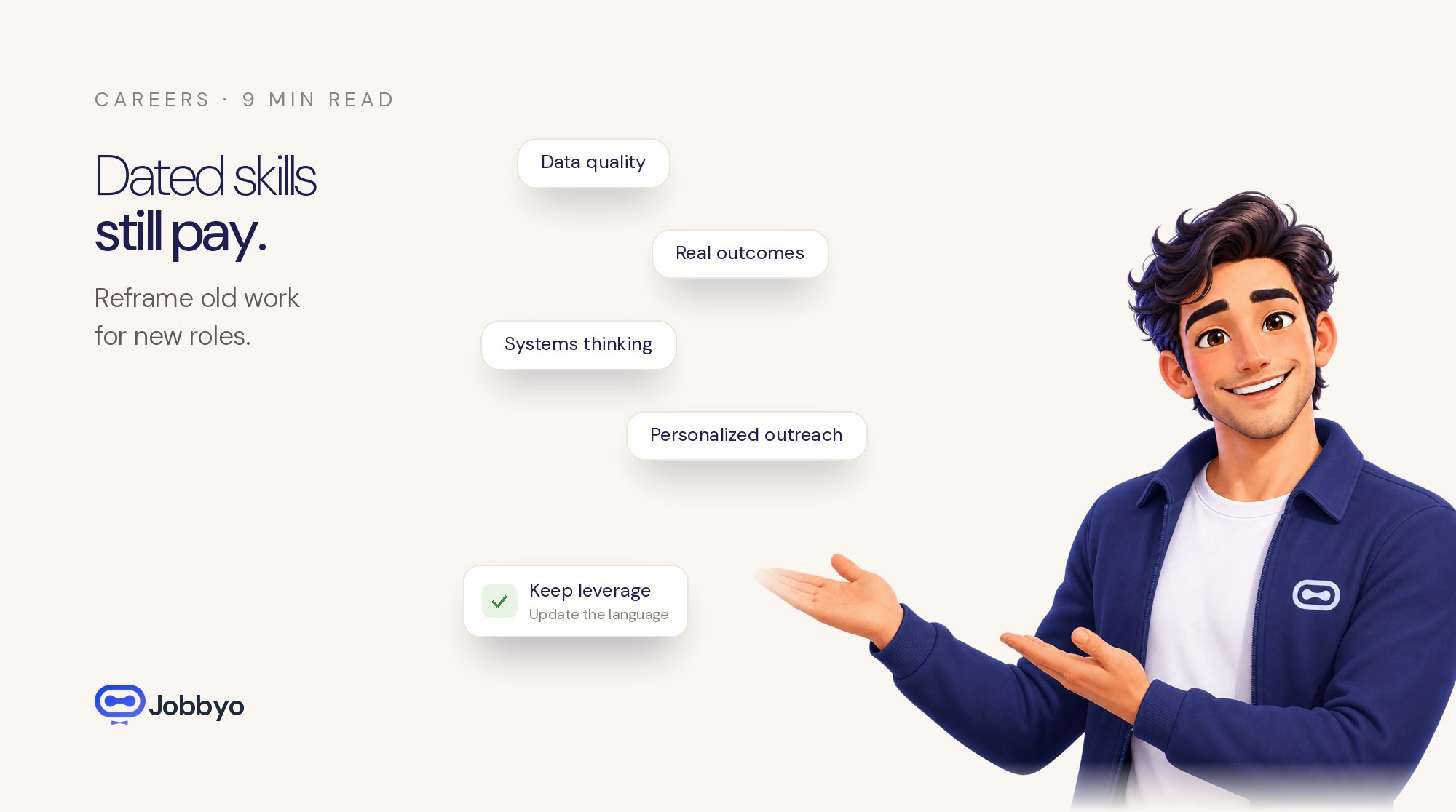
Some skills are losing value in their old form: typing data into fields, maintaining spreadsheet tabs, blasting cold emails, owning one software tool, or padding a resume with keywords.
That does not make the underlying skill useless. It means the market is paying for a different version of it.
Observed fact: job postings across operations, finance, marketing, analytics, customer success, recruiting, product, and sales now pair familiar work with automation, dashboards, CRM hygiene, risk control, customer insight, and cross-functional delivery.
Forecast: as AI copilots, self-serve analytics, workflow automation, and integrated SaaS tools keep spreading, employers will keep discounting slow manual work. They will still need people who can spot bad data, explain tradeoffs, understand customers, and keep messy teams moving.
The risk is not having older skills. The risk is describing useful work in stale language.
1. Manual data entry and spreadsheet-only reporting
Angle: If your resume still leads with maintained spreadsheets or entered data accurately, the hiring manager may read it as clerical work, even if the work was more important than that.
Observed fact: reporting did not disappear. The expectation changed. Employers want people who can clean messy data, standardize repeatable reporting, find patterns, and explain what the numbers mean.
Where it shows up: operations analyst, finance associate, marketing operations, revenue operations, customer success, product operations, and business analyst postings. These roles often mention dashboards, CRM data quality, workflow automation, business intelligence, pipeline visibility, forecasting, or spend tracking.
Cause: Excel and Google Sheets are still everywhere, but they now sit beside CRMs, ERPs, ATS platforms, Power BI, Tableau, Looker, Zapier, Make, and AI-assisted reporting tools. Manual entry alone is easier to automate, outsource, or absorb into a system.
Job-seeker move: do not delete spreadsheet experience. Reframe it around data quality, decisions, and repeatability.
Weak: Maintained weekly sales reports in Excel.
Stronger: Standardized weekly sales reporting so managers could see pipeline movement, stalled opportunities, and forecast risk faster.
Forecast: people who only enter data will face more pressure. People who can clean, organize, audit, automate, and explain data will keep leverage.
2. Keyword-based resume writing and ATS gaming
Angle: Keyword stuffing used to feel clever. Now it often makes a resume look like it came from the same prompt as everyone else.
Observed fact: ATS compatibility still matters. A resume should use the language of the role. But keyword dumping is weaker because recruiters and hiring teams need proof: scope, tools, context, outcomes, and judgment.
Where it shows up: recruiter guidance, hiring-manager feedback, and resume screening all point in the same direction. Relevance beats density. Clear examples beat a block of terms.
Cause: AI tools made it easy for every candidate to mirror a job description. When 200 applicants can all say project management, stakeholder communication, and agile, the useful question becomes: what did you actually ship, fix, reduce, improve, or prevent?
Job-seeker move: keep the right terms, but attach them to evidence.
Weak: Project management, stakeholder communication, agile.
Stronger: Coordinated product, design, and operations teams through a launch plan, surfaced scope risks early, and kept stakeholders aligned when priorities changed.
Forecast: keyword matching will not disappear, but generic matching will get less useful. Resumes that connect keywords to real work will age better.
3. Single-tool expertise
Angle: Being the Salesforce person, the Excel person, or the HubSpot person can help you get found. It should not be your whole pitch.
Observed fact: tool knowledge is valuable, but tool-only positioning is fragile. Employers want people who understand workflows, data quality, adoption, customers, governance, and process design.
Where it shows up: job descriptions that pair tools with outcomes: revenue operations, lifecycle marketing, customer retention, forecasting, segmentation, sales enablement, campaign operations, data governance, or process improvement.
Cause: companies migrate tools, consolidate software, change CRMs, add AI features, and expect employees to learn new systems quickly. A platform can become less central. The business problem stays.
Job-seeker move: keep the tool name for search, then explain the business value.
Weak: Salesforce administration.
Stronger: Improved CRM data quality, supported cleaner forecasting, and helped sales leaders identify pipeline risk.
Weak: HubSpot experience.
Stronger: Built lifecycle workflows, segmented contacts, and improved visibility into lead quality and follow-up gaps.
Forecast: narrow tool ownership will keep getting riskier. Systems thinking will travel better than any one platform.
4. Generic cold outreach and volume-based prospecting
Angle: I sent a lot of emails is not a strong sales, recruiting, or business development story anymore.
Observed fact: outreach is not obsolete. Generic outreach is. Buyers, candidates, founders, hiring managers, and executives are flooded with automated messages.
Where it shows up: sales, recruiting, partnerships, and business development roles now emphasize account research, personalization, segmentation, intent signals, consultative selling, candidate engagement, and relationship building.
Cause: automation made high-volume outreach cheap. Cheap outreach made people skeptical. A prospect can usually tell when a message was built from a template with one company name swapped in.
Job-seeker move: talk about relevance, not volume alone.
Weak: Sent outbound emails to prospects.
Stronger: Researched target accounts, tailored outreach by buying trigger and role, and improved conversation quality with better-fit prospects.
Weak: Contacted candidates for open roles.
Stronger: Built targeted candidate lists, personalized outreach by background and motivation, and kept hiring managers informed on funnel quality.
Forecast: mass outreach will keep getting easier to produce and easier to ignore. The advantage will move toward better targeting, better timing, and better judgment.
5. Status-update project management
Angle: Tracked deliverables and scheduled meetings sounds thinner than it used to.
Observed fact: project management is still valuable. Pure administrative coordination is easier to absorb into Asana, Jira, Monday, Trello, Slack, Teams, or a shared roadmap.
Where it shows up: operations, product, marketing, engineering, implementation, and program roles now emphasize prioritization, risk management, stakeholder alignment, resource tradeoffs, launch readiness, and execution under ambiguity.
Cause: collaboration tools made tasks more visible. The hard part is deciding what matters, what can slip, who needs to be pulled in, and how to keep work moving when scope changes.
Job-seeker move: translate coordination into delivery judgment.
Weak: Managed project timelines.
Stronger: Coordinated cross-functional launch timelines, surfaced blockers early, and kept stakeholders aligned through scope changes.
Weak: Scheduled meetings and tracked action items.
Stronger: Turned scattered workstreams into clear owners, deadlines, risks, and next steps for a cross-functional team.
Forecast: task tracking will keep getting automated. People who can manage ambiguity, conflict, risk, and tradeoffs will still matter.
Why older skills start to look obsolete before they actually are
Skills usually expire on a resume before they expire in the workplace.
A finance professional who built leadership reports may have strong analytical judgment. A recruiter who handled high-volume hiring may understand funnel health, candidate behavior, and stakeholder pressure. A customer support specialist who managed escalations may have product insight, emotional control, and pattern recognition.
But if the resume uses flat task language, the value gets buried.
Use this translation test:
- Old wording: manual reporting. Current signal: dashboarding, data cleanup, business insight, reporting automation.
- Old wording: administrative coordination. Current signal: operational discipline, stakeholder alignment, program execution, risk visibility.
- Old wording: cold outreach. Current signal: account research, message relevance, pipeline quality, candidate or buyer insight.
- Old wording: tool ownership. Current signal: systems thinking, adoption, governance, process improvement.
- Old wording: keyword matching. Current signal: role-specific evidence tied to the job.
This matters even more for career changers. If you are moving from finance to tech, retail to customer success, education to enablement, or operations to product, do not expect employers to connect the dots for you. Make the transfer obvious.
Older skills worth keeping
Writing
Plain writing is not going away. Vague writing is the problem. In a hiring market full of AI-generated cover letters, status updates, and LinkedIn posts, clear writing stands out.
Translate: wrote reports.
Better: created executive-ready summaries that clarified decisions, risks, and next steps.
Excel and spreadsheet thinking
Spreadsheets are not dead. A spreadsheet-only identity is the problem. The deeper skill is modeling, organizing messy information, checking assumptions, reconciling numbers, and making data usable.
Translate: advanced Excel.
Better: built models, reconciled data, identified anomalies, and supported planning decisions.
Customer service
Basic ticket handling may be more automated. Customer empathy, escalation judgment, and pattern recognition are harder to replace.
Translate: answered customer inquiries.
Better: resolved customer issues, identified recurring product friction, and escalated patterns to product or operations teams.
Administration
Administrative work gets dismissed by people who have never had to keep an executive, office, hiring loop, or compliance process from falling apart.
Translate: handled scheduling and documentation.
Better: managed executive workflows, protected sensitive information, and improved operational consistency.
Industry knowledge
Legacy industry experience can be a moat when it is tied to current business problems. Healthcare, finance, logistics, insurance, cybersecurity, education, and government work all carry context that generic candidates may not have.
Translate: worked in banking operations.
Better: understand regulated workflows, risk controls, documentation standards, and customer-impacting process failures.
Modern signals that can replace stale resume language
You do not need to chase every trend. You need to show how your real experience maps to the work employers are hiring for now.
Useful signals include:
- AI-assisted workflow experience
- Automation and process improvement
- Data interpretation instead of data entry alone
- Dashboarding and reporting clarity
- CRM, ATS, ERP, or SaaS fluency
- Cybersecurity and privacy awareness
- Cross-functional collaboration
- Customer insight and voice-of-customer analysis
- Revenue, retention, cost, risk, or efficiency impact
- Remote and async communication
- Change management and adoption
- Experimentation, testing, and iteration
Warning: adding these phrases without proof can backfire. A resume that says AI, automation, and data-driven without examples reads like decoration. Tie every modern signal to a task, tool, audience, or decision.
A fast resume audit for dated skills
Look for bullets that describe activity without value.
Weak legacy phrasing often looks like this:
- Responsible for reports
- Managed spreadsheets
- Assisted with projects
- Handled customer requests
- Maintained records
- Used Salesforce
- Scheduled meetings
- Supported marketing campaigns
- Communicated with stakeholders
Those lines are not automatically bad. They are incomplete.
Ask harder questions:
- Who used the work?
- What decision did it support?
- What risk did it reduce?
- What process became faster, cleaner, or more reliable?
- What customer, candidate, team, or leader benefited?
- What tool, workflow, or system improved?
- What business function depended on it?
A strong bullet connects skill, context, and outcome.
Before: Maintained weekly sales reports in Excel.
After: Standardized weekly sales reporting so managers could track pipeline movement, stalled opportunities, and forecast risks.
Before: Answered customer support tickets.
After: Resolved customer issues while identifying recurring product friction and escalating patterns to operations and product teams.
Before: Managed project timelines.
After: Coordinated cross-functional launch timelines, surfaced blockers early, and kept stakeholders aligned through scope changes.
That is not exaggeration. It is translation.
How Jobbyo fits in
Jobbyo is for job seekers who do not have time to rewrite every resume from scratch, decode every posting manually, or guess which applications are worth the effort.
A practical move: audit your resume for dated phrasing, then reposition the same experience for roles hiring now. Jobbyo helps tailor resumes and cover letters by role, align transferable skills with employer language, and filter out stale or low-quality postings that waste time.
That matters if you are:
- changing careers and need transferable skills to make sense quickly
- recently laid off and trying to rebuild momentum
- employed and searching confidentially
- technical or specialized but stuck explaining your value through one tool
- applying remotely and dealing with location, salary, or eligibility constraints
Jobbyo will not make every application convert. No serious tool should promise that. It can help you stop sending generic materials into a crowded market and start applying with sharper positioning.
Bottom line
The skills getting weaker are the low-context versions of useful work: manual reporting, generic outreach, task coordination, keyword stuffing, and single-tool identity.
The skills worth keeping are underneath: judgment, pattern recognition, communication, process discipline, customer understanding, and business context.
Do not delete your old experience. Translate it into the language of the job you want next.
Put this to work
Let Jobbyo find your
best matches for you.