10 min read
Use This ChatGPT Prompt to Create the Perfect Cover Letter
Use this ChatGPT prompt to write a tailored cover letter that sounds specific, credible, and human—then edit it before you apply.
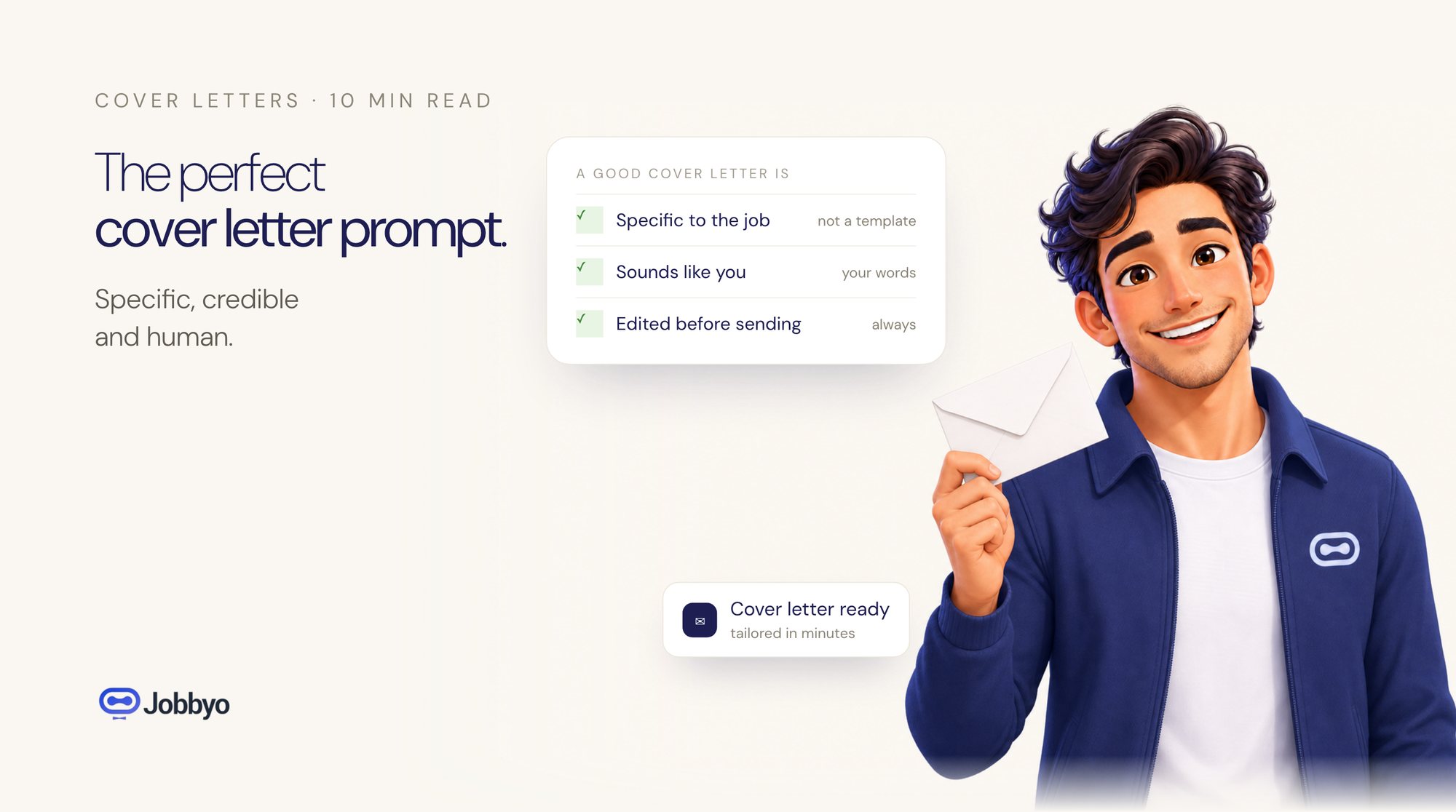
Most ChatGPT cover letters fail for a boring reason: the prompt gives the model almost nothing useful.
Ask for a professional cover letter and you get professional fog. Clean sentences. Safe adjectives. No hiring logic.
A useful cover letter is not a nicer version of your resume. It should do one job fast: show the employer why your background is relevant to the outcome they need from this hire.
That outcome might be reducing churn, fixing messy reporting, improving paid acquisition, shipping features faster, tightening security, or helping a team through a transition. If the letter does not connect your evidence to that outcome, it is decoration.
Use the prompt below for one real role. Not ten postings. Not a vague job title. One role you would actually take.
The prompt
Copy this into ChatGPT, then replace the bracketed sections with real information.
You are an expert career strategist and cover letter editor.

Write a tailored, credible cover letter for the role below. Do not use clichés, inflated language, or vague claims. Do not invent experience, employers, tools, metrics, certifications, clients, or results. If the evidence is missing, ask for it or use careful wording.

Goal:
Help the hiring manager understand, quickly, why my background is relevant to this role and what business outcome I can help support.

Target role:
[Paste job title]

Company:
[Paste company name]

Job description:
[Paste the full job description]

My resume:
[Paste your resume]

Likely target outcome for this role:
Based on the job description, identify the main outcome this hire is probably expected to deliver. Examples: reduce churn, improve sales pipeline quality, ship product features faster, strengthen security posture, improve data reliability, increase paid acquisition efficiency, improve customer onboarding, modernize finance operations, or lead a team through change.

My positioning:
[Write 2-4 sentences explaining how you want to be understood. Example: I am a finance professional moving into SaaS revenue operations. Emphasize forecasting, process improvement, stakeholder management, and Salesforce exposure. Do not imply that I have already owned a full-time RevOps function if that is not true.]

Constraints:
- Keep the letter between 250 and 400 words.
- Use a direct, human, confident tone.
- Avoid generic cover letter phrases such as I am thrilled, perfect fit, dynamic team, passionate, and strong communicator.
- Make the opening specific to the company, role, and likely business problem.
- Use 2-3 concrete examples from my background.
- Connect those examples to the likely target outcome for the role.
- If I am missing a requirement, address it honestly with adjacent experience or a realistic learning bridge.
- Do not summarize my resume line by line.
- End with a short closing that invites a conversation.

Before writing the letter:
1. Summarize the company’s likely hiring problem in 2-3 bullets.
2. Identify the 3 strongest pieces of evidence from my resume for this role.
3. Identify any gaps or risks in my candidacy and how to handle them.

Then write the cover letter.
Do not skip the target outcome section. That is the part that stops the letter from becoming a dressed-up template.
If you paste only a job title, the model will guess. If you paste the job description, your resume, and positioning notes, it has something to work with.
Why most AI cover letters sound generic
Generic prompt in, generic letter out.
A prompt like this is too thin:
Write me a cover letter for this job.
That usually produces sentences hiring managers have seen hundreds of times:
- I am excited to apply
- My skills align well with the role
- I am a strong communicator
- I would be a great fit for your team
Those lines are not disastrous. They are worse: they are easy to ignore.
The missing step is analysis. Before writing, the model needs to inspect the job description, infer what the employer is trying to fix or build, choose relevant proof from the resume, and decide how to handle gaps.
That matters most when the fit is not obvious: career change, layoff, remote competition, senior-level search, industry switch, or a move from individual contributor to manager. In those cases, the letter should translate your experience instead of repeating your resume.
Why this prompt works better
It starts with the employer’s problem
Hiring teams are not reading cover letters to admire your adjectives. They are trying to decide whether this person understands the work.
A product marketing role may be about repositioning a technical product before launch. A data engineering role may be about making dashboards reliable enough for executives to trust. A customer success role may be about lowering renewal risk in a difficult segment.
The title is only the wrapper. The business problem is the point.
It asks for evidence before prose
Good cover letters are built from proof, not personality claims.
Useful evidence can include product launches, migrations, audits, reporting fixes, customer segments, revenue ownership, cost reductions, workflow improvements, team leadership, tool experience, or cross-functional projects.
Without evidence, ChatGPT fills the space with polished mush.
It handles gaps instead of hiding them
If you are moving from finance into SaaS operations, the letter should not pretend you have already been a RevOps manager. It should show the overlap: forecasting, reporting discipline, stakeholder management, systems thinking, and process improvement.
That is a stronger move than bluffing. Hiring managers notice when a letter dodges the obvious concern.
It removes the dead phrases
Phrases like passionate, perfect fit, dynamic team, and excited to apply are not automatically wrong. They are just weak unless supported by evidence.
A sharper cover letter sounds like a capable person explaining the match, not a template trying to flatter the company.
How to edit the AI draft before sending
Use the AI version as a draft, not a final.
Check every claim
If the draft says led and the accurate word is supported, change it. If it adds a metric, tool, industry, certification, client type, or result that is not true, cut it.
A less flashy true sentence beats a stronger false one.
Rewrite the first sentence
AI often opens with the same sleepy rhythm: applying for X role at Y company.
Try starting with the company’s likely problem instead.
Weak:
I am excited to apply for the Marketing Manager role at Acme.
Better:
Acme’s move into mid-market SaaS accounts will need messaging that turns technical features into buying reasons for non-technical decision makers.
That sentence gives the reader a business context, not a greeting card.
Replace traits with proof
Do not lean on labels like analytical, collaborative, strategic, or adaptable.
Use a proof sentence instead:
For a revenue operations candidate: partnered with sales and finance to rebuild weekly pipeline reporting so leaders could identify stalled enterprise deals earlier.
The reader can infer the traits from the work.
Cut portable sentences
If a sentence could be pasted into fifty applications unchanged, it is probably not earning its place.
Tie the letter to the job description, product, customer type, team structure, market pressure, or operating problem.
Read it out loud
If it sounds stiff, simplify it. If it sounds casual, tighten it. If it sounds like LinkedIn wrote it, cut harder.
The goal is not literary flair. The goal is credible, specific, defensible writing.
How career changers should use the prompt
Career changers do not need to disguise the move. They need to reduce the perceived risk.
Add this to the prompt:
I am changing careers from [current field] to [target field]. Make the letter honest about the transition. Emphasize transferable skills and adjacent experience that reduce the employer’s perceived risk.
For a finance-to-tech-operations move, the bridge might include forecasting, process improvement, stakeholder management, reporting discipline, systems thinking, and comfort with ambiguity.
The letter should answer the quiet hiring-manager question: how much ramp time will this person need?
How recently laid-off professionals should use it
A layoff does not need to become the story.
If you want to mention it, add this:
I was recently laid off due to [brief context, if appropriate]. Do not make the layoff the focus. Position me as available, focused, and ready to contribute to the outcome this role requires.
One calm sentence is enough in most cases. Do not apologize for being available. For a team that needs help soon, availability can be useful.
How confidential job seekers should use it safely
If you are employed, senior, or working with sensitive information, do not paste confidential material into an AI tool.
Remove or generalize:
- Employer names that should not be shared
- Client names
- Unreleased product details
- Internal metrics
- Revenue figures you are not allowed to disclose
- Strategy details
- Proprietary process names
Use safer wording such as enterprise cybersecurity company, Fortune 500 financial services client, improved renewal workflow, or reduced manual reporting burden.
Add this to the prompt:
Protect confidentiality. Do not include sensitive company, client, product, revenue, or internal strategy details. Generalize anything that could expose confidential information while keeping the impact credible.
A cover letter should make you look sharp. It should not make you look careless.
The fastest way to use this in a real search
Pick one role you would accept.
Paste the full job description, your resume, and your positioning notes into ChatGPT. Read the strategy bullets before the letter. If the strategy is wrong, fix that before you edit the prose.
Then check the draft against five questions:
- Does it explain the match for this specific role?
- Does it connect your background to the outcome the employer likely cares about?
- Does it sound like you?
- Is every claim true?
- Could you defend every sentence in an interview?
If the answer is no, the prompt needs more evidence. Add the missing project, tool, customer type, constraint, metric, or context.
Where Jobbyo fits
Writing one strong cover letter is manageable. Doing that for every serious application is where job seekers burn time.
Jobbyo uses AI to tailor resumes and cover letters to each role, filters out stale or low-quality postings, and can apply for you automatically or with review, depending on your plan.
The aim is not mass-applying with bland materials. It is moving faster without stripping out the role-specific work that gets applications taken seriously.
Try the prompt on one target role first. Once you see the gap between a generic AI letter and a role-specific draft, use Jobbyo to tailor and send stronger applications while you spend more time on networking, interview prep, and choosing roles worth your attention.
Put this to work
Let Jobbyo find your
best matches for you.