11 min read
Top AI Jobs of 2026: The Career Changer’s Guide to AI-Adjacent Roles
AI jobs in 2026 aren’t only for ML engineers. Learn which AI-adjacent roles fit your transferable skills and how to apply credibly.
Most career changers should not aim straight at machine learning research roles. That is the hardest door to open if your background is in product, data, security, UX, operations, sales engineering, compliance, or business systems.
A better plan: pick two or three AI-adjacent roles where your past work gives you proof. Then rewrite every resume and cover letter around that proof.
That is the difference between a credible pivot and a resume with “AI” sprinkled on top.
The AI jobs worth watching in 2026
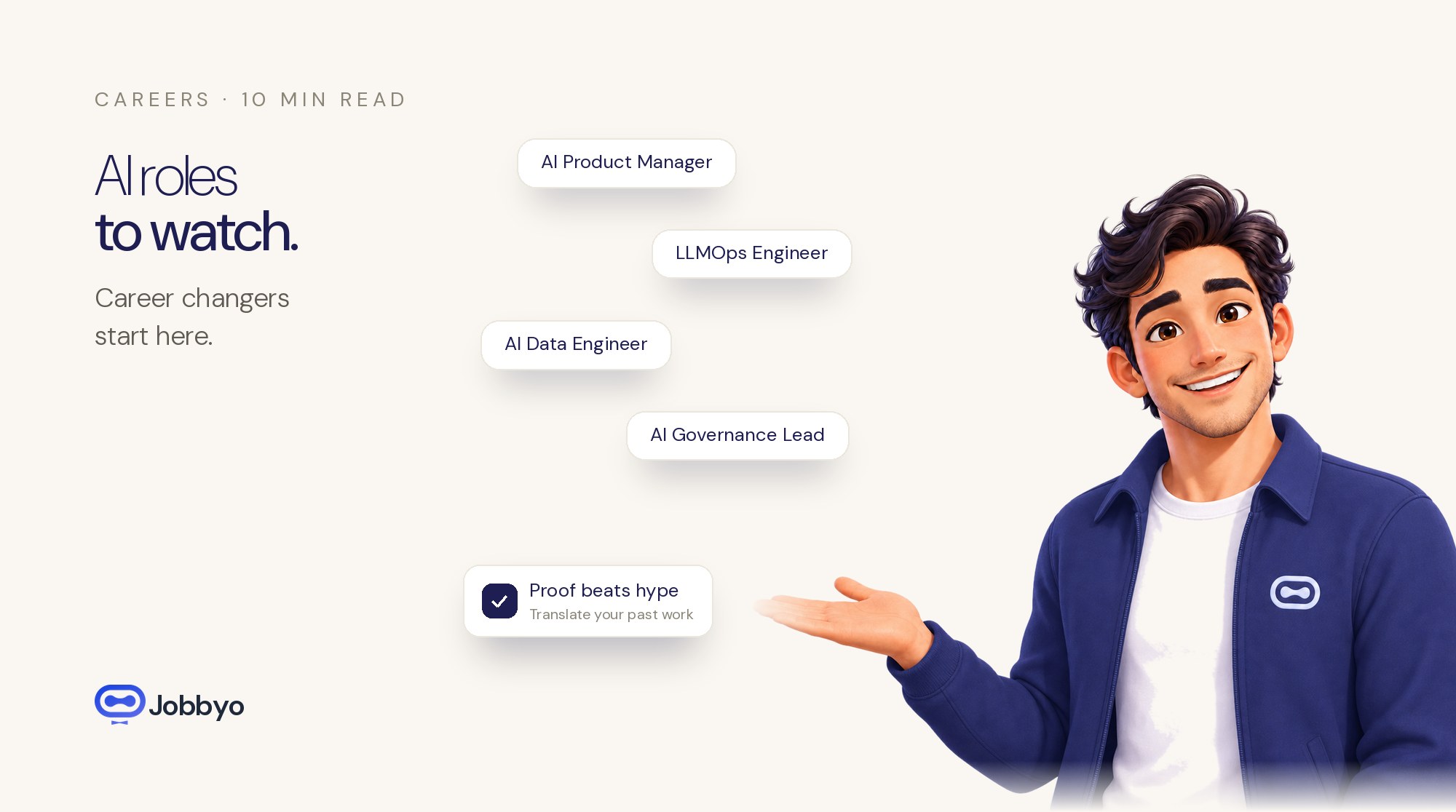
The most realistic AI roles for non-ML engineers usually sit around AI systems, not inside model research.
The main targets:
- AI Product Manager
- AI Solutions Architect
- AI Data Engineer
- LLMOps Engineer
- AI Governance, Risk, and Compliance Lead
- AI UX Designer or Conversation Designer
- AI Security Engineer
- AI Sales Engineer or AI Solutions Consultant
- AI Workflow Automation Specialist
Observed fact: employers are adding AI requirements to existing job families. Product postings mention AI roadmaps. Data postings mention model-ready pipelines. Security postings mention AI risk. Marketing and operations roles mention AI-assisted workflows and automation.
Source: Jobbyo’s review of current AI-related job titles and role descriptions across company career pages and job boards.
Forecast for 2026: hiring should keep shifting toward companies trying to put AI into products, internal systems, compliance processes, customer support, sales workflows, and data operations. Fewer employers need frontier model researchers. More need people who can make AI usable, safe, measurable, and tied to actual work.
What this means for you: do not self-reject because you are not an ML engineer. But do not fake it either. Your resume has to translate your existing experience into AI-relevant work without pretending you trained models if you did not.
1. AI Product Manager
Best bridge from: product management, product marketing, business analysis, operations, customer research, technical program management.
Less obvious truth: the AI PM is usually not the person training the model. The job is deciding which customer problems AI should solve, where AI creates risk, what the product should do when the model is wrong, and how the team measures whether the feature works.
Evidence: current AI PM job descriptions commonly combine product discovery, experimentation, data literacy, stakeholder management, and ownership of AI-enabled features.
Why this role is growing: companies have moved past vague AI curiosity. They now need product people who can decide where AI belongs in the user experience and where it should be kept out.
Resume move: lead with roadmap ownership, customer research, experiments, analytics, launches, cross-functional delivery, and judgment under risk. Do not make “I use ChatGPT” your pitch. Show the business problem you solved and the product decision you made.
2. AI Solutions Architect
Best bridge from: backend engineering, cloud engineering, data engineering, enterprise architecture, sales engineering, implementation consulting.
Less obvious truth: many AI architect roles are about systems, not algorithms. The work often means connecting models, APIs, data stores, applications, permissions, monitoring, and business workflows.
Evidence: AI architect and AI solutions postings frequently reference cloud platforms, system design, APIs, data pipelines, enterprise integrations, security, and stakeholder consulting.
Why this role is growing: companies want AI inside real products and internal tools. That takes architecture. A demo is not enough.
Resume move: show architecture decisions. Mention APIs, cloud services, integrations, authentication, data flow, performance, and security where you have real experience. A tools list is weaker than a clear example of a system you designed or improved.
3. AI Data Engineer
Best bridge from: analytics engineering, BI, data warehousing, ETL, backend data systems, data platform work.
Less obvious truth: plenty of AI failures are data failures with a better interface.
Evidence: AI implementation roles depend on clean, accessible, governed, well-modeled data.
Why this role is growing: AI products need pipelines, retrieval systems, vector databases, metadata, monitoring, governance, and usable business data. If the data is broken, the model is not the bottleneck.
Resume move: emphasize pipeline reliability, data quality, SQL, Python, orchestration, cloud data platforms, APIs, governance, and stakeholder-facing analytics. If you have cleaned messy business data, say it plainly. That is relevant experience.
4. LLMOps Engineer
Best bridge from: DevOps, MLOps, platform engineering, backend engineering, infrastructure.
Less obvious truth: the hard part often starts after the prototype works. Somebody has to run the AI system in production.
Evidence: emerging LLMOps roles build on DevOps, MLOps, and platform engineering responsibilities.
Why this role is growing: AI prototypes are easy to make and hard to operate. Employers need people who can handle deployment, monitoring, evaluation, latency, cost control, versioning, security, and failure modes.
Resume move: show production ownership. Hiring teams will care about reliability, observability, incident response, CI/CD, cloud infrastructure, and evaluation practices. Buzzwords will not cover a thin production record.
5. AI Governance, Risk, and Compliance Lead
Best bridge from: legal, compliance, audit, risk, privacy, security, healthcare, finance, public sector, vendor management.
Less obvious truth: AI adoption creates policy work. It creates audit work. It creates vendor review work. It creates privacy and customer-trust work.
Evidence: AI governance roles commonly mention risk frameworks, privacy, acceptable-use policies, vendor review, model documentation, regulatory awareness, and cross-functional oversight.
Why this role is growing: companies are worried about sensitive data, biased outputs, hallucinations, intellectual property, employee misuse, vendor risk, and customer trust.
Resume move: translate compliance, audit, privacy, vendor management, risk assessment, or regulated-industry experience into AI governance language. You do not need to code for many of these roles. You do need to understand how AI systems are being used and where they can cause harm.
6. AI UX Designer or Conversation Designer
Best bridge from: UX research, product design, content design, service design, support experience design.
Less obvious truth: AI products often fail because users do not know what the system can do, when to trust it, or how to recover when it gets something wrong.
Evidence: AI UX and conversation design roles increasingly combine user research, prompt interaction patterns, trust cues, onboarding, accessibility, and error-state design.
Why this role is growing: AI changes the interface. The user is not clicking through a predictable form anymore. They may be asking questions, reviewing generated work, correcting outputs, or deciding whether a recommendation is safe to use.
Resume move: emphasize user flows, research findings, usability testing, content strategy, prototyping, accessibility, and complex decision paths. Polished screens matter less than proof that you help users make good decisions.
7. AI Security Engineer
Best bridge from: application security, cloud security, security engineering, risk, privacy, identity and access management.
Less obvious truth: AI adds new risk to old systems. Data access, permissions, prompt behavior, model outputs, vendor tools, and internal misuse all become security concerns.
Evidence: security roles increasingly mention AI risk alongside privacy, governance, access control, vendor evaluation, and secure implementation.
Why this role is growing: companies are putting AI into products and workflows before every risk is fully understood. They need security people who can ask hard questions before sensitive data or customer trust is exposed.
Resume move: highlight threat modeling, access controls, cloud security, vendor review, incident response, privacy work, secure SDLC, and risk assessment. If you have worked with sensitive data or regulated environments, make that visible.
8. AI Sales Engineer or AI Solutions Consultant
Best bridge from: B2B SaaS sales engineering, implementation consulting, customer success architecture, technical account management.
Less obvious truth: many buyers do not need a more exciting demo. They need to know what is real, what is risky, what integrates with their stack, and what produces business value.
Evidence: AI sales engineering roles usually require product knowledge, technical discovery, demos, integration awareness, security conversations, and customer-specific solution mapping.
Why this role is growing: AI buying decisions are more complicated than normal software purchases. Buyers have to evaluate data access, privacy, workflow fit, model behavior, and measurable return.
Resume move: show technical discovery, enterprise demos, proof-of-concept work, stakeholder management, implementation planning, and business-case development. Tie the technical conversation to the customer’s workflow.
9. AI Workflow Automation Specialist
Best bridge from: operations, revenue operations, business analysis, project management, business systems, no-code and low-code building.
Less obvious truth: much of the AI work inside companies is not glamorous. It is summarizing documents, routing information, reducing manual admin, improving handoffs, and automating repetitive steps.
Evidence: job descriptions around AI automation, business systems, and operations increasingly mention workflow tools, process mapping, integrations, internal enablement, and productivity systems.
Why this role is growing: companies want practical AI gains inside everyday operations.
Resume move: highlight process improvement, systems thinking, automation tools, documentation, stakeholder training, and measurable operational outcomes. Do not inflate your technical depth. Show the workflow you improved.
Is AI Architect easier for a backend developer or a data engineer?
It depends on what the employer means by “AI Architect.” That title is not standardized.
If the role focuses on application architecture, APIs, cloud services, authentication, latency, and enterprise integrations, a backend developer usually has the cleaner bridge.
If the role focuses on data platforms, retrieval systems, analytics infrastructure, governance, warehousing, metadata, and model-ready pipelines, a data engineer may be better positioned.
If the role focuses on demos, discovery, customer requirements, and technical buying cycles, a sales engineer or solutions consultant may be credible.
If the role focuses on policy, model documentation, vendor review, and risk controls, a governance or compliance professional may have the better path.
Do not fall in love with the title. Read the responsibilities. The job description tells you which background has the advantage.
How to choose your 2-3 AI job paths
Start with evidence, not enthusiasm.
Ask:
- Have you shipped products?
- Built systems?
- Cleaned data?
- Managed risk?
- Designed user flows?
- Sold technical software?
- Improved workflows?
- Worked in regulated processes?
Then map that proof to a role.
A finance analyst might aim at AI governance, AI risk, analytics, or automation. A product marketer might aim at AI product marketing or AI go-to-market work. A Salesforce admin might aim at AI business systems or workflow automation. A backend developer might aim at AI solutions architecture or LLMOps. A UX researcher might aim at AI UX or conversation design.
Cut any path that requires a fake leap. If the posting requires deep model training and you do not have it, keyword stuffing will not save you. You need a bridge, not a costume.
A credible pivot sounds like this: “I have done adjacent work in a non-AI setting, and here is how that work applies to this AI-enabled role.”
A weak pivot sounds like this: “I am passionate about AI and took a course.”
Courses can support the pivot. They do not replace proof.
How to tailor your resume for AI jobs in 2026
Your resume has one job: make the match obvious.
For AI Product Manager roles, emphasize discovery, roadmap decisions, experiments, analytics, launches, and cross-functional delivery.
For AI Data Engineer roles, emphasize pipelines, data quality, governance, cloud platforms, APIs, orchestration, and reliability.
For LLMOps roles, emphasize production systems, observability, CI/CD, incident response, evaluation, latency, and cost control.
For AI Governance roles, emphasize risk assessment, policy, audit, privacy, vendor management, documentation, and regulated decision-making.
For AI UX roles, emphasize research, interaction design, trust, usability testing, accessibility, content strategy, and error states.
For AI Sales Engineer roles, emphasize discovery, demos, technical evaluation, implementation planning, integration questions, and customer-specific solution design.
For AI Workflow Automation roles, emphasize process mapping, automation, systems integration, documentation, stakeholder training, and operational improvement.
Generic resumes are especially weak in AI hiring because the titles are messy. One company’s “AI Strategist” may be an automation role. Another company’s “AI Product Lead” may be deeply technical. Another may be mostly commercial.
Your application has to remove that confusion for the hiring team.
How Jobbyo can help
Jobbyo helps you find relevant roles, avoid low-quality or stale postings, and tailor your resume and cover letter for each job path.
That matters because AI-adjacent roles are easy to misread. The title may look right while the responsibilities point to a different background entirely.
A practical next step:
- Pick two or three roles from this guide.
- Check which ones match evidence you already have.
- Build a separate resume angle for each path.
- Use Jobbyo to tailor applications role by role instead of sending one generic resume everywhere.
Most people will chase AI jobs by adding “AI” to their resume and hoping nobody looks too closely.
Do the harder, better thing: show the bridge between work you have already done and the AI-enabled work companies need now. That is where career changers can compete.
Put this to work
Let Jobbyo find your
best matches for you.