6 min read
The “Prompt Engineer” Job Title Shrank ~30% — But AI Skills Moved Into Other Roles
Prompt Engineer titles are shrinking, but AI workflow skills are spreading. Here’s how job seekers should adjust resumes and searches.
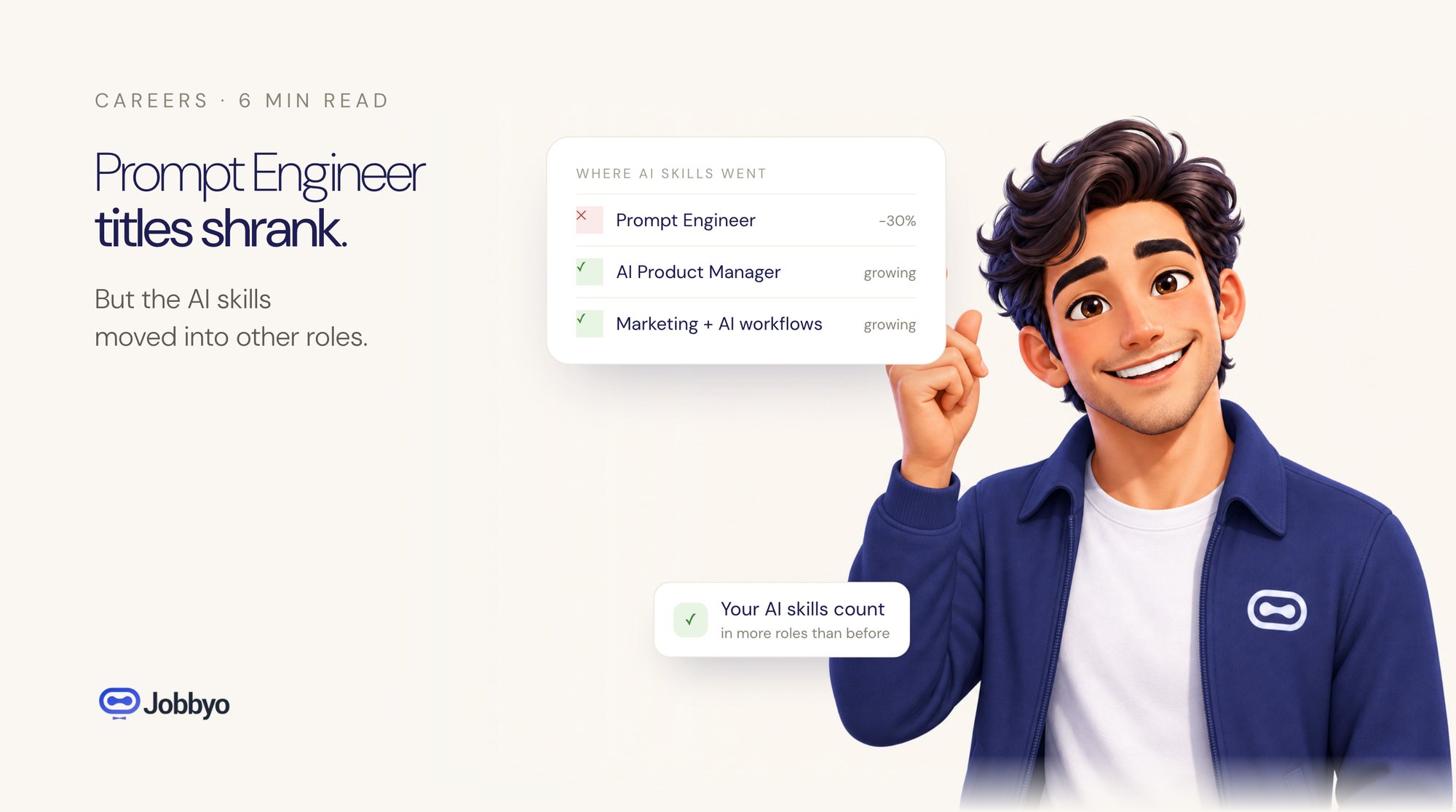
The title is shrinking. The work is not.
That is the point job seekers need to get right. If you search only for “Prompt Engineer,” you are looking through a keyhole. The broader demand is showing up inside ordinary job descriptions: product manager, marketer, analyst, UX researcher, engineer, recruiter, technical writer, RevOps analyst, customer success operations manager, and operations lead.
Source, sample size, and scope
This post is based on the supplied Jobbyo Job Market Intelligence brief covering 2024–2026.
Important limitation: the supplied brief does not disclose sample size or geography. So the numbers below should be treated as directional market intelligence, not a full labor-market census.
| Signal | Directional change | Source scope |
|---|---|---|
| Job postings using the exact “Prompt Engineer” title | Down about 30% | Jobbyo Job Market Intelligence brief; 2024–2026; sample size not disclosed; geography not disclosed |
| Roles asking for prompting skills | About 3x higher | Jobbyo Job Market Intelligence brief; 2024–2026; sample size not disclosed; geography not disclosed |
The read is simple: the title got weaker, while the skill moved into more jobs.
3 findings job seekers should pay attention to
1. The title is a bad search filter
“Prompt Engineer” had a loud moment because companies were experimenting. They needed people to test language models, write prompts, build internal use cases, review outputs, and show teams what the tools could do.
Some companies still need dedicated AI workflow, AI operations, model evaluation, or prompt-focused specialists, especially where internal tooling, regulated workflows, or quality review matter.
But many employers have stopped treating prompting as its own lane. They now expect people inside the function to use AI as part of the job.
That means a title-only search will miss relevant roles. Do not stop at:
- Prompt Engineer
- AI Prompt Specialist
- Generative AI Specialist
- AI Content Prompt Writer
Also search inside roles like:
- Product Manager
- Growth Marketing Manager
- RevOps Analyst
- Customer Success Operations Manager
- UX Researcher
- Technical Writer
- Data Analyst
- Sales Enablement Manager
- Software Engineer
- Recruiter
- Learning and Development Lead
- Business Operations Manager
The AI requirement may be buried in the responsibilities section, not the headline.
2. Employers want workflow judgment, not clever prompts
Most hiring teams are not looking for someone who can type a fancy instruction into ChatGPT. They want someone who can use AI without making the work sloppier, riskier, or harder to trust.
In practice, that means you can:
- Turn a vague task into clear instructions.
- Provide context, constraints, examples, and success criteria.
- Check the output instead of accepting it at face value.
- Revise the prompt when the first answer is weak.
- Protect confidential, customer, employee, or financial information.
- Convert a one-off prompt into a repeatable workflow.
- Connect AI output to a business decision, document, campaign, report, dashboard, or customer experience.
This is why domain knowledge matters. A marketer using AI for campaign briefs is solving a different problem than a data analyst using AI to draft SQL notes or document dashboards. A UX researcher using AI to organize interview notes is solving a different problem than a recruiter using AI to draft outreach or summarize candidate feedback.
The tool is not the story. The work product is.
3. Your resume has to show outcomes, not tool names
A skills section that says “ChatGPT” does not carry much weight. It tells the employer you touched the tool. It does not tell them whether you improved anything.
Use this structure instead:
AI-assisted workflow + business task + result
Examples:
- Used generative AI workflows to synthesize customer feedback into product themes for roadmap planning.
- Built reusable AI-assisted content briefs to improve consistency across campaign launches.
- Applied AI-supported research workflows to summarize competitive positioning and speed up sales enablement updates.
- Created prompt templates for internal reporting, reducing repetitive drafting and improving stakeholder-ready summaries.
- Used AI-assisted analysis to convert meeting notes, support tickets, and CRM inputs into clearer operational action items.
If you have a real metric, use it. If you cannot defend the number in an interview, leave it out. Specific qualitative proof is better than a fake percentage.
Weak phrasing:
- Experienced with AI.
- Prompt engineering skills.
- Used ChatGPT for productivity.
Stronger phrasing:
- Designed AI-assisted workflows for research synthesis, first drafts, and executive-ready summaries.
- Reviewed AI outputs for accuracy, tone, and business relevance before publication.
- Created reusable prompts and review steps to standardize team documentation.
Those lines show judgment, process, and quality control. That is what employers are trying to buy.
Job-seeker takeaway
Start with the roles you actually want. Pull several current job descriptions and highlight every mention of:
- generative AI
- AI workflows
- prompt design
- prompt engineering
- automation
- LLMs
- AI-assisted research
- AI content workflows
- AI operations
- workflow optimization
- model evaluation
- human-in-the-loop review
- AI governance
- productivity tooling
Then combine those terms with your function:
- product manager generative AI
- marketing manager AI workflows
- data analyst LLM
- customer success AI operations
- UX researcher AI-assisted research
- technical writer generative AI
- RevOps automation AI
- recruiter AI workflows
This matters even more if you are changing lanes. A finance-to-tech candidate may get more traction with “business analyst + AI workflows” or “RevOps analyst + automation” than with a pure “Prompt Engineer” search. A laid-off marketer should show how AI supports campaign production, research synthesis, messaging tests, or content repurposing. A senior operator in a confidential search should frame AI as process redesign, team enablement, governance, decision quality, and operating leverage.
The strongest positioning is not “I am an AI person.”
It is: “I can do this job better because I know where AI fits, where it fails, and how to review the work before it reaches customers, leaders, or the market.”
Jobbyo can help identify high-fit roles, filter out stale postings, and tailor resumes and cover letters to each job description. But the first move is yours: stop chasing one flashy title, audit the postings, and make your AI workflow skills visible where employers are actually asking for them.
Put this to work
Let Jobbyo find your
best matches for you.