9 min read
The Hiring Market in 2026: Trends and Strategies for a Mismatched Job Search
The 2026 hiring market is mismatched, not hopeless. Learn how to target real demand before sending more applications.
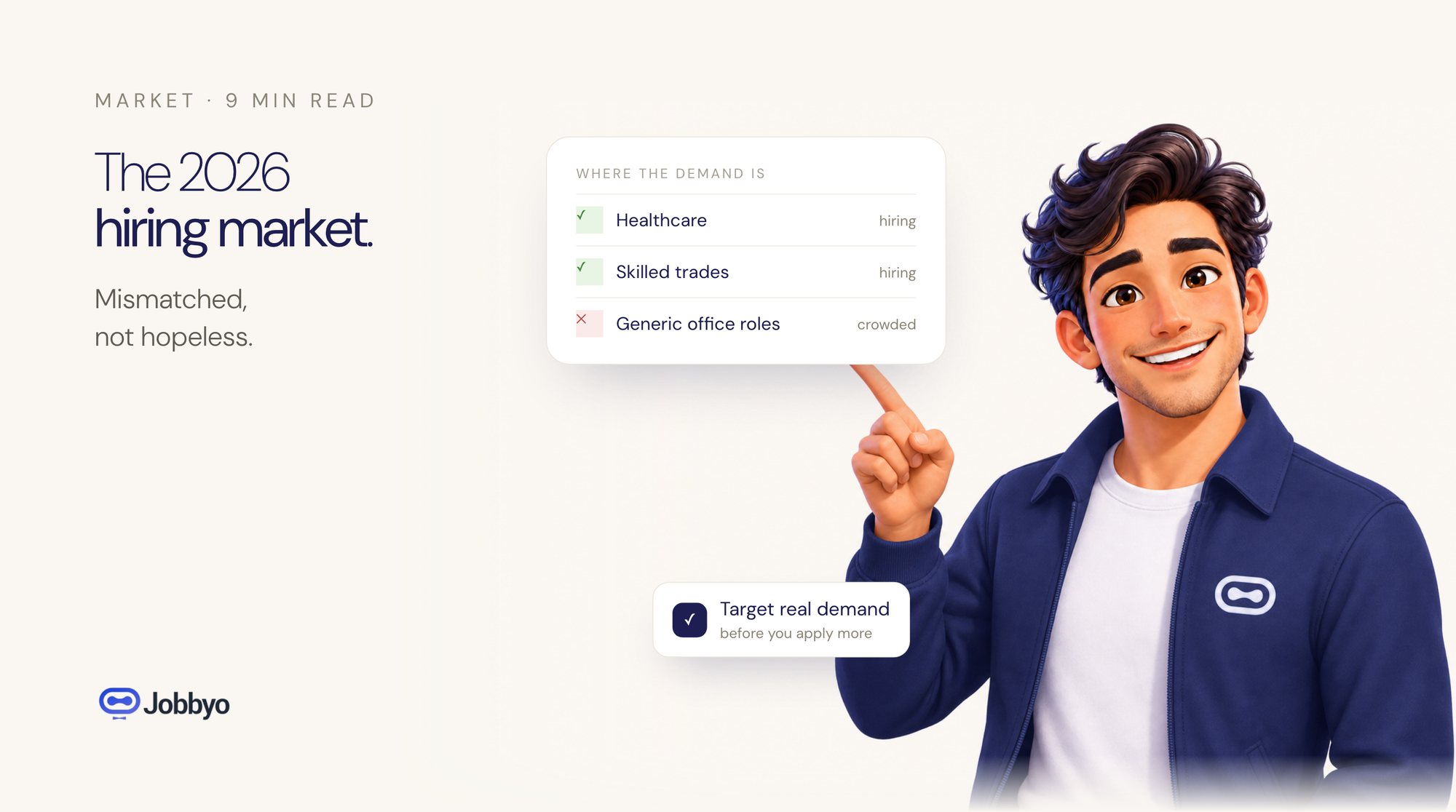
The 2026 job search is punishing people who chase obvious openings.
Remote roles. Big-name employers. Broad titles like Marketing Manager, Business Analyst, Customer Success Manager, Product Manager, and Data Analyst. Those postings attract the crowd first, and the crowd is bigger when one-click apply and resume tools make low-effort applications easy.
At the same time, employers still miss on specific hires. They need a Salesforce admin with the right cloud background. A product marketer who knows vertical SaaS. A data engineer who has worked in the company’s stack. A finance operator who can carry regulatory experience into fintech workflows.
That gap is the market. It is not solved by sending 80 more generic applications.
The better move: check whether your target role is active, funded, specific, and close to your proof before you spend another hour tailoring a resume.
Be careful with hiring-market stats
Do not build your search around a viral chart unless the chart tells you five things:
- who published it
- what was counted
- how many people, employers, or postings were included
- which dates were covered
- which country, region, industry, or job family was measured
The source brief behind this article says application volume is rising. It also references employer difficulty filling roles and longer time-to-fill. It does not name an external source, define the sample, give a date range, identify the geography, or explain the methodology.
So those claims should not be treated as verified statistics here.
Use them as a warning, not as evidence: the market may be noisy, and your own search needs a demand check.
Build a demand check before you apply
Pick one role family, one seniority band, and one location rule. Then review a small, current set of postings before you send applications.
For example: mid-level customer success roles, B2B SaaS, remote within the U.S., posted or refreshed in the last 14 days.
For each role, log what you can actually see.
| Signal | What to check | What it tells you |
|---|---|---|
| Posting date | Posted or refreshed in the last 7 to 14 days | The role is more likely to be active |
| Repeated listing | Same job copied across boards | The market may look larger than it is |
| Evergreen title | Same role always open | Could mean churn, pipeline hiring, or a stale listing |
| Salary range | Range shown before the interview process | Fewer late-stage surprises |
| Skill detail | Tools, systems, customers, regulations, markets, or outcomes named | Stronger evidence of a real hiring need |
| Location rule | Remote, hybrid, state limits, time zone, travel, office radius | Prevents wasted applications |
| Team context | Manager, department, product area, or business problem named | Easier to tailor your resume |
| Related openings | Several roles on the same team or function | Possible budgeted hiring or team buildout |
After you review the postings, write down three observations:
- What demand looks real.
- What looks inflated by duplicates or old listings.
- What your resume does not yet prove.
Then decide what to do: narrow the search, widen the location, change the target title, build a separate resume version, or stop applying to that cluster for now.
This is not labor economics. It is self-defense.
The mistake: applying by title instead of problem
Most candidates search by title. Hiring teams hire against a problem.
A Customer Success Manager at a developer-tools company may need technical onboarding, API fluency, and expansion experience. The same title at a healthcare SaaS company may require workflow training, compliance awareness, and stakeholder management across clinical teams.
A Marketing Manager role can mean paid acquisition, lifecycle, content, product marketing, field marketing, or partner marketing. A Business Analyst role can sit inside finance, data, operations, compliance, or product.
If your resume treats those as the same job, the hiring team will not do the translation for you.
Fix it before applying:
- Group target roles by skill cluster, not title.
- Build a separate resume version for each cluster.
- Put the employer’s actual problem in the top third of the resume.
- Replace task bullets with outcome bullets.
- Remove experience that distracts from the target role.
One resume for three job families is usually three weak applications.
Application volume creates noise. Do not become the noise.
Automation is not the enemy. Lazy automation is.
When candidates use autofill tools, job boards, and one-click apply without checking fit, employers receive more weak applications. That makes screeners harsher. It also means a decent candidate can disappear if the resume is vague.
Before applying, ask:
- Does the resume headline match this role family?
- Do the first five bullets prove the required skills?
- Are the tools, customers, systems, markets, or regulations visible?
- Is the seniority level believable?
- Is the location workable?
- Is the salary likely close enough?
- Is the posting fresh enough to deserve time?
If the answer is no, do not send a placeholder application. Either tailor it or skip it.
Career changers need evidence, not a speech
Pivots fail when the resume explains the change instead of proving the fit.
Finance to tech is credible when the resume shows forecasting, risk, compliance, analytics, stakeholder management, or revenue impact.
Teaching to customer success is credible when the resume shows onboarding, adoption, training design, communication, retention behavior, or account support.
Operations to product is credible when the resume shows process improvement, user pain, prioritization, cross-functional delivery, or measurable workflow gains.
Do not bury the bridge on page two. Put it near the top.
Use a short target-role summary. Add a skills section that maps to the new role. Rewrite bullets in the target employer’s language without lying. Drop industry jargon from the old field when it blocks the reader.
A pivot is not an apology. It is a positioning job.
If you were laid off, protect your energy
A layoff makes speed feel urgent. Panic applying feels productive for about two days. Then it becomes a spreadsheet full of silence.
Use a triage system instead.
| Role type | Move |
|---|---|
| Strong match | Apply quickly with a tailored resume |
| Adjacent match | Apply only if the resume can prove the bridge in the top third |
| Weak match | Skip unless you have a referral or unusually strong evidence |
| Old posting | Put it below fresh roles |
| Vague posting | Research the company before spending time |
| Salary mismatch | Skip unless there is a clear strategic reason |
| Remote with unclear location rules | Verify geography before applying |
The goal is not the largest application count. The goal is the highest number of credible recruiter conversations per hour spent.
Senior candidates should not depend on job boards
Senior and executive searches run through quieter channels: referrals, retained search, investor networks, former colleagues, board contacts, and direct outreach.
Public postings can still be useful, but they are rarely enough.
For a senior search:
- Build a target-company list before an application list.
- Watch for new executives, funding, layoffs, acquisitions, product launches, market expansion, and regulatory pressure.
- Use an executive resume that shows scope, revenue, risk, transformation, operating model, and decision quality.
- Keep LinkedIn changes subtle if your search is confidential.
- Avoid mass-applying in ways that expose your search without improving your odds.
At higher levels, you are not only looking for openings. You are looking for organizational pain you can credibly solve.
Technical specialists should test whether the job is real
Weak technical postings ask for every tool in the ecosystem and explain none of the work.
Stronger postings give clues: architecture, data volume, security requirements, cloud environment, product area, team structure, incident ownership, compliance needs, deployment process, or customer scale.
Look for:
- specific languages, platforms, frameworks, or systems
- ownership expectations
- team context
- production environment details
- security, compliance, or scale requirements
- a realistic match between seniority and responsibility
- compensation or level transparency
If a company urgently needs a technical hire, the posting usually gives enough detail to tailor against the actual problem. If it reads like a keyword dump, treat it with suspicion.
Remote does not mean anywhere
Remote-first candidates need to read the fine print.
A role can be remote within one country, one state list, one province list, one time zone, or one office radius. It can require quarterly travel, client visits, security clearance, licensing, or employment in a state where the company already has payroll set up.
Before applying, check:
- Is it fully remote, hybrid, or remote near an office?
- Are any states, countries, or provinces excluded?
- Is pay adjusted by location?
- Are working hours tied to a specific region?
- Does the company already employ people where you live?
- Are there travel, licensing, compliance, or security constraints?
Remote roles attract broad applicant pools. If your resume does not show role fit, industry fit, and evidence that you can operate remotely, you are easy to cut.
A better 2026 application checklist
Before sending the next batch, run the role through this list:
- Is the posting recent enough to deserve time?
- Does the description name real work, or only generic traits?
- Can your resume prove the required skills in the top third?
- Are your outcomes visible, not just your responsibilities?
- Is the salary likely close enough?
- Do the location rules work?
- Are there related openings that suggest a real team need?
- Is there a referral path?
- Have similar roles produced recruiter responses for you?
- Are you leaving time for outreach and interview prep?
Jobbyo is built for this kind of market. It helps tailor resumes and cover letters to each role, supports reviewed or automated applications, and filters stale or low-quality postings so you do not waste time chasing dead ends.
The 2026 hiring market rewards relevance. Not volume. Not panic. Not another generic resume sent to a role that was probably filled three weeks ago.
Audit the demand first. Apply where the evidence is real.
Put this to work
Let Jobbyo find your
best matches for you.