10 min read
Recruitment Trends 2026: Quality of Hire Over Quantity
In 2026, hiring teams are prioritizing fit over volume. Job seekers need sharper positioning, not more generic applications.
Most job seekers are tracking the wrong number.
They know how many applications they sent this week. They do not know how many of those applications made a hiring manager think, within 10 seconds, "Yes, this person fits the role."
That gap matters in 2026. Employers are not only trying to fill seats. They are trying to lower hiring risk: faster ramp time, fewer mismatches, stronger shortlists, and candidates who can explain the job’s actual problems back to them.
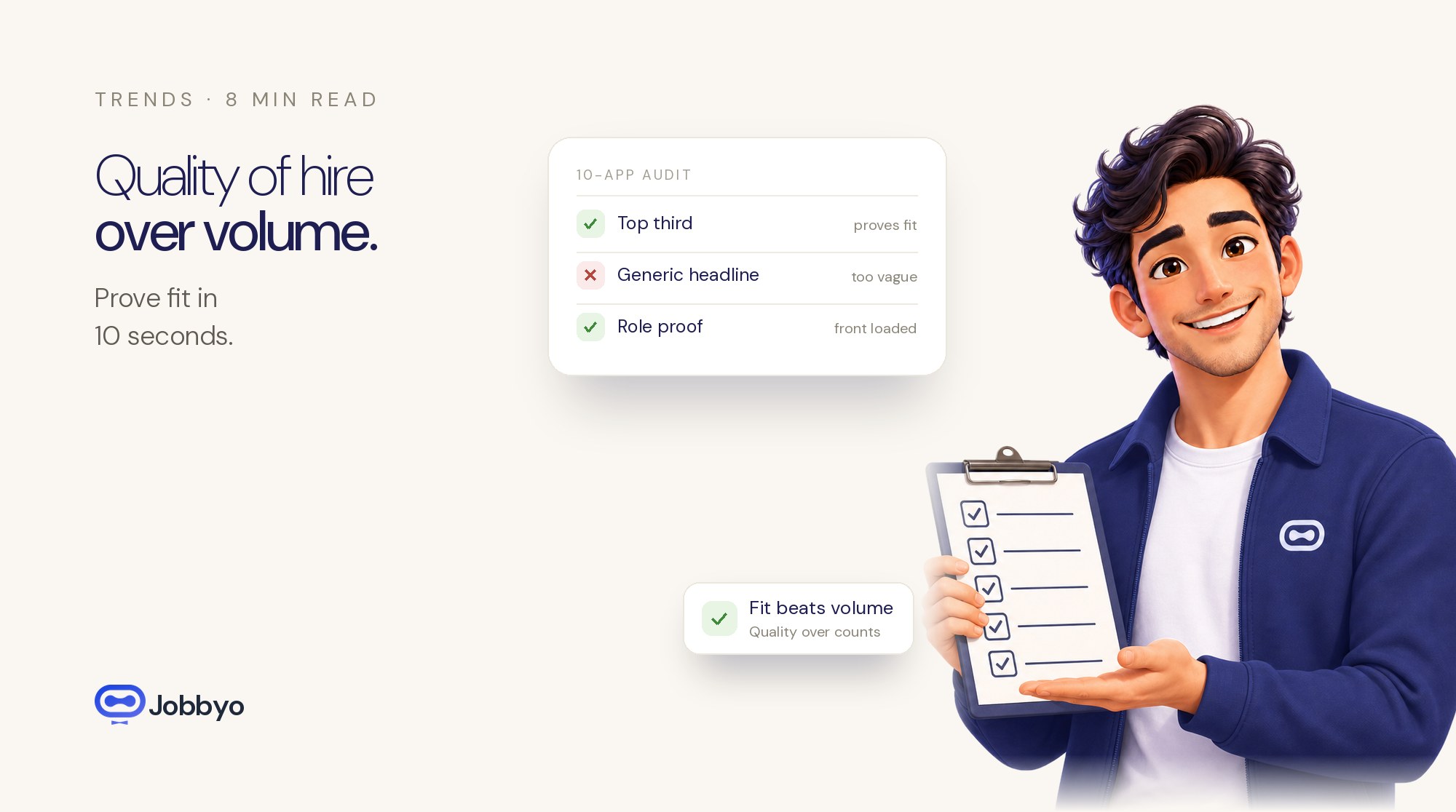
So the move is simple: audit your next 10 applications. If the top third of your resume does not prove role fit fast, do not send it yet.
What "quality of hire" means for candidates
For a hiring team, quality of hire is not a warm feeling. It is a risk calculation.
Before they invite you to interview, they are asking questions like:
- Can this person handle the work described in this posting?
- Have they solved similar problems before?
- Will they need heavy hand-holding for the first 90 days?
- Does their experience match the team’s tools, customers, workflows, or stage of company?
- Can the hiring manager defend this shortlist to the rest of the interview panel?
That is why mass applying gets weaker when employers care more about relevance. A resume can contain the right keywords and still fail because the fit is buried, vague, or unconvincing.
A generic resume says, "I have experience."
A strong resume says, "I have done work that looks like this job. Here is the proof."
That is the difference.
Why generic high-volume applications are easier to reject
AI has made it easier to produce decent-looking resumes and cover letters. That creates a new problem: more applications now look polished at first glance, but many say almost nothing specific.
Recruiters can spot that fast.
The weak applications usually have the same flaws:
- A headline like "Experienced professional" that could belong to 10,000 people.
- A summary that describes the candidate but not the match to the role.
- Bullets that list responsibilities instead of outcomes, tools, scale, stakeholders, or business context.
- Career-change experience that never gets translated into the target function.
- The best proof sitting halfway down page two.
That kind of application may feel productive because you sent it. But the resume is asking the reader to do the hard work: interpret your background, connect the dots, and imagine your fit.
Most hiring teams will not do that for you.
A better daily question is not, "How many jobs did I apply to?"
Ask, "How many roles did I apply to where my fit was obvious?"
How AI changes the search without replacing judgment
AI is now involved on both sides of the hiring process. Employers use AI-assisted tools to search, screen, summarize, and compare candidate profiles. Job seekers use AI to rewrite resumes, draft cover letters, find postings, and move faster.
That does not make fit less important. It makes weak fit easier to expose.
A keyword match may help your resume enter the conversation. It will not make a hiring manager believe you can do the job. The evidence still has to hold up: the right projects, the right tools, the right level, the right business context.
Use AI for precision, not spam.
Worth doing:
- Paste in the job description and identify the actual work, not just the keywords.
- Compare the posting against your strongest projects, metrics, tools, and stakeholders.
- Rewrite bullets so they show relevant outcomes, not a job-history dump.
- Adjust the resume summary for the specific role and company type.
- Draft a cover letter only when it adds context the resume cannot carry.
- Skip stale, low-fit, underpaid, or obviously misaligned postings before you waste an hour.
That is where Jobbyo fits: not as a way to become the loudest applicant in the pile, but as a way to find better-fit roles and make each application harder to dismiss.
What your resume needs to show in the first 10 seconds
A recruiter scanning your resume should understand three things almost immediately:
- The role you are targeting.
- The part of your background that matches it.
- The proof that makes the match credible.
If the job is SaaS operations and you are coming from finance, do not lead with "detail-oriented professional with strong communication skills." Lead with the work that travels: revenue workflows, reporting, process improvement, stakeholder management, forecasting, compliance-heavy operations, systems implementation, or cross-functional execution.
If you are a product marketer applying to B2B SaaS roles, the top of the resume should show positioning, launches, sales enablement, customer research, competitive analysis, and revenue-facing work.
If you are a data engineer, do not bury the technical fit under soft-skills language. Show the stack, data systems, scale, production environment, and business use case.
Use this test: if someone reads only the top third of your resume, would they know why you belong in this specific applicant pool?
If not, tailor before you apply.
How to read posting counts before you apply
Hook:
Do not chase every spike in online job ads. Track the roles that are current, relevant, and realistic for your search. A bigger list of postings is useless if most of them are stale, out of range, outside your geography, or wrong for your level.
Sample size and scope:
Use your next 10 target applications as the sample. Keep the scope tight:
- Target role
- Seniority level
- Location or remote eligibility
- Salary range
- Industry preference
- Work authorization needs
- Schedule or travel constraints
The geography should match where you can actually work. If you need remote roles in the United States, do not judge your search by every posting on the internet. If you can work only in Toronto, do not treat North America-wide posting counts as your market.
If you use external labor-market data, cite the named source and define the sample size, time window, and geography. Do not turn a random job-board count into a market conclusion.
Chart:
| Application audit field | What to track |
|---|---|
| Job title | Does it match your target role, or only sound close? |
| Posting age | Is it recent, reposted, or possibly stale? |
| Location/remote fit | Can you legally and practically work there? |
| Salary clarity | Is compensation listed or discoverable before a call? |
| Level fit | Is the role junior, mid-level, senior, lead, or executive? |
| Role-fit score | On a 1-5 scale, how clearly do your skills match the requirements? |
| Resume tailored? | Did you change the headline, summary, and strongest bullets? |
| Proof visible fast? | Can the top third of the resume make the case? |
| Decision | Apply, tailor later, or skip. |
Three findings to look for:
First, separate volume from usable volume. A high number of postings does not help if the roles are underpaid, misleveled, stale, outside your location, or built around requirements you cannot prove.
Second, watch reposts. A reposted role may be legitimate, but it deserves a closer look. It can signal a slow process, shifting requirements, unrealistic expectations, or a posting that exists before the company is ready to hire.
Third, compare fit before effort. If a posting requires you to rewrite your entire work history to seem plausible, it may be a bad use of time. If the role already lines up with your strongest proof points, that is where tailoring has the highest upside.
Job-seeker takeaway:
Posting counts are market noise until you filter them through your constraints. Your strategy is not "apply to more." Your strategy is "apply where the match is strong enough to defend."
Soft CTA:
Before your next batch, review the roles like a hiring team would. Weak fit? Skip. Strong fit but unclear resume? Tailor. Strong fit and obvious proof? Send it.
Which postings are worth your time?
Not every job ad deserves your resume.
A posting is worth serious effort when it passes these checks:
- The responsibilities match work you can prove. Ignore the title for a minute. Look at the problems the role owns. If you have solved similar problems, you have material for a strong application.
- The description gives you something concrete to tailor against. Tools, stakeholders, workflows, customers, metrics, technical environment, sales motion, compliance requirements, or company stage are useful clues.
- The role respects your non-negotiables. Salary, location, remote policy, travel, seniority, schedule, industry, and work authorization are not small details. They decide whether the process is worth starting.
This matters even more for senior and executive candidates in confidential searches. Random exposure is not the goal. Relevant conversations are.
It also matters for career changers. You may not match every requirement on paper, so you need postings where your transferable experience actually maps to the job. Do not apply to roles where your entire strategy is hoping the employer figures it out for you.
How to translate transferable skills without exaggerating
Career changers lose interviews when they describe the old job instead of the future value.
Translation fixes that.
Examples:
- "Managed client relationships" becomes "managed competing stakeholder expectations across deadlines, budgets, and service issues."
- "Built financial reports" becomes "turned operating data into leadership-ready reporting for planning and decisions."
- "Led projects" becomes "coordinated cross-functional work from planning through delivery."
- "Handled compliance processes" becomes "worked in documentation-heavy environments with strict review standards."
Do not inflate the work. Make the relevance clear.
If you are changing industries or functions, the hiring manager’s concern is predictable: "Will this person understand our context fast enough?"
Your resume has to answer that before the interview.
What to do before the next application
Run this check before you send the next resume:
- Does the headline name the target role or function?
- Does the summary reflect the actual job description?
- Are the strongest proof points in the top third?
- Did you tailor bullets to the employer’s priorities?
- Did you translate transferable experience into the target role’s language?
- Is the posting current, realistic, and relevant?
- Would a hiring manager understand the fit in 10 seconds?
If the answer is no, stop and fix the application.
This is where candidates give up leverage. They find a role they care about, then send a resume built for a different job. That is not efficient. It is optimistic waste.
Jobbyo helps close that gap by finding relevant roles, filtering out low-value postings, and customizing resumes and cover letters by role. You can review before sending when you want control, or automate more of the workflow when speed matters.
The standard does not change: fewer lazy applications, stronger evidence, clearer fit.
In 2026, hiring teams are looking for candidates who lower risk. Job seekers should answer with applications that make the decision easier.
Start with your next 10. If the resume does not prove role fit in the first 10 seconds, tailor it before you apply.
Put this to work
Let Jobbyo find your
best matches for you.