Nursing Shortage: 2026 US Statistics & Key Insights
The 2026 nursing shortage signals durable healthcare demand — and real career paths for pivots, layoffs, and healthcare-adjacent roles.
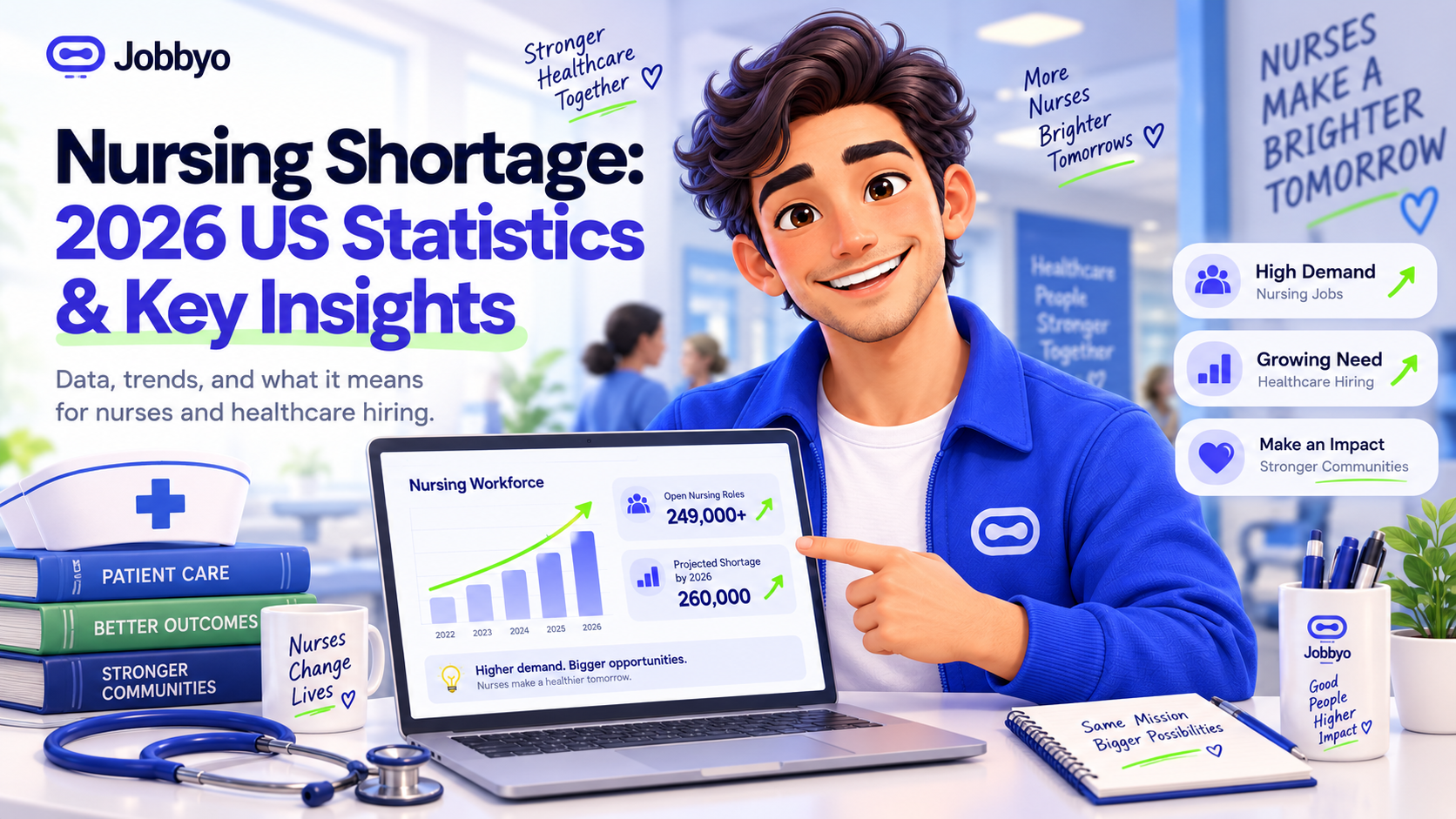
Nursing Shortage 2026: US Hiring Signals Career Changers Should Watch
The US nursing shortage is a hiring signal. Do not turn it into a fantasy.
It does not mean every hospital is hiring for every role. It does not mean a former SaaS manager can walk into a clinical job. It does mean one thing worth taking seriously in 2026: healthcare employers still have hard staffing problems tied to patient care, licensing, scheduling, documentation, compliance, claims, and operations.
If you were laid off from tech, finance, HR, customer success, product, or analytics, pay attention. The opening may not be bedside nursing. It may be the work sitting next to nursing: care coordination, patient access, revenue cycle, workforce analytics, clinical recruiting, EHR support, payer operations, or healthtech implementation.
A shortage is not an offer letter. It is a map of pressure points.
What the 2026 nursing shortage means
The nursing shortage is the gap between the nurses healthcare employers need and the qualified nurses available in a given location, specialty, shift, or care setting.
The causes are not mysterious:
- More older patients need care.
- Experienced nurses retire or leave bedside roles.
- Burnout pushes clinicians out of high-stress units.
- Nursing schools face limits on faculty, classroom space, and clinical placements.
- Rural facilities, long-term care providers, emergency departments, behavioral health units, home health agencies, and critical care teams often face sharper staffing pressure.
- Employers compete for nurses who already have licenses, specialty experience, and shift flexibility.
Do not read the shortage as one clean national story. A rural hospital, a long-term care facility, a major academic medical center, and a home health agency can all have different staffing problems. Wages, state licensing rules, local housing costs, patient volume, specialty mix, and weekend or overnight coverage all change the picture.
For a job seeker, the useful question is not whether healthcare is hiring. That is too vague. Ask this instead: which employers in my target market keep hiring, for which roles, under which requirements, and with what level of training support?
Why this matters if you are changing careers
When a health system cannot staff enough nurses, the strain spreads.
Nurses need scheduling support. Patients need intake and follow-up. Managers need workforce reports. Clinics need referral coordinators. Hospitals need documentation help, payer communication, denial management, credentialing, onboarding, quality reporting, and software support.
That is where non-clinical candidates can compete.
A laid-off customer success manager might look at patient engagement, member services, healthtech implementation, provider account management, or care navigation support. A finance professional might target revenue cycle, payer analytics, hospital operations, or healthcare FP&A. A data analyst might move toward quality reporting, utilization analytics, claims data, or workforce dashboards. A recruiter or HR partner might shift into clinical talent acquisition, credentialing, or workforce planning.
Healthcare is not recession-proof. Hospitals cut budgets. Healthtech companies miss targets. Insurers restructure. Provider groups freeze roles.
But patient care demand does not move in sync with corporate hiring cycles. That is the signal.
The nursing shortage statistics to track in 2026
Do not build a career plan from one national headline. Use several sources, then compare them against local job postings.
Track these sources:
- BLS Occupational Outlook Handbook and Employment Projections: registered nurses, licensed practical and vocational nurses, nurse practitioners, medical and health services managers, medical assistants, and healthcare support occupations.
- BLS Occupational Employment and Wage Statistics: state and metro-level employment and wage data for clinical and healthcare operations roles.
- HRSA workforce projections: national and regional projections for nursing and other health workforce categories.
- State nursing boards and state workforce centers: license counts, renewal patterns, age distribution, vacancy reports, and state-specific workforce studies.
- AACN updates: nursing school enrollment, faculty shortages, rejected qualified applicants, and clinical training constraints.
- Hospital association reports: labor costs, vacancy rates, rural access problems, unit closures, and staffing strain.
- Employer postings: repeated openings by unit, shift, location, credential, and department.
The best job-seeker signal is repeated, specific hiring behavior. If three hospitals in your area keep posting for emergency department nurses, nurse case managers, patient access reps, schedulers, clinical recruiters, EHR trainers, and revenue cycle analysts, that tells you more than a national average.
Still, repeated postings are not always good news. They can also mean low pay, bad managers, impossible schedules, high turnover, stale requisitions, or ghost jobs. Read the details. Look for posting dates, shift language, required credentials, salary ranges, sign-on incentives, and whether the same job has been recycled for months.
Nursing roles most exposed to the shortage
The pressure is usually strongest where the work requires direct patient care, licensure, specialized judgment, nights, weekends, emotional stamina, or physical endurance.
Common pressure areas include:
- Bedside registered nursing
- Emergency department nursing
- Critical care and ICU nursing
- Long-term care and skilled nursing
- Home health
- Behavioral health
- Primary care support
- Care coordination and case management
- Nurse practitioner roles
- Nurse education and clinical training
The credential matters, but the working conditions matter just as much. Units with heavy patient loads, constant documentation, overnight coverage, short staffing, or high emotional intensity usually fight harder to retain people.
That creates demand for roles that remove friction from care teams: schedulers, workforce analysts, clinical recruiters, credentialing coordinators, EHR trainers, patient access staff, utilization review support, process improvement specialists, and documentation support roles.
Healthcare-adjacent jobs worth targeting
You do not need a nursing license to move closer to healthcare demand. You do need to stop applying like a tourist.
Strong non-clinical lanes include:
- Healthcare operations: clinic operations, practice management, service-line coordination, patient access, scheduling.
- Revenue cycle: billing operations, claims follow-up, denial management, coding support, payer relations.
- Care coordination support: patient navigator, referral coordinator, population health coordinator, member services.
- Healthcare recruiting: nurse recruiting, clinical sourcing, workforce planning, credentialing coordination.
- Healthcare technology: EHR implementation, product support, healthtech customer success, clinical workflow analysis.
- Data and analytics: workforce analytics, quality reporting, claims analytics, utilization reporting, patient experience dashboards.
- Compliance and risk: HIPAA operations, audit support, credentialing, policy coordination, vendor risk.
- Product and marketing: provider enablement, payer solutions, patient engagement platforms, B2B healthtech product marketing.
A project manager from another industry may already know workflow mapping, stakeholder management, reporting, deadlines, and process cleanup. A SaaS implementation specialist may already know user training, adoption problems, messy requirements, and post-launch support. A recruiter may already understand pipeline management, hiring manager alignment, candidate communication, and compliance-sensitive workflows.
The problem is translation. A hospital hiring manager may not care that you supported enterprise software accounts. They may care that you handled urgent escalations, documented handoffs, trained users, protected sensitive information, and kept service teams moving under pressure.
Your resume has to make that connection fast.
How to rewrite your experience for healthcare roles
Do not open with a plea about breaking into healthcare. Open with the problem you can solve.
Use healthcare-relevant proof:
- Managed enterprise customer escalations → handled urgent stakeholder issues in regulated, service-critical environments.
- Built sales dashboards → created reporting workflows for capacity planning, response time, and operational visibility.
- Implemented SaaS tools → mapped workflows, trained users, supported adoption, and documented requirements across complex teams.
- Managed recruiting pipelines → built candidate workflows for hard-to-fill roles with compliance steps and multiple decision-makers.
- Reduced support backlog → improved intake, triage, follow-up, and service response in a high-volume environment.
Healthcare employers look for accuracy, confidentiality, documentation, empathy, compliance awareness, and follow-through. If your resume only says fast-paced, cross-functional, strategic, and results-driven, it sounds like every other resume in the pile.
Show the concrete behavior instead: protected sensitive data, coordinated handoffs, reduced errors, improved turnaround time, trained users, resolved escalations, documented workflows, or supported regulated customers.
Should you become a nurse in 2026?
Maybe. But do not treat nursing like a quick career hack.
Nursing can be stable, meaningful, and high-impact. It also requires education, licensing, clinical training, physical stamina, emotional resilience, and direct responsibility for patient care.
Before you choose that path, check:
- State education requirements
- Program cost
- Time to complete prerequisites and clinical hours
- Clinical placement availability
- NCLEX and licensing steps
- Typical shifts for new graduates
- Specialty options
- Burnout risk
- Income needs while training
- Advancement paths after licensure
For some people, the RN path is the right move. For others, a healthcare-adjacent role is the cleaner pivot because it uses existing experience in operations, analytics, product, finance, recruiting, compliance, or customer-facing work.
The best move is not the one that sounds safest in a headline. It is the one that fits your skills, money timeline, retraining tolerance, and actual local market.
How to search without wasting months
Do not spray applications across every job with healthcare in the title. That is just a new version of the same ATS black hole.
Use a tighter search:
- Pick one lane: provider operations, payer operations, healthtech, analytics, revenue cycle, recruiting, compliance, or clinical training support.
- Pick a geography, especially if the role depends on state rules, patient sites, hybrid work, or local licenses.
- Ignore vague evergreen postings unless you can verify active hiring.
- Remove stale posts that have been recycled for months with no detail.
- Tailor your resume to the role without pretending to have clinical credentials.
- Prioritize postings that name a department, shift, system, patient population, payer process, or software platform.
- Prepare a career-change explanation that connects your old work to a healthcare problem.
A strong pivot resume makes a hiring manager think: this person may be new to healthcare, but they understand our operating environment.
A generic resume does the opposite.
How Jobbyo helps with healthcare and nursing-adjacent roles
Jobbyo helps job seekers target better-fit roles instead of burning hours on low-quality postings.
For a healthcare pivot, that matters. The right job may be patient access coordinator, healthtech implementation specialist, clinical recruiter, revenue cycle analyst, care operations associate, workforce analyst, or member services manager. It may not have nurse in the title at all.
Jobbyo can help tailor resumes and cover letters to each posting, filter out stale or low-fit jobs, and apply automatically or with review depending on your plan. That is useful when you need every application to connect your transferable skills to the employer's real requirements.
The nursing shortage is a real labor-market signal. It is not a shortcut. The candidates who benefit will be the ones who read the data, target active openings, and translate their experience clearly.
If you want to test healthcare-adjacent roles without turning your week into an application marathon, start your free trial with Jobbyo.