9 min read
IT Recruitment Trends 2026: How AI Is Changing Tech Hiring
AI is reshaping IT recruiting in 2026. Learn how skills-based matching changes resumes, portfolios, keywords, and applications.
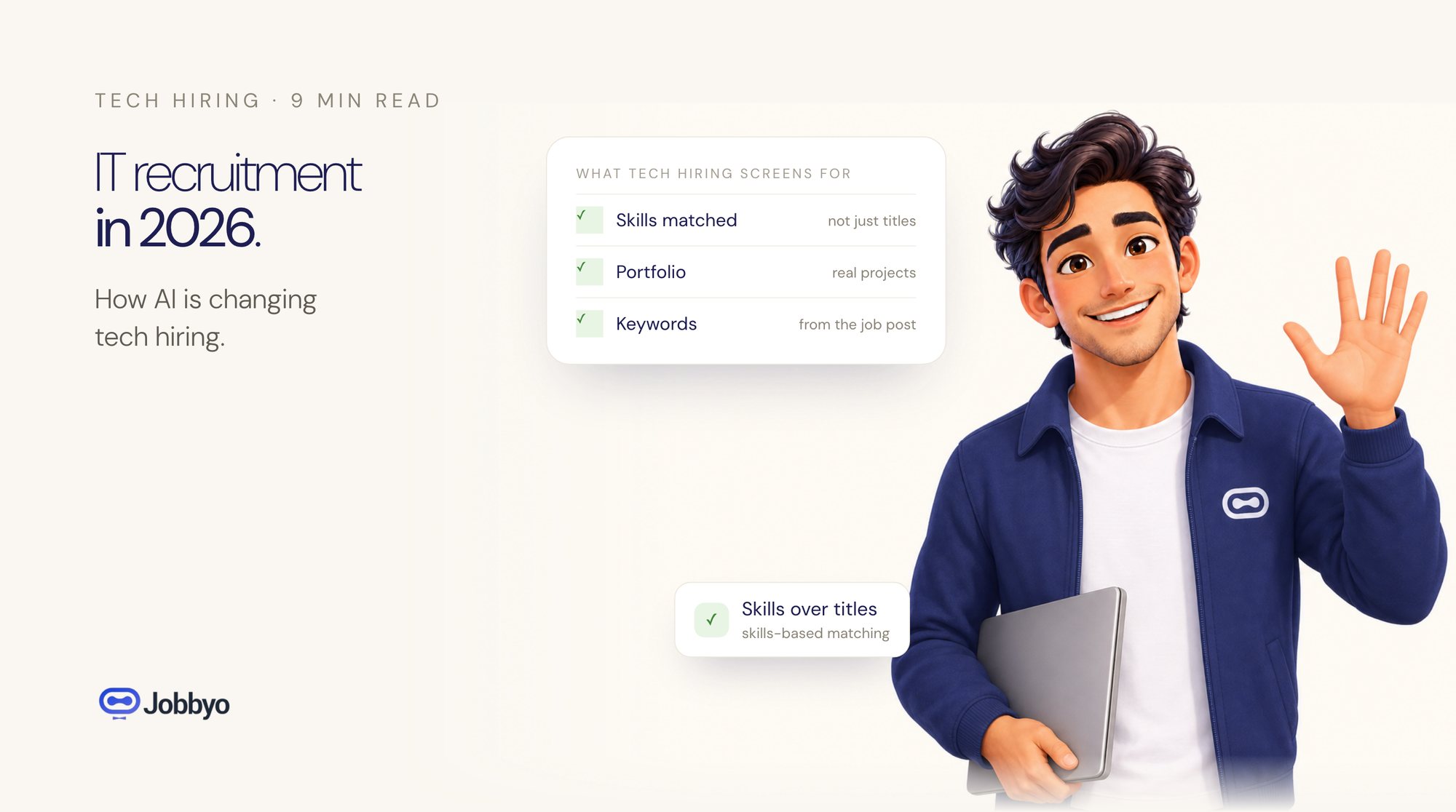
By 2026, many tech candidates will not lose because they are unqualified. They will lose because their resume, LinkedIn profile, portfolio, or job-board profile gives recruiting software a blurry version of them.
AI-assisted sourcing, screening, and skills matching are already inside the hiring stack. The point is not that a robot is hiring you. The point is harsher: at many companies, software helps decide which candidates a recruiter looks at first.
That changes the job search for IT candidates. A long list of tools is no longer enough. The stronger signal is proof: the right skill, used in the right setting, for the role you actually want.
The 2026 shift: from job titles to evidence
Tech recruiting is moving away from simple title matching and toward skills, context, and proof of work.
Recruiting teams are using AI tools to:
- Search resume databases and LinkedIn profiles by skills, projects, and role context
- Compare applications with job requirements
- Summarize candidate profiles for recruiters
- Draft outreach to passive candidates
- Spot adjacent skills for career changers and internal transfers
- Cut down manual screening before interviews start
That does not remove humans from hiring. It changes what humans receive. If the system summarizes you badly, misses your strongest experience, or cannot connect your background to the job, you may never reach the shortlist.
For IT candidates, the practical rule is simple: make your materials readable by software and convincing to people.
Four 2024 recruiting-tech moves that point to 2026
The direction is already visible in public product announcements from LinkedIn, Workday, Indeed, and HiredScore.
LinkedIn Hiring Assistant
News: On October 29, 2024, LinkedIn announced Hiring Assistant, calling it its first AI agent for recruiters. LinkedIn said the product helps recruiters turn hiring goals into candidate searches, surface applicants, and handle repetitive recruiting work.
Why candidates should care: LinkedIn is already a primary sourcing channel for engineers, analysts, product managers, cybersecurity professionals, data specialists, and SaaS operators. If recruiter search becomes more AI-assisted, a vague profile becomes expensive. Past job titles alone will not carry you.
Do this: Make the target role obvious. If you want data engineering roles, your headline, About section, experience, and skills should show data pipelines, ETL, Airflow, Spark, SQL optimization, and cloud data platforms in real work context. Do not write 'worked on data initiatives' when you mean 'built and maintained batch pipelines in Airflow.'
Workday Illuminate and Recruiter Agent
News: On September 17, 2024, Workday announced Workday Illuminate, its next generation of AI capabilities, including AI agents for HR and finance. Workday described recruiting-related agents as tools intended to support recruiter productivity and candidate work.
Why candidates should care: Workday is used by many enterprise employers, including companies hiring large IT teams. When AI is embedded inside the HR platform, your application has to be easy to parse and easy to summarize.
Do this: Use standard resume headings, clean formatting, clear dates, specific tools, and bullets tied to technical or business outcomes. Skip graphics-heavy templates. Skip unexplained acronyms. If a system is going to summarize your background, give it concrete material: systems migrated, tickets reduced, dashboards built, incidents handled, costs cut, deployments improved.
Indeed Smart Sourcing
News: In May 2024, Indeed announced Smart Sourcing, an AI-powered sourcing product designed to help employers find and contact candidates.
Why candidates should care: Job boards are moving beyond basic keyword search. Recruiters are being pushed toward candidates who look aligned by skills, experience, availability, location, and role fit.
Do this: Keep job-board profiles current. State your target role. State remote, hybrid, relocation, state, or time-zone limits clearly. If you want Python backend roles, do not let your profile read like a general IT support profile.
Workday acquired HiredScore
News: Workday completed its acquisition of HiredScore on April 2, 2024. HiredScore focused on AI-powered talent orchestration, including candidate matching and internal mobility.
Why candidates should care: Enterprise hiring platforms are investing in systems that compare people to roles at scale. That affects external applicants and employees trying to move into technical teams.
Do this: Spell out transferable skills. A finance candidate moving into data analytics should connect forecasting, variance analysis, SQL reporting, dashboards, stakeholder reporting, and decision support to analytics job requirements. Do not assume a recruiter, manager, or algorithm will build that bridge for you.
How recruiters will search for IT candidates in 2026
Title and keyword search will still exist. Boolean is not dead. But AI-assisted search lets recruiters describe the work they need done.
A recruiter may not search only for AWS DevOps Engineer Kubernetes Terraform. They may ask for someone who can manage AWS infrastructure, improve CI/CD reliability, support Kubernetes in production, and partner with security on cloud risk.
That is bad news for resumes built like tool dumps.
Weak signal:
- AWS, Azure, GCP, Kubernetes, Docker, Jenkins, GitHub Actions, Terraform, Ansible, Python, Bash
Stronger signal:
- Built Terraform modules for AWS infrastructure used by application teams
- Improved deployment reliability with GitHub Actions and automated rollback checks
- Worked with security teams to remediate cloud configuration risks
- Supported Kubernetes workloads in production environments
The second version still has the keywords. It also shows ownership, setting, and evidence.
Build the resume around the target role, not your entire life story
A 2026 IT resume needs to answer one question quickly: why this person for this role?
Use these five pieces.
- Target-role headline
Say what you are aiming for: Cloud Security Engineer, Data Engineer, Salesforce Administrator, B2B SaaS Product Marketing Manager, or Frontend Engineer with React and TypeScript.
- Focused skills section
Group tools by category: languages, frameworks, cloud, data tools, security tools, CRM platforms, analytics, product methods, or design tools. Do not list every tool you opened once in 2019.
- Proof-based bullets
Each bullet should show what you built, automated, migrated, secured, analyzed, designed, launched, or improved. If there is a number, use it. If there is no safe number, use scope: user group, system type, team size, environment, frequency, or business function.
- Role-specific language
Mirror the job description honestly. If you have handled incident response and the job asks for incident response, use that phrase. Do not bury it under 'handled urgent technical issues.'
- Transferable-skill translation
Career changers need to make the connection explicit. A finance-to-tech candidate should not stop at budgeting. Better: forecasting, variance analysis, SQL reporting, executive dashboards, and data-backed planning.
This is not about gaming AI. It is about making the match hard to miss.
LinkedIn, GitHub, and portfolios need to tell the same story
Your resume may get you into the search results. Your proof decides whether you look serious.
That matters for software engineers, data professionals, UX/UI designers, cybersecurity candidates, technical product managers, and SaaS marketers. When AI makes more candidates look findable, evidence becomes the filter.
Update your public materials with:
- Plain-English project summaries
- The problem, your role, the tools, and the outcome
- Screenshots, architecture diagrams, dashboards, or case studies when appropriate
- GitHub repositories with readable README files
- Working links that do not require guessing or special access
- Notes that clarify whether the work was professional, academic, freelance, or personal
If your work is confidential, do not leak details to look impressive. Senior and executive candidates can show scope without exposing sensitive information: budget range, team size, system type, risk level, industry, region, or operating model.
How to apply when software may screen first
Treat every application as if a system will parse it before a recruiter reads it.
That does not mean mass-applying to 300 bad-fit jobs. AI screening can reject weak matches faster than a person can. The better approach is targeted volume: apply consistently, but only where your background can credibly map to the role.
Before you apply, check:
- Is the role I want visible in the top third of the resume?
- Are the required tools and skills easy to find?
- Do my bullets prove those skills in context?
- Does LinkedIn match the resume, or does it tell a different story?
- Does my portfolio support the same target role?
- Is the posting current, real, and worth the time?
- Will salary, location, remote eligibility, or work authorization cause problems later?
Many candidates waste hours on roles that are stale, underpaid, location-restricted, or barely related to their background. That is not persistence. That is leakage.
What career changers should do differently
Career changers cannot rely on recruiters to connect the dots.
AI matching may get better at spotting adjacent skills, but it still needs evidence. If you are moving into IT, data, product, cybersecurity, UX, or SaaS marketing, translate your old work into the language of the new role.
Examples:
- Finance to data analytics: forecasting, SQL, dashboards, variance analysis, stakeholder reporting
- Customer support to cybersecurity: ticket triage, incident documentation, access control, risk escalation
- Operations to product: workflow mapping, user pain points, process improvement, requirements gathering
- Marketing to RevOps: funnel analysis, CRM hygiene, attribution, automation, reporting
Do not brand yourself as 'aspiring' if you already have relevant evidence. Lead with the part of your background that maps to the work.
The smarter 2026 IT job search
A strong 2026 job search starts with a narrower target and better materials.
Use this workflow:
- Pick one target role or a tight role family
- Collect current job descriptions from companies you would actually consider
- Mark the repeated tools, skills, responsibilities, and outcomes
- Rewrite the resume around those patterns
- Update LinkedIn, GitHub, portfolio, and case studies to support the same story
- Apply to fresh, relevant roles
- Track response quality, not just application count
- Use the saved time for networking and interview prep
Jobbyo fits this model. It helps audit and tailor applications to the role, customize resumes and cover letters, apply automatically or with review, and filter out ghost or stale postings that waste time.
AI-assisted recruiting is not waiting for 2026. It is already in the stack. By 2026, sloppy materials will simply get punished faster. The candidates who adapt will not be the loudest applicants. They will be the clearest matches.
Put this to work
Let Jobbyo find your
best matches for you.