13 min read
ChatGPT Cover Letter Prompts: 5 That Work, Plus Fixes Before You Send
Use 5 role-specific ChatGPT cover letter prompts, plus quick fixes for generic AI drafts before you send your next application.
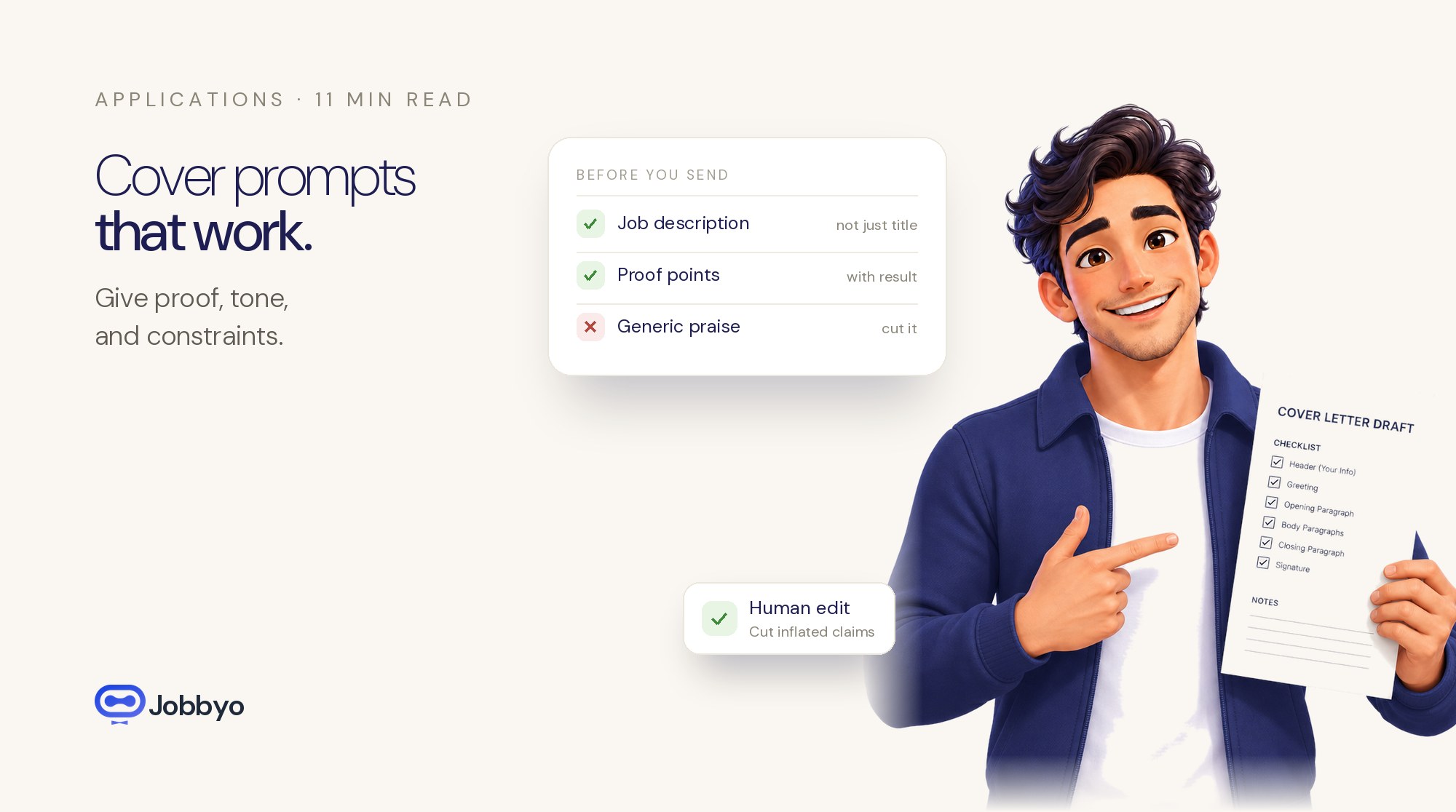
A useful ChatGPT cover letter prompt does not ask for a nice letter. It gives the model raw material: the job description, the company or team problem, your proof, and the tone you can defend in an interview.
If you give ChatGPT one sentence, you get filler. If you give it a role, an outcome, and evidence, you get a draft worth editing.
Use the five prompts below for the situations where cover letters usually go wrong: weak openings, full tailored drafts, career pivots, resume gaps, layoffs, and tone cleanup. Each section gives you the problem, the exact prompt, why it works, and what to cut before you send.
What makes a ChatGPT cover letter prompt work?
A strong prompt gives ChatGPT four inputs:
- The job description, not just the job title.
- Your relevant experience, not your entire life story.
- The employer’s likely outcome: lower churn, cleaner reporting, faster onboarding, stronger pipeline, safer infrastructure, better compliance.
- Tone and length constraints, because cover letters die when they ramble.
Most bad AI cover letters open like this:
I am excited to apply for this role because I am passionate about contributing to your team.
That sentence could be sent to a hospital, a SaaS company, a school district, or a bank. It proves nothing.
A better letter earns the reader’s attention in the first few lines. It names the role, points to the work that matters, and shows one piece of evidence from your background. Not your whole resume. One strong reason to keep reading.
Treat ChatGPT as a drafter, not a witness. It can organize your material. It cannot verify your metrics, your tools, your job history, or the company’s priorities. You still have to cut the inflated parts.
1. Prompt for a stronger cover letter opening
Problem
Your opening paragraph sounds interchangeable. It tells the hiring manager you are interested, but it does not show that you understand the job.
Exact prompt
Write 3 different opening paragraphs for a cover letter for the role below.

Job title: [PASTE JOB TITLE]
Company: [PASTE COMPANY NAME]
Job description: [PASTE JOB DESCRIPTION]
My most relevant background: [PASTE 3-5 RESUME BULLETS OR A SHORT SUMMARY]
Company or team priority I want to address: [PASTE WHAT THIS ROLE SEEMS HIRED TO SOLVE — FOR EXAMPLE: REDUCE CHURN, SCALE INFRASTRUCTURE, LAUNCH AN ENTERPRISE PRODUCT, IMPROVE REPORTING, GROW PIPELINE]

Requirements:
- Do not use the phrase 'I am excited to apply'.
- Do not use generic praise about the company.
- Make the opening specific to the role and the business outcome.
- Keep each version under 90 words.
- Use a direct, confident, human tone.
- Include one concrete proof point from my background in each version.
Why it works
Hiring teams already know you want the job. You applied.
The opening has a different job: show that you understand why the role exists. A customer success role may be about retention. A data analyst role may be about reporting accuracy. A platform engineering role may be about uptime, migrations, or developer velocity.
Asking for three versions gives you options. One draft may have the cleanest angle. Another may have the best first sentence. The third may show you what sounds too polished to trust.
How to edit the output
Replace soft language with the actual outcome.
Cut phrases like:
- drive results
- support business goals
- contribute to growth
- bring value to the team
Use concrete language instead:
- shorten onboarding time
- improve forecast accuracy
- increase trial-to-paid conversion
- reduce manual Salesforce cleanup
- stabilize cloud infrastructure during migration
Then check the verbs. If ChatGPT says you led a project you only supported, change led to supported, built, analyzed, coordinated, or contributed to. A precise claim beats an inflated one.
2. Prompt for a full tailored cover letter
Problem
You need a complete draft, but a one-line request gives you a polished block of nothing. It repeats your resume, compliments the company, and never makes a case.
Exact prompt
Write a tailored cover letter for this role using the information below.

Job title: [PASTE JOB TITLE]
Company: [PASTE COMPANY NAME]
Job description: [PASTE FULL JOB DESCRIPTION]
My resume or relevant experience: [PASTE RESUME TEXT OR THE MOST RELEVANT SECTIONS]
My strongest 3 proof points for this role:
1. [PROOF POINT WITH RESULT OR SCOPE]
2. [PROOF POINT WITH RESULT OR SCOPE]
3. [PROOF POINT WITH RESULT OR SCOPE]
What I want the hiring manager to believe after reading: [FOR EXAMPLE: I CAN STEP INTO A HIGH-AMBIGUITY PRODUCT MARKETING ROLE AND TURN CUSTOMER INSIGHTS INTO LAUNCHES THAT SUPPORT PIPELINE]

Instructions:
- Write 250-350 words.
- Use 4 short paragraphs.
- Paragraph 1: connect my background to the role’s main business problem.
- Paragraph 2: show the strongest evidence from my experience.
- Paragraph 3: explain why this company and role are a logical fit without generic flattery.
- Paragraph 4: close with confidence and a clear next step.
- Do not repeat my resume line by line.
- Do not invent metrics, employers, tools, certifications, or achievements.
- Keep the tone professional, direct, and not overly enthusiastic.
Why it works
The prompt gives ChatGPT a persuasion target. Instead of writing a pleasant cover letter, it has to make the hiring manager believe one specific thing.
The proof points do most of the work. If you do not provide evidence, the model has two bad choices: stay vague or make up impressive details. Both weaken the application.
This structure also keeps the letter from becoming a resume in paragraph form. The resume lists history. The cover letter should explain fit.
How to edit the output
Cut any sentence that could appear in another candidate’s letter.
Keep sentences that mention:
- a requirement from the job posting
- a tool, market, customer type, regulation, or workflow from the role
- a result, scope, or example from your background
- a reason the role makes sense at this point in your career
Then compare the draft against the job description. If the posting emphasizes stakeholder management, compliance, enterprise sales, Python pipelines, Salesforce administration, UX research, or customer onboarding, the letter should reflect that priority. Not all of them. The ones the job clearly cares about.
3. Prompt for a career change or pivot
Problem
You are moving into a new function or industry, and your resume does not look like the obvious match. The cover letter needs to translate your experience without sounding defensive.
Exact prompt
Help me write a cover letter section that explains my career pivot clearly and confidently.

Target role: [PASTE TARGET ROLE]
Target industry or function: [PASTE TARGET INDUSTRY OR FUNCTION]
Job description: [PASTE JOB DESCRIPTION]
My previous role or background: [PASTE CURRENT OR PAST ROLE]
Transferable skills that matter for this job: [PASTE 3-5 SKILLS]
Relevant projects, wins, or training: [PASTE EXAMPLES]
What I do NOT want to sound like: apologetic, inexperienced, or vague

Write 2 versions:
1. A short paragraph for a cover letter.
2. A slightly more detailed version for an email to a recruiter.

Requirements:
- Lead with transferable value, not with the fact that I am changing careers.
- Connect my past experience to the target role’s outcomes.
- Avoid the phrase 'Although I lack experience'.
- Do not overstate my background.
- Keep the tone practical and confident.
Why it works
Career changers often open with the gap. That is the wrong order.
A line like 'Although I am new to this industry' makes the reader think about risk before value. Lead with the skill that travels: analysis, stakeholder management, customer education, process improvement, technical troubleshooting, operations, writing, training, or leadership under pressure.
This matters for common pivots: finance to tech, operations to product, teaching to customer success, agency marketing to B2B SaaS, or military leadership to corporate operations.
How to edit the output
Delete any sentence that asks the employer to take a chance on you. Replace it with evidence.
Weak version:
I am eager to bring my unique background into this new field.
Stronger template:
My background in [PAST FIELD] trained me to [TRANSFERABLE SKILL], which maps to this role’s need for [TARGET OUTCOME OR RESPONSIBILITY].
Example:
My background in financial analysis trained me to turn messy data into decisions, which maps to this role’s focus on customer segmentation and revenue reporting.
Do not hide the pivot. Make it make sense.
4. Prompt for an employment gap, layoff, or time away
Problem
You were laid off, took time for caregiving, had a health break, relocated, finished a contract, or stepped away from work. You need to address the gap without letting it take over the letter.
Exact prompt
Write a brief, professional cover letter paragraph that addresses an employment gap or layoff without making it the focus.

Target role: [PASTE TARGET ROLE]
Job description: [PASTE JOB DESCRIPTION]
My situation: [BRIEFLY EXPLAIN — FOR EXAMPLE: COMPANY-WIDE LAYOFF, CAREGIVING BREAK, HEALTH BREAK, RELOCATION, CONTRACT ENDED]
Length of gap if relevant: [PASTE TIMEFRAME OR WRITE: DO NOT MENTION]
What I did during the gap, if relevant: [COURSES, FREELANCE WORK, VOLUNTEERING, PORTFOLIO PROJECTS, CERTIFICATIONS, NETWORKING, INTERVIEWING]
Most relevant experience for this job: [PASTE 3-5 BULLETS]

Requirements:
- Keep it under 80 words.
- Do not sound apologetic.
- Do not overshare personal details.
- Transition quickly back to my fit for the role.
- Do not use the phrase 'career break' unless it sounds natural.
- Give me 3 versions with different tones: neutral, confident, and warm.
Why it works
A gap explanation should remove uncertainty, not become the story.
You do not owe a hiring manager a memoir. You owe them a clear, professional line if the gap is likely to raise a question. The best version is usually short, calm, and followed immediately by evidence that you can do the job.
Asking for three tones helps you avoid overcorrecting. Neutral is usually safest. Warm can work for people-centered roles or companies with a more personal culture. Confident works when the layoff or contract ending was straightforward and recent.
How to edit the output
Cut anything that sounds like a justification spiral.
A practical version can be this short:
After a company-wide layoff, I used the transition period to sharpen my analytics portfolio and focus on roles that combine revenue operations experience with hands-on dashboard development.
That line gives context, shows momentum, and returns to the job. No apology. No oversharing.
5. Prompt for fixing the tone of an AI cover letter
Problem
The draft has usable facts, but the voice is wrong. It sounds robotic, inflated, too eager, too stiff, or too junior for the role.
Exact prompt
Revise this cover letter for tone without changing the facts.

Target role: [PASTE TARGET ROLE]
Company: [PASTE COMPANY NAME]
Seniority level: [PASTE LEVEL — FOR EXAMPLE: ASSOCIATE, MANAGER, DIRECTOR, STAFF ENGINEER, VP]
Preferred tone: [CHOOSE: DIRECT, WARM, EXECUTIVE, CONCISE, TECHNICAL, CONSULTATIVE, UNDERSTATED]
Cover letter draft: [PASTE DRAFT]

Revision rules:
- Keep all facts accurate.
- Do not add new achievements or metrics.
- Remove generic phrases and overused AI wording.
- Make the language sound like a real professional wrote it.
- Keep it under [PASTE WORD COUNT].
- Make the confidence level appropriate for the seniority of the role.
- After revising, list the 5 biggest changes you made and why.
Why it works
Sometimes the problem is not structure. It is credibility.
A director-level candidate should not sound breathless. A staff engineer should not sound like a motivational poster. A technical specialist should use precise nouns and tools. A customer-facing candidate can sound warmer, but still needs evidence.
This prompt turns ChatGPT into an editor. That is usually safer than asking it to invent a letter from scratch.
How to edit the output
Read the letter out loud. If a sentence would sound fake in an interview, rewrite it.
Watch for phrases like:
- I am thrilled to submit my application
- My diverse background uniquely positions me
- I am confident I would be an asset
- In today’s fast-paced environment
- I have a proven track record
Those phrases are not illegal. They are just tired, and they usually arrive without proof. Replace them with plain language and evidence.
Instead of:
I have a proven track record of driving cross-functional results.
Use:
I have managed launches across product, sales, and customer success teams, including [PASTE SPECIFIC LAUNCH, MARKET, CUSTOMER SEGMENT, OR RESULT].
Four checks before you send an AI-generated cover letter
1. Cut fake specificity
AI loves sentences that sound targeted but say nothing.
Weak:
I admire your commitment to innovation.
Better template:
Your move toward [SPECIFIC MARKET, PRODUCT, CUSTOMER TYPE, OR OPERATING PRIORITY] is relevant to me because my background includes [SPECIFIC RELATED WORK].
If you cannot name the company priority, do not pretend you studied it. Focus on the role requirements instead.
2. Verify every fact
ChatGPT can invent tools, numbers, responsibilities, certifications, employers, and company details. It can also upgrade your role without permission.
Check every claim against your resume, LinkedIn profile, portfolio, and actual work history. If you cannot defend the sentence in an interview, delete it.
A true but modest claim beats a shiny exaggeration.
3. Match the role’s real priorities
Do not write a leadership letter for a hands-on execution role. Do not write a creativity letter for a compliance role. Do not spend half the page on strategy if the posting is asking for ticket resolution, SQL queries, call coaching, or month-end close.
Use the job description as a ranking system. The top responsibilities deserve the most space.
4. Make it shorter
Most cover letters improve after a 20 percent cut.
Remove throat-clearing. Remove company flattery. Remove any paragraph that only says you are interested, passionate, impressed, or eager. Keep the evidence.
A strong 230-word letter is better than a padded 500-word letter.
ChatGPT or an AI job search assistant?
Use ChatGPT when you are working on one application and you have the job description, your resume, and enough judgment to edit the output.
Use an AI job search assistant when the bottleneck is volume and repetition. Jobbyo tailors the resume, cover letter, and application for each role, then applies automatically or with your review depending on your workflow.
That distinction matters. Job searching is writing, but it is also finding live openings, avoiding stale or ghost postings, tailoring materials, tracking applications, networking, and preparing for interviews. If manual tailoring is draining the hours you need for higher-value work, automation can help.
The best way to use these prompts
Pick one role you actually want. Paste the job description into the prompt that matches your problem: opening, full draft, pivot, gap explanation, or tone cleanup.
Then edit with a hard rule: every claim must be true, specific, and relevant to the role.
If you are applying to a small number of carefully chosen jobs, these prompts can help you produce sharper letters faster. If you are applying across dozens of roles and need the resume, cover letter, and application tailored each time, Jobbyo can handle that workflow automatically.
Put this to work
Let Jobbyo find your
best matches for you.