Best AI Job Search Tools in 2026, Compared
LazyApply, Sonara, AIApply, Jobright, Simplify, and Jobbyo all promise to fix your job search with AI. Here's an honest look at what each one actually does, what it costs, and which type of job seeker it fits.
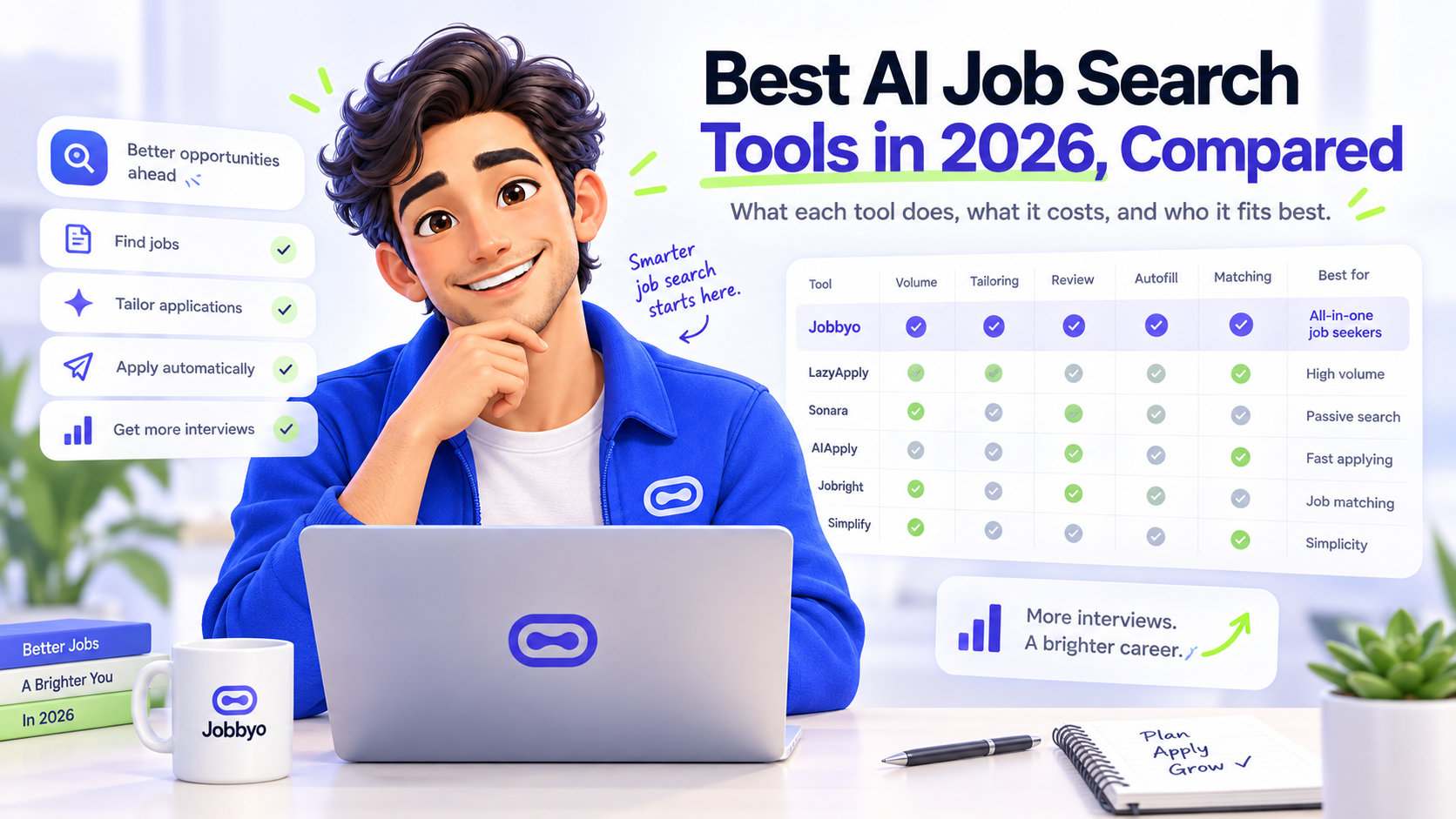
Best AI Job Search Tools in 2026, Compared
"AI job search tool" has become a crowded category, and the tools in it don't all do the same thing. Some are built to submit as many applications as possible, as fast as possible. Others are built to slow you down just enough to make each application count. Neither approach is automatically right — it depends on what's actually holding your search back.
Here's a straightforward comparison of six tools people search for most, including where we think each one genuinely earns its place and where it falls short.
What these tools are actually solving for
Before comparing features, it helps to separate two different problems people lump together as "the job search is broken":
- Volume problem: You're not applying to enough roles, or filling out repetitive application forms is eating your time.
- Quality problem: You're applying plenty, but your materials aren't tailored enough to get past the applicant tracking system or catch a recruiter's attention.
Auto-apply tools solve the first problem. Tailoring tools solve the second. Most job seekers actually have some of both, which is why picking the right tool means being honest with yourself about which one is really costing you interviews.
The tools, compared
| Tool | Best for | Core approach | Starting price |
|---|---|---|---|
| LazyApply | Maximum volume, minimum cost | Chrome extension bulk-applies via LinkedIn Easy Apply, Indeed, ZipRecruiter with templated answers | One-time payment, roughly $99+ |
| Sonara | Hands-off, high-volume applying | Autopilot scans postings and auto-submits applications on your behalf | ~$24/month, or ~$6/month billed annually |
| AIApply | All-in-one drafting toolkit | AI resume builder, cover letters, interview prep, plus semi-automated applying | Free tier; paid plans roughly $30-49/month |
| Jobright | AI-assisted matching and tailoring | Job matching scored against your resume, per-job tailoring, assisted auto-fill | Free tier; Pro roughly $30/month |
| Simplify | Free autofill and tracking | Browser extension autofills applications and tracks your pipeline; you still submit manually | Free tier; paid tier for expanded matching |
| Jobbyo | Tailored applications with human review | AI matches, tailors resume/cover letter, and drafts each application — you approve before anything sends | Starter/Premium/Max plans, weekly or quarterly billing |
Pricing changes often in this category, so treat these as directional rather than exact — check each vendor's site before you commit.
LazyApply
LazyApply is built for one thing: applying to as many jobs as possible, as fast as possible, for a one-time fee instead of a subscription. If your bottleneck is genuinely time — you know what roles you want, you just can't fill out fifty forms a day — it's a reasonable, cheap option.
The tradeoff is real, though. Answers to screening questions are generic and reused across applications, there's no resume tailoring, and heavy Easy Apply automation can bump against LinkedIn's terms of service. Users generally describe it as effective at volume and weak at relevance.
Sonara
Sonara takes a similar autopilot approach but as a subscription product with a more polished interface. It scans postings continuously and submits applications without much manual input, which appeals to people who want the process to run in the background.
The most consistent complaint is match quality — several users report a large share of auto-applied jobs weren't actually relevant to their background, which means the applications flying out under your name may not represent you well. There's also no cover letter generation, so anything requiring a written pitch still falls on you.
AIApply
AIApply leans into being a full toolkit rather than just an apply button: resume builder, tailored cover letters, interview prep, and assisted applying in one product. For someone who wants AI help across the whole process, not just submissions, it's one of the more complete options.
The common criticism is that quality drops at high volume without manual review, and users report frequent upgrade prompts and unclear billing. If you use it deliberately — for a handful of well-chosen roles rather than mass output — the drafting tools are genuinely useful.
Jobright
Jobright focuses on matching first: it scores roles against your resume and helps you understand why a job is or isn't a fit before you apply, along with per-job resume tailoring aimed at ATS filters. Its free tier is generous enough to test before paying.
Feedback is mixed-to-positive — people like the matching and tailoring, but note the automation is more "assisted" than fully hands-off, meaning you're still doing real work per application. Some also flag aggressive upsell prompts toward the paid tier.
Simplify
Simplify is the closest thing to a free utility on this list: a browser extension that autofills applications and tracks your pipeline, with a well-regarded Chrome extension and large existing user base. It doesn't pretend to be a full auto-apply tool — you review and submit every application yourself, which some job seekers will actually prefer.
It's a strong pick if your main pain point is the tedium of retyping the same information into every ATS, not the strategy behind which jobs you're targeting or how tailored your materials are.
Jobbyo
Jobbyo's approach is closer to Jobright's matching-and-tailoring model than to LazyApply's or Sonara's pure autopilot, with one deliberate difference: nothing gets submitted without your review first. The AI handles the repetitive parts — finding relevant roles, tailoring your resume and cover letter to each one, drafting the application — but you approve every submission before it goes out.
That's a real tradeoff worth naming honestly. It's slower than a pure auto-apply tool by design, and it costs more than a one-time LazyApply purchase. What it's built to solve is the failure mode we saw across several of the auto-apply-only tools above: applications going out fast but landing on the wrong jobs, or with generic materials that don't hold up to scrutiny. In one documented case, a job seeker's response rate moved from 2% under generic mass-applying to 28% after switching to tailored, reviewed applications — and users report roughly 3x more interview callbacks on average compared to pure auto-apply tools. The Max plan adds human strategy coaching and an interview-within-30-days guarantee for job seekers who want more support than software alone provides.
Which tool actually fits your situation
If you're short on time and comfortable with generic applications going out fast, LazyApply or Sonara will get you the most volume for the least effort — just expect a lower hit rate per application. If you want AI to draft materials but you're doing the applying yourself, AIApply or Simplify are solid, budget-friendly choices depending on whether you want drafting help (AIApply) or just faster form-filling (Simplify). If tailoring and match quality matter more to you than raw volume, Jobright and Jobbyo are the closer fit, with the main difference being how much control you keep before an application goes out — Jobright leans more assisted-DIY, Jobbyo builds the review step into the process itself.
The honest tradeoff: volume vs. tailoring
None of these tools can guarantee an offer, and any product that implies otherwise is overselling. What the data across this category consistently shows is that tailored, reviewed applications outperform generic mass-applying by a wide margin, even when mass-applying produces far more total submissions. If your response rate is the problem, more volume from an untailored tool usually won't fix it — it just produces more silence, faster.
The right tool is the one that matches your actual bottleneck: time, drafting, matching, or review. Most job seekers are better served by fewer, better-targeted applications than by the highest possible submission count, whichever tool gets them there.