8 min read
AI Job Titles Are Expanding Beyond Tech. Here’s How to Use That in Your Search
AI-labeled jobs are spreading beyond tech. Learn how to reposition transferable skills for AI-adjacent roles in 2026.
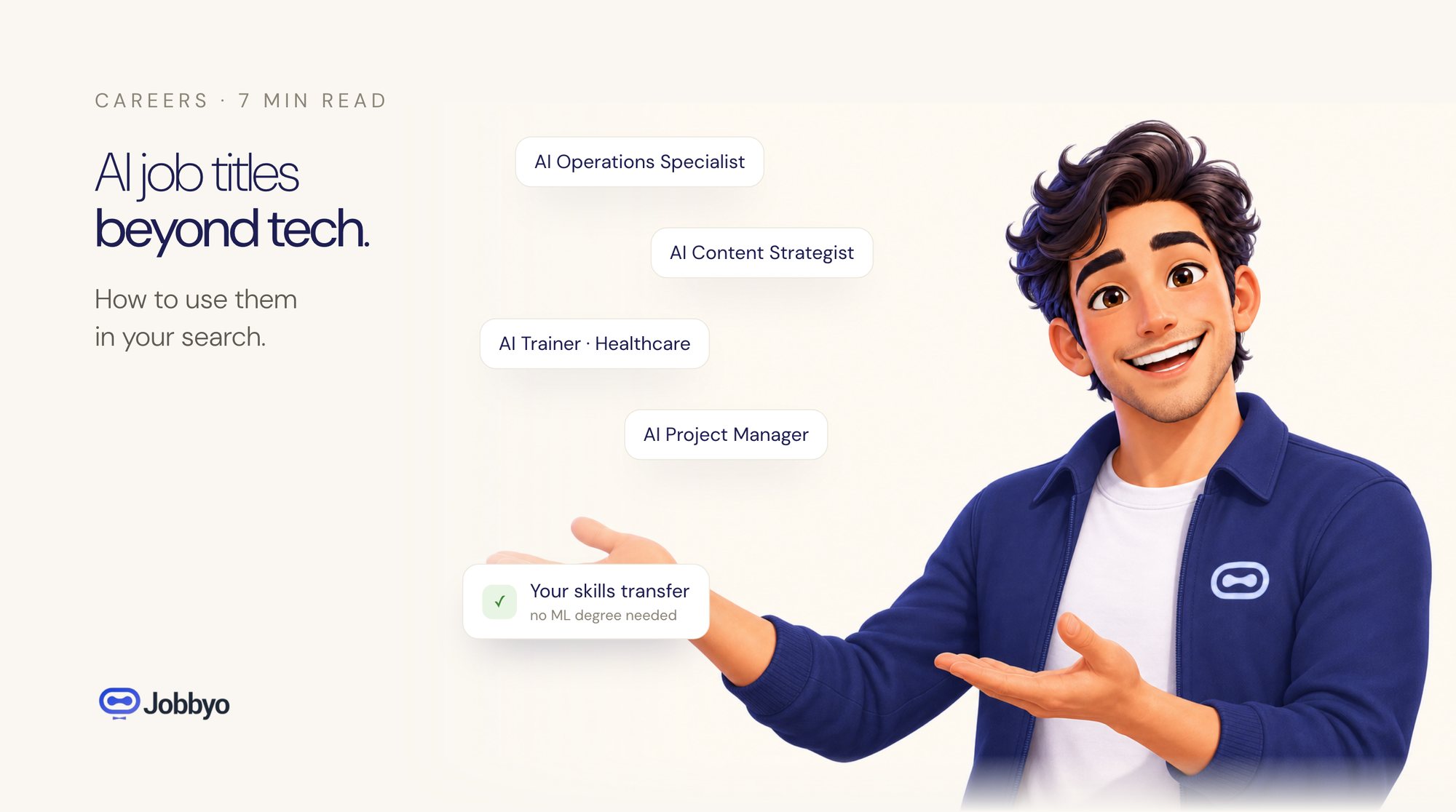
If you are ignoring every posting with “AI” in the title because you are not a machine learning engineer, you may be cutting yourself out of jobs you could actually do.
That does not mean every AI role is secretly easy. Some are deeply technical. If a posting asks for Python, model deployment, data pipelines, cloud infrastructure, evaluation frameworks, or research experience, believe it.
But many newer AI-labeled jobs are not asking you to build a model. They are asking you to use AI inside marketing, operations, customer support, HR, finance, product, sales, compliance, or enablement.
That is a different search strategy.
The surprising fact for 2026
Observed fact: employers are putting “AI” into more job titles across business functions, not only engineering and data teams.
Indeed’s report says companies are adding AI language to titles across a broader mix of roles than the usual software and data jobs. That matters because a title like “AI Operations Manager,” “AI Content Strategist,” or “AI Customer Experience Lead” may sound more technical than the actual work.
An AI Operations Manager may be improving handoffs, documentation, tooling, and reporting. An AI Content Strategist may be building AI-assisted research and review workflows. An AI Customer Experience Lead may be improving ticket triage, knowledge-base quality, and agent response drafts.
None of that is the same as training neural networks.
Forecast: this naming trend will probably spread as more teams try to add AI to ordinary business processes. The title may change faster than the work underneath it.
Why employers are doing this
AI is moving into routine knowledge work.
A marketing team may use AI for campaign research, competitor scans, content briefs, segmentation ideas, creative testing, and performance summaries.
A finance team may use AI to support forecasting, variance analysis, reporting cleanup, anomaly detection, and board-deck preparation.
A support team may use AI for ticket routing, draft replies, call summaries, help-center updates, and escalation patterns.
A product team may use AI to sort customer feedback, summarize interviews, compare feature requests, and speed up discovery notes.
In plain English: the employer may be looking for someone who understands the function and can make AI useful inside it.
That is where good candidates misread the room. An operations manager sees “AI Operations” and assumes “engineer.” A content marketer sees “AI Content” and assumes “data scientist.” A finance analyst sees “AI Strategy” and assumes “PhD.”
Sometimes that caution is correct. Often, it is just self-rejection with better branding.
How to tell whether the role is technical
Read the requirements, not the title.
A technical AI job will usually name technical work directly: Python, SQL, machine learning frameworks, model evaluation, model deployment, data pipelines, vector databases, cloud infrastructure, AI architecture, MLOps, or research publications.
An AI-adjacent business job will usually point to business work: workflow automation, analytics, vendor selection, process improvement, content operations, customer operations, product research, enablement, governance, documentation, training, compliance, or adoption.
If the posting says “build and deploy models,” do not pretend you have done that.
If the posting says “improve support workflows using AI tools,” and you have run ticket queues, written macros, cleaned up help-center content, trained agents, or tracked CSAT drivers, you may have a real angle.
What to put on your resume
Do not spray “AI” into every bullet. It reads desperate.
Look for proof that you can use tools, data, and judgment to improve a business process. Useful evidence includes:
- Workflow automation: you reduced manual work, shortened handoffs, or created repeatable steps.
- Data-informed decisions: you used dashboards, reports, customer data, revenue metrics, or performance trends.
- Tool adoption: you helped choose, test, launch, or standardize software for a team.
- AI tool use: you used AI to draft, summarize, research, classify, analyze, or brainstorm with human review.
- Quality control: you checked AI-assisted work for accuracy, tone, compliance, brand fit, or customer risk.
- Documentation: you wrote SOPs, playbooks, knowledge-base articles, training guides, or governance notes.
- Cross-functional translation: you helped business teams and technical teams make the same decision from the same facts.
- Risk awareness: you considered privacy, bias, security, compliance, or customer trust before using a tool.
Weak resume bullet:
- Used AI tools to improve productivity.
Better:
- Used AI-assisted research and content workflows to speed up campaign planning while keeping brand and compliance review in place.
Stronger for an AI marketing role:
- Built a repeatable AI-assisted campaign research process to compare competitor messaging, summarize customer themes, and prepare launch briefs.
The difference is proof. “AI tools” is vague. “Competitor messaging,” “customer themes,” and “launch briefs” tell a hiring manager what you actually did.
How career changers should use this shift
Treat AI titles as translation exercises.
If you are moving from finance into a tech company, your advantage may be forecasting, risk, reporting, stakeholder management, and operating discipline. Pair that with AI-assisted analysis or reporting workflows.
If you are moving from customer support into product operations, your advantage may be knowing where customer pain shows up: tickets, call notes, reviews, refunds, bug reports, and escalation reasons. Pair that with AI-assisted synthesis and prioritization.
If you are moving from HR into people analytics or AI enablement, your advantage may be policy, change management, training, employee experience, and adoption. Pair that with responsible tool rollout and clear guardrails.
Do not cosplay as a machine learning engineer. Hiring teams can smell it.
Position yourself as the person who can make AI work in the messy middle: unclear workflows, imperfect data, nervous stakeholders, compliance questions, and teams that need training before they need another tool.
Why strong IT hiring matters here
AI adoption still depends on infrastructure, security, systems, data access, permissions, integrations, and implementation support. When companies keep hiring IT talent, they often also need people who can connect technical work to business use.
That creates openings for project managers, analysts, product marketers, enablement leads, customer success managers, operations leads, compliance specialists, Salesforce admins, UX designers, security analysts, and product managers.
For technical candidates, AI may become an add-on to a familiar role.
For non-technical candidates, AI may make the market harder to read. Some postings will be real. Some will be buzzword soup. Some will be stale. Some will be inflated titles with ordinary duties.
Use the job description as a filter:
- Is the role building AI systems or using AI tools?
- Does it ask for coding, or does it ask for process improvement?
- Is success measured by model performance, workflow speed, cost, accuracy, adoption, customer experience, or risk reduction?
- Does the posting name a team, manager, business function, and real responsibilities?
- Are the AI use cases clear, or is the company just decorating a vague job with a hot keyword?
If the post cannot explain the work, be skeptical.
How to tailor your resume for an AI-labeled role
Start with the business problem. Then decide whether your experience matches it.
Use this five-step audit before applying:
- Find the function. Is the job really about marketing, sales, operations, finance, HR, support, product, data, or engineering?
- Find the AI use case. Is AI being used for automation, analysis, content, customer experience, risk, personalization, reporting, or internal enablement?
- Find your proof. What have you done that shows similar judgment, tool use, workflow ownership, analysis, documentation, or stakeholder impact?
- Rewrite the bullets. Make the connection clear without inventing technical skills.
- Rewrite the summary. Tell the reader your AI-adjacent value in the first few lines.
Generic summary:
“Marketing manager with experience in demand generation, campaign planning, and content strategy.”
Stronger summary for an AI-adjacent marketing role:
“Marketing manager experienced in using customer insights, performance data, and AI-assisted workflows to improve campaign research, content operations, and go-to-market execution.”
That is not hype. It is accurate positioning.
What to do next
Observed fact: AI is showing up in more job titles across more business functions, according to Indeed.
Forecast: more employers will use AI language in postings as teams experiment with automation, analysis, content generation, customer support, reporting, and internal enablement.
The move is not to become an AI engineer overnight. The move is to stop treating “AI” as an automatic disqualifier.
Before you skip a posting, check the actual requirements. Before you apply, rewrite your resume around the specific AI use case in the role.
Worth doing now: audit your resume for automation, analytics, tool adoption, workflow improvement, documentation, quality control, enablement, governance, and cross-functional translation.
Then tailor the application.
That is where Jobbyo fits: it helps filter out low-quality and stale postings, identify roles that match your background, and tailor your resume and cover letter so your AI-adjacent skills do not disappear inside a generic application.
Put this to work
Let Jobbyo find your
best matches for you.