6 min read
15 Common Resume Mistakes to Avoid in 2026 (Experienced Professionals)
Avoid the resume mistakes that get experienced professionals filtered out by ATS, AI screeners, and overloaded recruiters in 2026.
A good career can disappear inside a weak resume. In 2026, your resume may be parsed by an ATS, summarized by an AI screening tool, checked against knockout requirements, and skimmed by a recruiter before a hiring manager opens it.
That does not mean you need a louder template, a second page of filler, or a pile of keywords. It means the match has to be obvious for the exact role in front of you.
Here are the resume mistakes that cost strong candidates interviews, especially experienced professionals, career changers, remote workers, and people applying in crowded markets.
Turning each role into a duty list
A resume should not read like a copied HR file. Employers already know what product managers, analysts, engineers, marketers, and operations leads are hired to do. They need to see where your work changed something.
Why it costs you: Two candidates can share the same title; the stronger resume shows the launch, migration, process, revenue, adoption, risk reduction, or decision the candidate influenced.
Sending the same resume to every posting
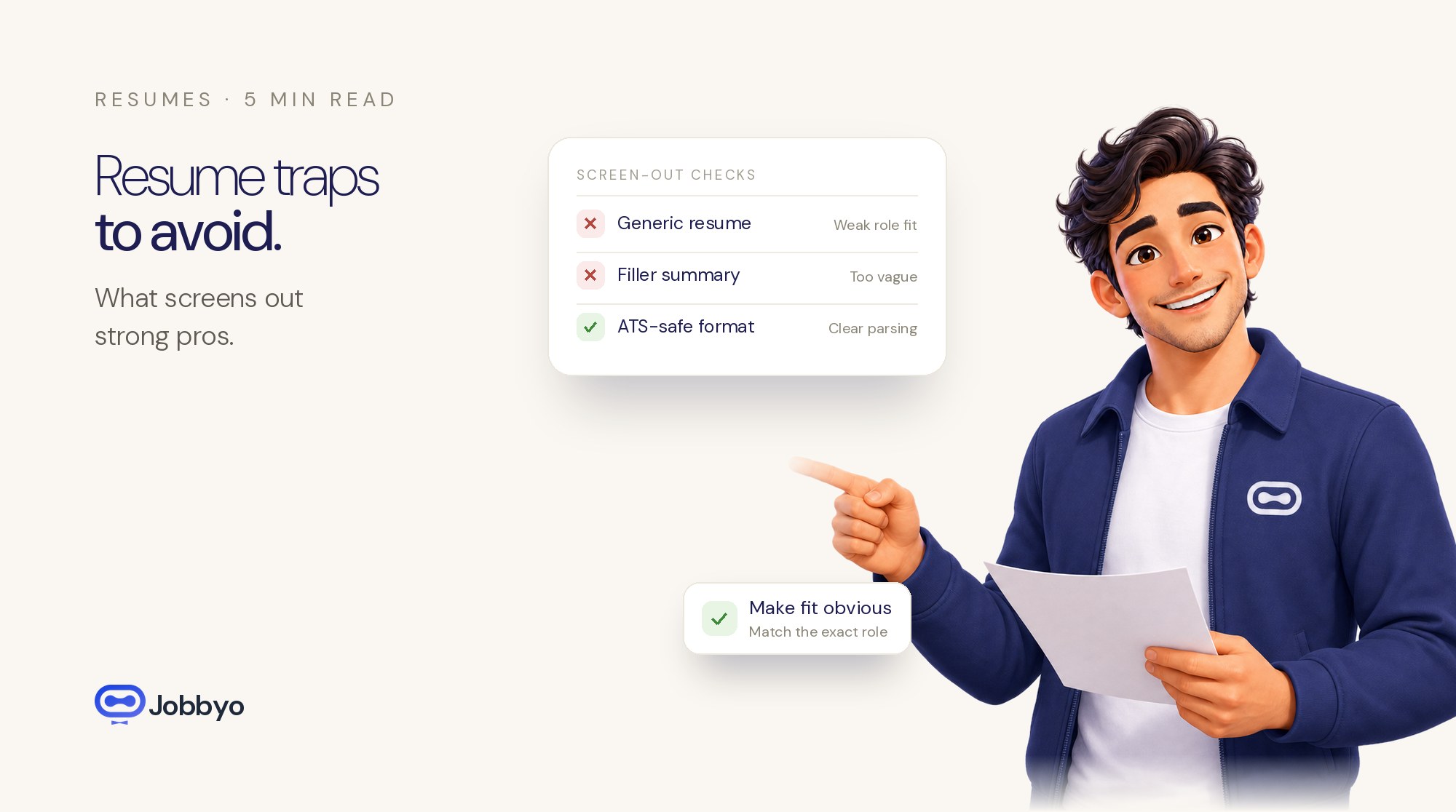
A generic resume saves you time and pushes the matching work onto the employer. That is a bad trade when software and recruiters are screening for fit against one job description, not your whole career archive.
Why it costs you: If a posting asks for Salesforce implementation and your resume says only business systems experience, the strongest match may never surface.
Putting the best evidence too far down the page
Experienced candidates often lead with chronology and hope the reader connects the dots. The reader may not get that far.
Why it costs you: If the first screen shows older leadership work while the role needs recent cloud migration, lifecycle marketing, or revenue operations experience, the recruiter can reject the resume before reaching the relevant proof.
Opening with a filler summary
Phrases like results-driven professional and proven track record take up prime space without naming a target role, function, industry, or strength.
Why it costs you: A vague summary can fit almost anyone, so it gives ATS software, AI screeners, and recruiters almost nothing to use.
Ignoring the employer’s wording when it is accurate
Do not copy a posting blindly. Do use the employer’s terms when they honestly match your background.
Why it costs you: Customer lifecycle marketing and email marketing may overlap, but a screening system may not treat them as the same phrase.
Dumping keywords into a skills block with no proof
A long stack of tools can get scanned, but it does not show that you can use them under real business pressure.
Why it costs you: Python, SQL, Airflow, dbt, and Snowflake are stronger inside a bullet about building, fixing, or improving a data pipeline.
Describing activity without showing the result
Not every bullet needs a hard metric. Every strong bullet does need a consequence.
Why it costs you: Managed weekly reporting is weaker than reworked weekly reporting so leaders could spot pipeline risk earlier.
Assuming a career change explains itself
Career changers get punished when they make employers translate the connection between old work and target work.
Why it costs you: A finance-to-tech candidate has to frame forecasting, stakeholder management, systems work, or process improvement in language a SaaS hiring team recognizes.
Giving every past job the same amount of space
More experience does not mean more detail. Senior professionals often dilute their best positioning by over-explaining older, unrelated, or lower-impact roles.
Why it costs you: A resume that preserves everything makes the reader work harder to find what matters now.
Using formatting that parsing software can misread
Complex templates can look polished and still break when an ATS tries to identify dates, job titles, employers, and skills.
Why it costs you: Multi-column layouts, text boxes, icons, graphics, headers, footers, and unusual section labels can hide information the system is supposed to extract.
- Putting core skills inside graphics
Skill bars, logos, charts, and icon sections look modern but usually say less than plain text.
Why it costs you: A Salesforce logo or five-dot rating tells less than a bullet about the Salesforce workflow, migration, dashboard, or implementation you owned.
- Trying to look open to too many roles at once
Flexibility is useful. A resume aimed at product, operations, customer success, strategy, and marketing at the same time usually looks unfocused.
Why it costs you: Employers hire for a specific problem, and a broad resume rarely proves you are the safest answer to that problem.
- Using seniority as the selling point
Years of experience can help, but tenure alone is not positioning. Senior candidates need to show judgment, scope, influence, and relevance.
Why it costs you: Over 15 years of experience is less persuasive than the size of the teams, systems, budgets, markets, programs, or decisions you influenced.
- Leaving remote, hybrid, or location details unclear
If location, time zone, work authorization, state restrictions, or remote preference could affect eligibility, do not make the employer guess.
Why it costs you: Ambiguity about work model or geography can create friction before anyone discusses your qualifications.
- Rushing applications to stale or low-fit jobs
Volume feels productive when the market is crowded. It often creates more silence.
Why it costs you: Even a strong resume performs poorly when it goes to the wrong role, the wrong market, or a posting that is no longer actively hiring.
Closing takeaway
In 2026, qualification has to be easy to see. The first pass may come from software. The second may come from a recruiter with too many reqs and too little time. Neither will interpret a vague resume generously.
Use a strong base resume as source material, then adjust it for each serious role. Tune the target title, summary, skills section, bullet order, truthful keywords, relevant achievements, tools, platforms, and industry language.
This is where Jobbyo helps: it tailors your resume and cover letter to each role, helps you avoid preventable ATS issues, filters weak or stale opportunities, and reduces manual application work so you can spend more time on networking, interview prep, and decisions that actually move the search forward.
The best resume is the one that makes the employer’s problem and your proof meet on the page.
Put this to work
Let Jobbyo find your
best matches for you.