How to Use AI to Decode Any Job Description and Walk Into Interviews Prepared
The interview questions you'll be asked are hiding in the job description. Here's how to use AI tools to extract them, identify your gaps, and prepare answers that land — before you ever get on the call.
How to Use AI to Decode Any Job Description and Walk Into Interviews Prepared
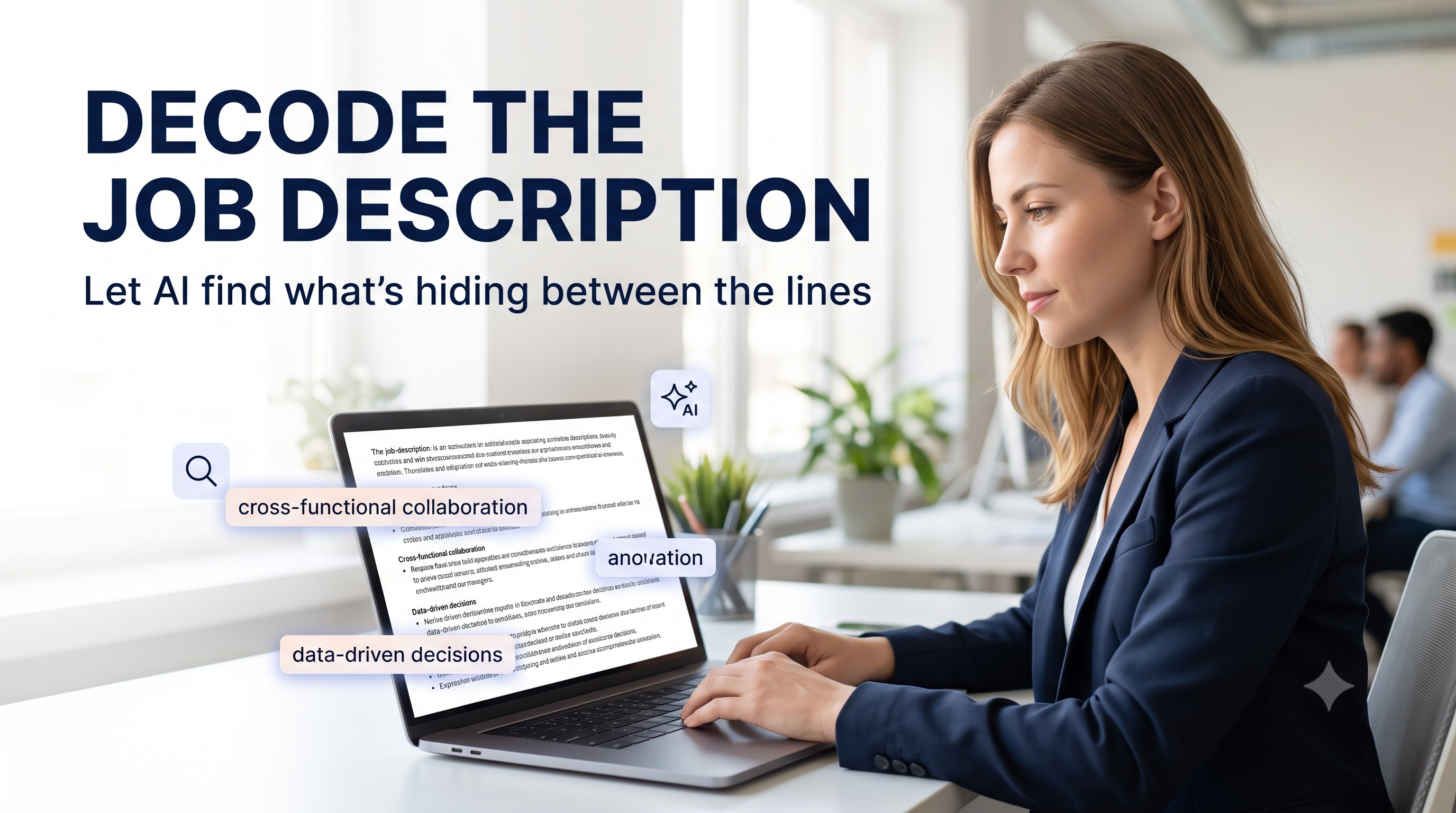
Job descriptions contain far more information than most candidates extract from them. Most people read a JD to decide whether to apply. The ones who land offers read it to prepare for every stage of the process — including the interview questions they'll be asked, often weeks before they're in the room.
The shift that makes this possible: AI tools can analyze a job description and surface the implicit priorities, likely interview questions, skill gaps to address, and language patterns that interviewers use. What used to take hours of careful reading and guesswork can now happen in minutes.
This isn't about gaming the system. It's about being genuinely prepared — showing up to an interview with a clear understanding of what the company needs and specific evidence that you can deliver it.
What a Job Description Actually Contains
A well-written job description contains at least four layers of information:
Layer 1: Explicit requirements — the qualifications and skills listed directly. Most candidates read only this layer.
Layer 2: Implicit priorities — what the company is trying to solve. A JD that spends three bullet points on "cross-functional collaboration" and one on "technical skills" tells you something about the actual challenge this role is being hired to address.
Layer 3: Cultural signals — how the company talks about the role reveals how they think. "Move fast and iterate" is different from "rigorous and data-driven." The language they use will be the language your answers should echo.
Layer 4: Interview question scaffolding — every requirement is a potential interview question. "Experience leading through ambiguity" becomes "Tell me about a time you navigated a situation without clear direction." Reading the JD this way transforms it into an interview prep guide.
AI tools make extracting layers 2-4 fast and systematic.
Step 1: Extract the Implicit Priorities
Paste the full job description into ChatGPT, Claude, or a similar tool and ask:
"Read this job description carefully. What are the three biggest problems this company is trying to solve with this hire? What implicit priorities are buried in the language — even if they're not stated directly? What would success look like in this role based on how the description is written?"
This prompt often surfaces things that aren't visible in a straight reading. A JD for a "Senior Product Manager" that repeatedly mentions "go-to-market," "revenue growth," and "customer acquisition" is really hiring a growth PM — not an infrastructure or platform PM. That distinction changes how you position your experience entirely.
Compare the AI's output to your own read of the JD. Where they differ is often where the most useful insight is.
Step 2: Generate the Likely Interview Questions
Once you understand the priorities, ask the AI to predict what you'll be asked:
"Based on this job description, generate the 10 most likely behavioral interview questions I'll be asked. Focus on the core skills and challenges implied by the description. Include 2-3 questions that most candidates won't prepare for but that directly address the implicit priorities you identified."
This prompt reliably produces a useful interview question set. The behavioral questions it generates will almost certainly overlap with what you're actually asked — because your interviewers are reading the same JD.
Work through each question and draft a brief STAR answer (Situation, Task, Action, Result). You don't need to memorize them — you need to know which story from your background answers each question.
Step 3: Identify the Skills Gap (Before the Interview Does)
If there are requirements in the JD you're less confident about, find out before you're asked about them:
"Identify any requirements in this job description that I should prepare to address even if my experience doesn't directly match. For each, suggest how someone could reframe related experience to credibly speak to it — and flag any gaps that would genuinely be difficult to work around."
This prompt helps you do two things:
- Prepare honest, confident answers for areas where your experience is adjacent rather than exact
- Know in advance which weaknesses might be probed — so you're not caught off guard
The worst moment in an interview isn't being asked about a gap. It's being surprised by a question about a gap you hadn't considered. AI prep eliminates most of those surprises.
Step 4: Mirror the Company's Language
Every company has its own language. They talk about customers differently than they talk about users. They call something "velocity" at one company and "throughput" at another. Using their vocabulary — naturally, not awkwardly — signals cultural fit.
"Based on this job description, identify the 10 most important terms, phrases, or concepts this company uses. For each, explain what they're likely signaling culturally or strategically."
When you use these terms in your interview answers, it feels like alignment. Because it is — you've internalized how they think about the work.
This is especially useful for technical or domain-specific roles where vocabulary differences between industries can make an otherwise strong candidate sound like an outsider.
Step 5: Prepare Your "Why This Company" Answer
This question comes up in almost every interview and is frequently answered poorly. AI can help you develop a genuinely compelling, specific answer.
Paste the job description plus anything you know about the company (recent news, product announcements, blog posts) and ask:
"Based on this JD and company context, help me draft a specific, compelling answer to 'Why this company?' that goes beyond generic enthusiasm. It should reference something real about what the company is building, connect it to my background, and signal that I've done genuine research."
The output needs your editing — you know your own background better than the AI does — but it gives you a structure and often surfaces angles you hadn't considered.
Automating This Across Multiple Applications
If you're applying at volume, running this analysis manually for every role would eat hours you don't have. Here's how to streamline it:
Build a Reusable Prompt Template
Create a master prompt document that you paste job descriptions into. Keep it in Notion, a Google Doc, or a note-taking app. Your template might look like:
ROLE: [paste job title and company]
JD: [paste full job description]

Please do the following:
1. Identify the 3 biggest problems this role is being hired to solve
2. Generate 8 likely behavioral interview questions
3. Identify any skills gaps to prepare for
4. List 10 key terms/phrases from this JD to mirror
5. Draft a 3-sentence "why this company" starting point
Running this template takes less than 2 minutes per application. The output gives you a prep document for each role that would previously have taken 30-60 minutes of careful, manual analysis.
Prioritize Which Roles to Analyze Deeply
Not every application warrants the full 5-step analysis. For roles where you're highly qualified and genuinely excited, run the full process. For applications you're less invested in, a quick version (just the likely questions and language patterns) still gives you a meaningful edge.
Jobbyo tracks your applications and flags which ones have advanced to active stages — making it easy to know which JDs deserve the deep prep treatment and which you're still waiting to hear back on.
The Day Before the Interview
The day before, revisit your prep document and do three things:
1. Review your question-answer pairs out loud. Speaking them, not just reading them, reveals which answers feel natural and which feel stiff. Fix the stiff ones.
2. Read three things about the company. A recent press release, a blog post, and the LinkedIn profiles of your interviewers. Look for anything you can reference naturally.
3. Prepare two company-specific questions. Not "what does your company do?" questions — questions that show you understand what they're building and have thought about the challenges. AI can help here too:
"Based on this JD and company context, suggest 5 smart questions I could ask at the end of an interview that would demonstrate I've done serious research and thought about what success in this role actually requires."
What AI Can't Do
AI can analyze text. It can't tell you how an interviewer personally communicates, what a company's culture actually feels like to work in, or whether the hiring manager's stated priorities match their actual ones. For that, you need:
- Real conversations: If you can get 15 minutes with someone on the team before the interview, the intelligence you gather is more valuable than any JD analysis.
- Employee reviews: Glassdoor, Blind, and LinkedIn connections who've worked there give you context that no public document contains.
- Your own read of the conversation: Pay attention to what the interviewer emphasizes, what questions they return to, and where their energy shifts. That's live data that updates everything you prepared.
AI prep is a foundation. The human layer built on top of it is what actually wins the interview.
The candidates who walk into interviews most prepared aren't necessarily the ones who spent the most hours reading about the company. They're the ones who extracted the right information efficiently — and then invested the time saved into practicing the answers that matter.
Jobbyo generates the application volume that gets you into more rooms. This system makes sure you're genuinely ready when you get there.