The Thank-You Email That Actually Helps You Get the Job (With Templates)
Most candidates skip the post-interview thank-you email. Those who send them often do it wrong. Here's what actually works — and why this 5-minute step can change the outcome of a close decision.
The Thank-You Email That Actually Helps You Get the Job (With Templates)
Most candidates either skip the post-interview thank-you email entirely or send a generic "Thanks for your time" message that does nothing. A small minority send a thank-you that actually changes the outcome.
Here's the data point that's worth sitting with: in a survey of 300 hiring managers, 68% said that receiving a thoughtful thank-you note positively influenced their perception of a candidate. For close decisions between two strong finalists, several hiring managers in that same study mentioned the follow-up as a deciding factor.
This isn't about being polite. It's about using a 5-minute action strategically when most of your competition won't bother.
When to Send It
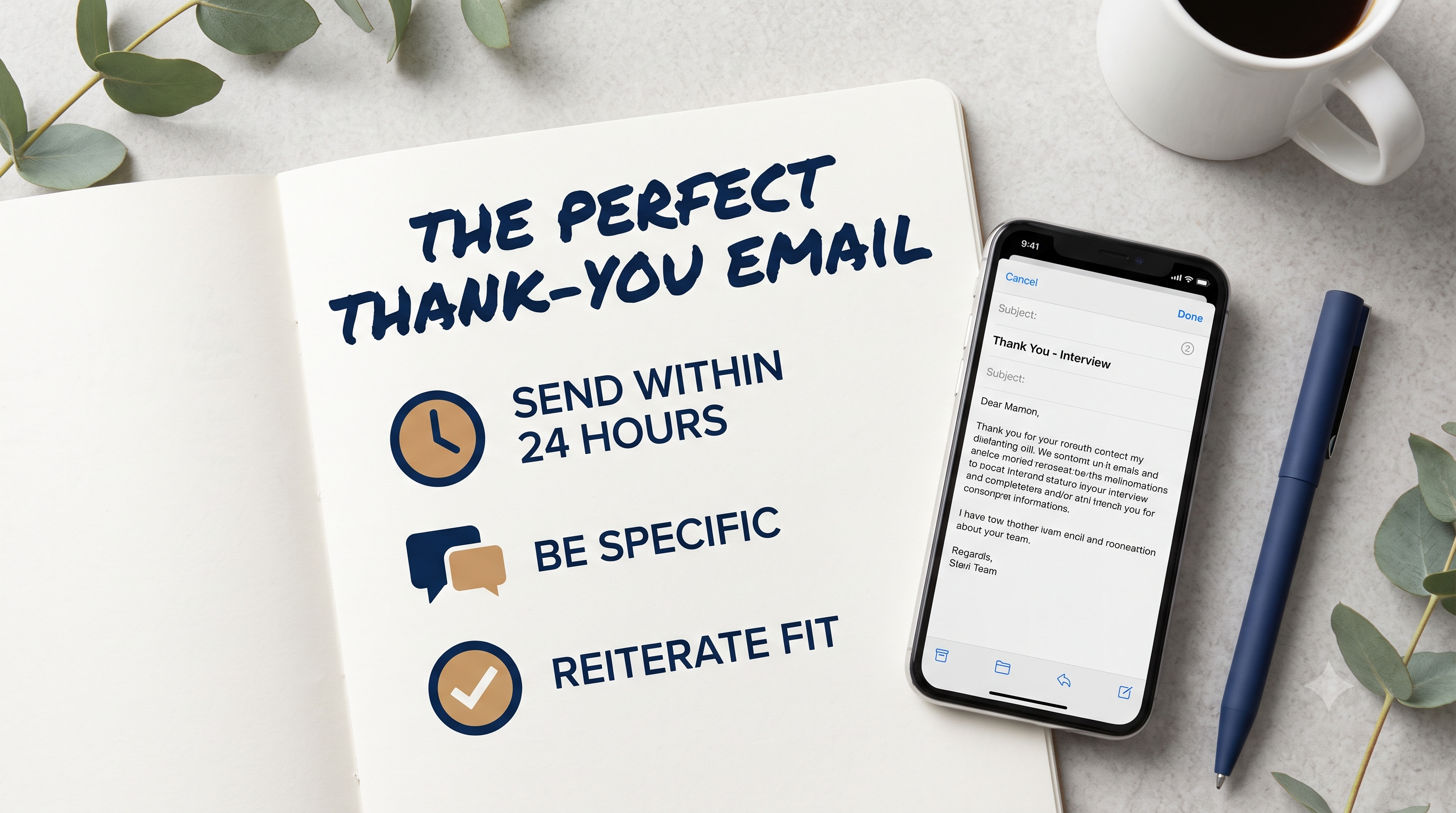
Send your thank-you email within 24 hours of the interview, ideally the same evening or the next morning. The window matters:
- Same day (evening): Shows you're engaged and didn't need to think hard about whether to follow up. Good for early-stage roles or when you felt a strong connection.
- Next morning: Slightly more considered; good default timing.
- 48+ hours later: Starts to look like an afterthought. Still send it, but the impact diminishes.
If you interviewed with multiple people, send individual emails to each one — not a group message or the same template with names swapped. Each interviewer had a different conversation with you, and your follow-up should reflect that.
What Makes a Thank-You Email Work
The emails that actually help are not about saying "thank you." They do four things:
1. Acknowledge the conversation specifically. Not "I enjoyed learning about the role" — but "the way you described how the team's approach to product prioritization evolved after the 2024 reorg gave me a different lens on the challenges."
Specificity proves you were paying attention. It's also nearly impossible to fake.
2. Reinforce one key point from your candidacy. If there was a moment in the interview where you felt your answer was less clear than you wanted, or a strength you didn't fully surface, this is your opportunity. Keep it brief — one or two sentences at most.
3. Express genuine, specific interest. "I'm excited about this opportunity" is noise. "After our conversation about the expansion into enterprise clients, I'm even more interested in this role than I was going in" is a real signal.
4. Keep it short. Three to five short paragraphs. Hiring managers are busy. A thank-you email that requires scrolling is already a problem.
The Templates
Use these as starting points — the specific details you fill in are what make them actually useful.
Template 1: Standard First-Round Interview
Subject: Thank you — [Your Name] / [Role Title]
Hi [Name],
Thank you for taking the time to meet with me today. I really enjoyed our conversation — particularly [specific topic or insight from the interview]. [One sentence expanding on why it was interesting or how it connected to your experience].
The more I learn about what the team is working on, the more interested I am. [One sentence about why this specific role or company resonates based on what you learned].
Thanks again for your time and consideration. I look forward to hearing about next steps.
Best,
[Your Name]
Template 2: After a Strong Interview You Want to Reinforce
Subject: Thank you — [Your Name]
Hi [Name],
I appreciated the time you spent with me this [morning/afternoon]. Our conversation about [specific topic] gave me a much clearer picture of what the team is navigating, and it reinforced how well this aligns with the work I've been doing in [relevant area].
One thing I didn't get to expand on fully: [brief, specific point — a relevant accomplishment, a skill, a perspective]. I wanted to mention it because [why it's relevant to what you discussed].
I came away from our conversation more excited about this opportunity than I was going in. I hope to have the chance to work with you and the team. Please don't hesitate to reach out if you have any additional questions — I'm happy to connect.
[Your Name]
Template 3: After a Technical or Skills-Based Interview
Subject: Follow-up — [Your Name] / [Role Title]
Hi [Name],
Thank you for walking me through [specific exercise, challenge, or topic] during our conversation today. I found [specific part] particularly interesting — it mapped closely to [relevant situation from your own experience], and it helped me understand how the team thinks about [relevant problem].
I appreciated the depth of the technical discussion. It reinforced for me that this is a team I'd want to be part of.
Looking forward to hearing about next steps. In the meantime, if there are any follow-up questions, I'm happy to answer them.
Best,
[Your Name]
Template 4: After a Final Round (Tight Decision Context)
Subject: Thank you — [Your Name]
Hi [Name],
Thank you for including me in the final conversations for [role]. The time the team has invested has genuinely shaped how I think about this opportunity.
Our conversation about [specific topic] stayed with me. [One or two sentences about why — connect it to your background or something you care about professionally].
I want to be clear that this role is my first choice right now. [One sentence on why — specific to what you learned in the process, not generic enthusiasm.] I believe I'd be able to contribute quickly, and I'm eager to get started if there's a fit.
Please let me know if anything else would be helpful as you make your decision.
[Your Name]
Common Mistakes
Waiting too long. If you're drafting a thank-you email three days later, the moment has passed. Send it within 24 hours or not at all.
Sending the same message to multiple interviewers. Hiring teams compare notes. If two people receive identical emails, it signals that your personalization was performative.
Over-qualifying. "I know you probably have many strong candidates..." or "I hope I didn't come across as too [X]..." — any language that hedges or undermines your candidacy should be cut.
Turning it into a pitch deck. The thank-you email is not the place to send your portfolio, a 30-60-90 day plan, or a lengthy case study (unless they specifically asked for one). Keep it conversational.
Not sending one at all. In a competitive field, leaving this step out means voluntarily giving up an advantage. The candidates who don't send a follow-up make the decision easier for hiring managers — just not in the way they intended.
When You Had a Rough Interview
If you stumbled on a question or felt the interview went poorly, the thank-you email is a chance to recalibrate — but only if you use it correctly.
Don't write: "I apologize if my answer to [question] was confusing..."
Instead, address the content directly: "I've been thinking about your question on [topic] since our conversation. I want to share a more complete answer: [concise, clear response — 2-3 sentences]."
This shows composure, self-awareness, and the ability to follow up clearly — qualities that matter in most professional roles. It won't always reverse a rough interview, but it's meaningfully better than silence.
Checking In After the Thank-You
If you sent your thank-you and heard nothing within their stated timeline (or after a week if no timeline was given), a brief check-in is appropriate:
"Hi [Name], I wanted to follow up on our conversation from [date]. I remain very interested in the [role] and am happy to answer any additional questions. Could you share an updated timeline for next steps?"
One follow-up is professional. Two starts to feel pressured. After two unanswered check-ins, move on mentally while keeping the application open on paper.
The job search is competitive. Most of the actions that differentiate strong candidates are things that most people skip — because they take effort, because the payoff isn't immediate, or because no one told them it mattered. The post-interview thank-you is one of the clearest examples.
Five minutes. A genuine, specific message. Often the difference in a close call.
Use Jobbyo to keep your pipeline full and your applications moving — so each interview you get is one of many, not one you're holding your breath for.