11 min read
The Data-Driven Salary Negotiation Guide: How to Ask for More (and Get It)
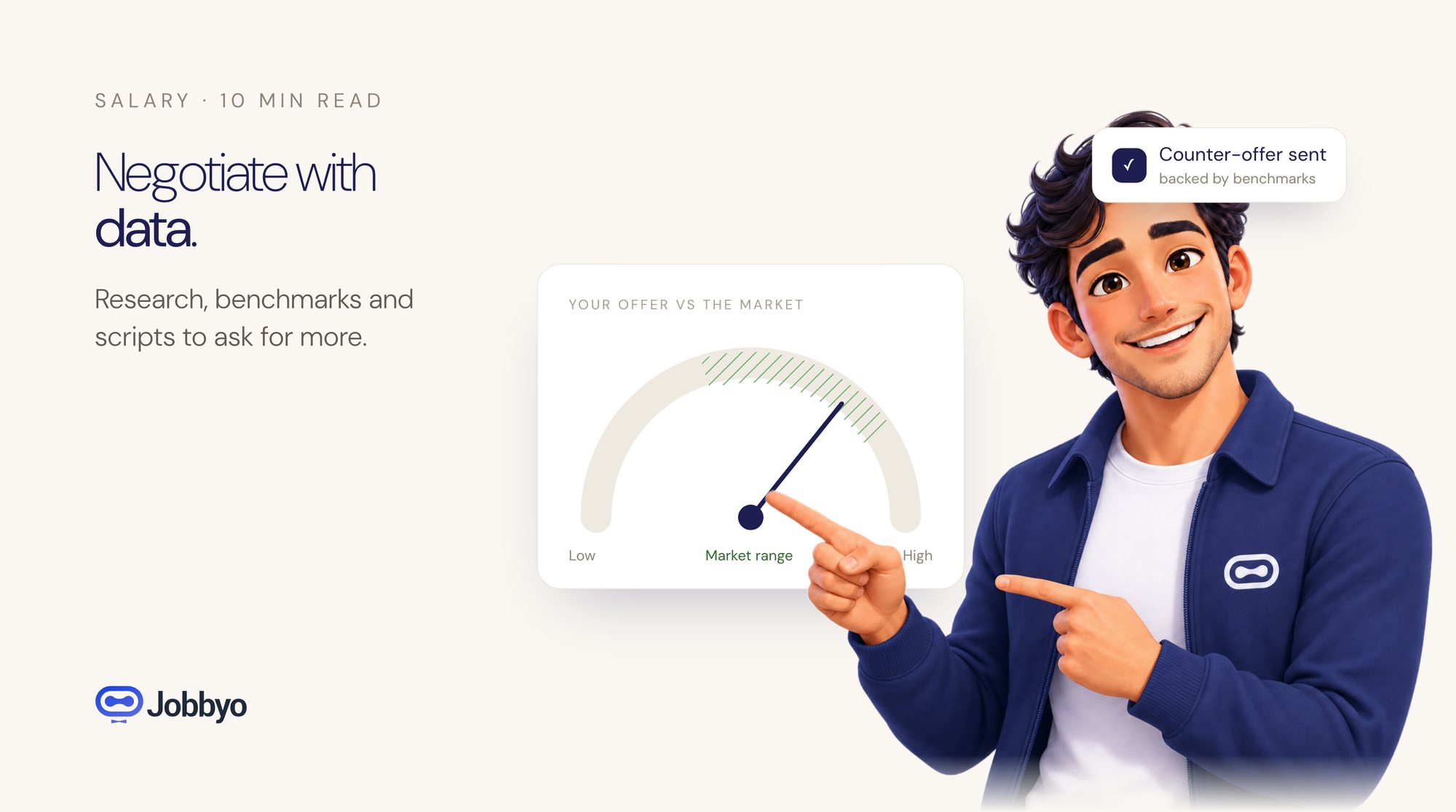
Most people leave money on the table because they negotiate with feelings instead of data. Here's how to use research, benchmarks, and proven scripts to get the salary you deserve.
Here's a number that should make you uncomfortable: according to multiple salary surveys, roughly 55% of workers have never negotiated their salary. Not once. They received an offer, felt relieved to get it, and accepted whatever number was on the paper.
Those people are leaving an average of $5,000 to $10,000 per year on the table. Over a 30-year career, that compounds into hundreds of thousands of dollars in lost earnings — not counting the retirement contributions, bonuses, and future raises that are all calculated as a percentage of your base salary.
The reason most people don't negotiate isn't greed. It's fear. Fear that the offer will be rescinded. Fear of looking ungrateful. Fear of not knowing what to say or how to say it.
This guide eliminates all three. We're going to walk through the exact process of negotiating your salary using data, not feelings. By the end, you'll know how to research your market value, structure your ask, handle objections, and close the conversation with more money in your pocket.
Why Companies Expect You to Negotiate
Before we get into tactics, let's address the biggest misconception: that negotiating is somehow rude or risky.
It's not. Here's why.
Every company has a salary range for every role. When they make you an offer, they almost never start at the top of that range. The initial offer is typically at the 25th to 50th percentile of the approved range, leaving room for negotiation.
Hiring managers know this. HR knows this. The recruiter who extended your offer knows this. When you accept without negotiating, you're not making them happy — you're making their budget look good.
Multiple surveys of hiring managers confirm that they rarely rescind offers because a candidate negotiated. The most common outcome of negotiating is getting more money. The second most common outcome is getting the original offer confirmed. Losing the offer entirely is extremely rare and almost always involves unprofessional behavior, not the act of negotiating itself.
Companies have budgeted for negotiation. You're not asking for a favor. You're participating in a process that both sides expect.
Step 1: Know Your Number Before the Conversation
The single biggest mistake in salary negotiation is walking in without a number. If you don't know what you're worth, you're negotiating blind — and you'll either ask for too little (leaving money on the table) or too much (without the data to support it).
How to Research Your Market Value
Use multiple data sources and triangulate:
Salary databases:
- Levels.fyi — Best for tech roles, with verified compensation data including base, bonus, and equity
- Glassdoor — Broad coverage across industries, though data can be outdated
- Payscale — Good for adjusting by location, experience, and skills
- LinkedIn Salary Insights — Useful for seeing ranges by role and region
- H1B Salary Database — Public records of salaries for sponsored workers, often reflects competitive market rates
How to use them: Search for your exact job title in your location. Look at the range, not just the median. Note the 25th percentile (low end), 50th percentile (market rate), and 75th percentile (strong candidate rate).
Talk to people:
The most accurate salary data comes from conversations. Reach out to peers in similar roles and ask directly: "I'm evaluating an offer and trying to understand the market. Would you be comfortable sharing your salary range?" Many people will tell you, especially if the conversation is reciprocal.
If direct conversation feels awkward, online communities can help. Subreddits like r/cscareerquestions, r/overemployed, and Blind (for tech) have active salary-sharing threads.
Ask the recruiter:
Many states and cities now require employers to share salary ranges in job postings or during the interview process. If the range isn't posted, ask: "Can you share the salary range for this position?" This is a normal, professional question that recruiters expect.
Setting Your Target
Once you've gathered data, set three numbers:
- Your target: The number you'd be thrilled to get. Usually at the 65th-75th percentile for your role and location.
- Your minimum: The lowest number you'd accept. Below this, you walk away.
- Your anchor: The first number you'll say out loud. This should be 10-15% above your target, because negotiation always involves some concession.
Write these numbers down. Having them clearly defined before the conversation prevents emotional decision-making in the moment.
Step 2: Time Your Negotiation Right
Timing matters more than most people realize. Here's when to negotiate and when to wait.
The best time to negotiate is after you have a written offer. At this point, the company has decided they want you. They've invested time and resources in the hiring process. The switching cost of going back to their second-choice candidate is high. You have maximum leverage.
Don't negotiate during the interview process. When a recruiter asks your salary expectations early in the process, deflect: "I'd like to learn more about the role and the full compensation package before discussing specific numbers. Can you share the range you've budgeted for this position?"
This accomplishes two things: it avoids anchoring yourself too low before you understand the full scope of the role, and it shifts the anchoring responsibility to the employer.
Don't negotiate at the verbal offer stage. When the recruiter calls to say "We'd like to offer you the role at $X," don't respond immediately. Say: "Thank you — I'm excited about this opportunity. I'd like to review the full offer in writing before I respond. Can you send the details over?"
This buys you time to prepare your counteroffer without the pressure of an on-the-spot decision.
Step 3: Structure Your Counter
When the written offer arrives, take at least 24 hours before responding. During that time, prepare your counter using this framework.
The Data-Driven Counter Script
This is the conversation framework that works. It has four parts:
1. Express enthusiasm (genuine, not performative)
"Thank you for this offer. I'm genuinely excited about the role and the team. After our conversations, I'm confident this is the right fit."
This matters because it signals that you're negotiating from a position of genuine interest, not as a power play. The hiring manager needs to know that a higher offer will actually close the deal.
2. Present your data
"I've done some research on compensation for this role, and based on market data from [sources], the range for someone with my experience and skill set in [location] is typically [range]. Given my background in [specific relevant experience] and the results I've delivered — specifically [quantified accomplishment] — I believe a base salary of [your anchor number] would be more aligned with the market."
Notice what this does: it frames your ask around external data, not personal need. You're not saying "I need more money." You're saying "The market says this role is worth more, and my experience supports that."
3. Justify with specifics
"In my current/previous role, I [specific accomplishment with numbers]. I'm confident I can bring that same impact to your team, particularly in [area relevant to the job description]."
This connects your ask to value. You're not just citing data — you're explaining why you, specifically, are worth the higher number.
4. Open the conversation
"I'd love to find a number that works for both of us. Is there flexibility in the base salary, or are there other components of the package we could discuss?"
This is critical. It signals that you're collaborative, not combative. It also opens the door to non-salary compensation — which is often easier for companies to adjust.
Step 4: Handle the Most Common Responses
After you make your counter, the company will respond in one of four ways. Here's how to handle each.
"We can meet you at [number between your anchor and the original offer]"
This is the most common outcome and usually a good one. If the number is at or above your target, accept it. Don't try to squeeze more — you've already won.
If it's below your target but above your minimum, you can try one more push: "I appreciate you coming up. Could we meet at [your target]? That would make this a clear yes for me." If they can't, decide based on the full package.
"The salary is firm, but we can offer [other benefits]"
Don't dismiss this. Non-salary compensation can be extremely valuable:
- Signing bonus: A one-time payment that doesn't affect the company's ongoing salary budget. Often easier to negotiate than base salary.
- Equity/stock options: Can be worth more than salary over time, especially at growing companies.
- Extra PTO: Additional vacation days cost the company relatively little but add significant value to your quality of life.
- Remote work flexibility: If the role is hybrid, negotiating additional remote days can save commuting costs and time.
- Professional development budget: Funds for courses, conferences, or certifications.
- Earlier review cycle: If they can't pay more now, ask for a salary review at 6 months instead of 12.
When the base salary is truly fixed, these alternatives can close the gap.
"We need to check with [leadership/finance/HR]"
This is normal. Say: "Of course, I understand. I'm happy to give you time. When would be a good time to reconnect?" Then wait. Don't follow up multiple times or send additional justification — it weakens your position.
"This is our final offer — take it or leave it"
Rare, but it happens. If the offer is at or above your minimum, decide based on the complete picture: role, growth potential, culture, benefits, and your alternatives. If it's below your minimum, it's okay to walk away. Say: "I appreciate the opportunity and the time we've invested. Unfortunately, the compensation doesn't align with my market research and what I'd need to make a move. I'd love to stay in touch for future opportunities."
Walking away is hard. But accepting a below-market offer creates resentment that compounds over time. It's better to decline respectfully and continue your search.
Step 5: Close the Deal Properly
Once you've reached a number you're happy with, close clearly and professionally.
"Thank you — I'm happy to accept at [agreed number]. Could you send an updated offer letter reflecting the new terms? Once I have that, I'll sign and return it immediately."
Get everything in writing before you resign from your current job or stop other interview processes. Verbal agreements are not binding. The signed offer letter is what counts.
Common Mistakes That Kill Negotiations
Negotiating based on personal need. "I need $X because my rent increased" is not a negotiation argument. Your compensation should reflect your market value and the value you bring to the company — not your expenses.
Giving a range instead of a number. If you say "I'm looking for something in the $90-100K range," you'll get $90K. Always anchor with a specific number.
Apologizing for negotiating. "I hope this isn't too forward, but..." undermines your position before you've even stated it. Negotiating is professional, expected, and nothing to apologize for.
Threatening to walk without being willing to. Never bluff. If you mention another offer, be prepared for them to say "take it." Only mention alternatives if they're real and you'd genuinely consider them.
Negotiating too many things at once. Focus on your top priority (usually base salary), get that resolved, then move to secondary items. Trying to negotiate salary, equity, PTO, and title simultaneously overwhelms the conversation.
Using Data Throughout Your Career
Salary negotiation isn't a one-time event. The principles in this guide apply every time you get a new offer, every annual review, and every time you take on significant new responsibilities.
Build the habit of tracking your market value annually. Save your accomplishments and quantified results throughout the year — not just when review season comes around. The best time to prepare for your next negotiation is right now, while your recent wins are fresh.
Tools like Jobbyo help you understand your market position by matching your profile against current job listings and their posted salary ranges. When you can see that companies are offering $X for roles that match your exact skill set, you walk into every negotiation with confidence backed by data.
The difference between people who earn what they're worth and people who don't isn't talent or luck. It's preparation.
Prepare with data. Negotiate with confidence. Get what you're worth.
Put this to work
Let Jobbyo find your
best matches for you.