9 min read
Remote Work in 2026: Where to Find Legitimate Remote Jobs (and Avoid Scams)
Remote work isn't dead — but finding real remote jobs has gotten harder. Here's where to look, which industries are still hiring remote, and how to spot scams before you waste your time.
Every few months, another headline declares remote work is dead. And every few months, millions of people continue working from their home offices, coffee shops, and co-working spaces.
The reality in 2026 is more nuanced than either side wants to admit. Remote work isn't dead, but it has changed shape. The pandemic-era free-for-all — where virtually every knowledge worker could find a fully remote position — has given way to a more selective market. Some companies have pulled back to hybrid. Others have doubled down on remote-first culture. And a growing number of scam operations have moved in to exploit the demand.
If you're looking for a legitimate remote job right now, this guide will tell you exactly where to find one, which industries are hiring, and how to protect yourself from the increasingly sophisticated scams targeting remote job seekers.
The State of Remote Work in 2026
Let's start with the numbers.
According to recent workforce data, approximately 28% of full-time employees in the US work in a hybrid arrangement, while 16% are fully remote. That's down from the 2022 peak, but it's still dramatically higher than pre-pandemic levels, when only about 5% of workers were fully remote.
The distribution isn't even across industries, though. Tech, marketing, finance, customer support, and creative services have the highest concentration of remote roles. Manufacturing, healthcare (clinical roles), and hospitality remain predominantly in-person, which shouldn't surprise anyone.
What has changed is the geography. In 2021, a company in San Francisco might hire a remote worker in any US state without thinking twice. In 2026, companies are more deliberate about where their remote workers are located — driven by tax implications, labor laws, and time zone alignment.
This means that "remote" doesn't always mean "work from anywhere." Many postings now specify remote-eligible states or regions. Reading the fine print matters more than ever.
Where to Actually Find Remote Jobs
Not all job platforms are created equal when it comes to remote work. Some are flooded with scam postings. Others are curated but expensive. Here's what's actually worth your time.
Specialized Remote Job Boards
Dedicated remote job boards tend to have higher-quality listings because they vet employers more carefully than general platforms.
- We Work Remotely — One of the longest-running remote job boards, focused primarily on tech and marketing roles. Listings are paid, which filters out many low-quality postings.
- FlexJobs — A subscription-based platform that manually screens every listing. The paid model keeps scams out, though the subscription cost can be a barrier.
- Remote.co — Maintained by the FlexJobs team, with free listings and company profiles that give insight into remote work culture.
- Remotive — Curated remote tech jobs with a strong community component. Their newsletter is worth subscribing to.
General Job Boards (With the Right Filters)
LinkedIn, Indeed, and Glassdoor all have remote filters, but the quality varies significantly.
On LinkedIn, use the "Remote" location filter and combine it with date-posted filters to find fresh listings. Be cautious with listings that say "Remote" in the title but "Hybrid" in the description — this bait-and-switch is frustratingly common.
Indeed's remote filter has improved, but you'll still encounter postings from staffing agencies that use "remote" as a keyword even when the role isn't fully remote. Look for direct employer postings when possible.
AI-Powered Job Matching
This is where the landscape has shifted the most. Instead of manually searching multiple boards, AI-powered tools can aggregate remote listings across platforms and match them to your profile.
With Jobbyo, you can set "remote" as a location preference in your job search criteria. The system then sources matching roles from across the web, scores them against your resume, and queues them in your dashboard. This eliminates the daily ritual of checking five different job boards and scrolling through hundreds of irrelevant listings.
The advantage isn't just speed — it's coverage. No human can realistically monitor every platform, every day, for every relevant posting. Automation ensures you never miss a qualified opportunity because you didn't check the right board on the right day.
Company Career Pages
If you have target companies in mind, go directly to their career pages. Many remote-first companies — like GitLab, Automattic, Zapier, and Buffer — post roles on their own sites before (or instead of) listing them on job boards.
Create a list of 15-20 companies whose remote culture and mission align with your goals. Check their careers pages weekly, or better yet, set up job alerts directly on their sites.
Industries Actively Hiring Remote Workers in 2026
Not all industries are equally friendly to remote work. Here's where the opportunities are concentrated right now.
Software Development and Engineering
This remains the largest pool of remote jobs. Front-end, back-end, full-stack, DevOps, data engineering, and machine learning roles are all commonly available remotely. The demand for experienced developers continues to outpace supply, giving candidates significant leverage in negotiating remote arrangements.
Marketing and Content
Digital marketing, content strategy, SEO, social media management, and brand marketing are all highly remote-compatible. The work is primarily digital, deliverables are measurable, and collaboration tools have made remote marketing teams highly effective.
Customer Support and Success
Many companies have permanently shifted customer support to remote models. Customer success manager and account management roles are also increasingly remote, particularly for SaaS companies with distributed customer bases.
Finance and Accounting
Financial analysis, accounting, bookkeeping, and FP&A roles have seen steady growth in remote availability. The shift to cloud-based financial tools has made location increasingly irrelevant for these functions.
Design and Creative Services
UX/UI design, graphic design, video production, and creative direction are all well-suited to remote work. Portfolio-based hiring makes it easier for designers to demonstrate skills regardless of location.
Sales
Inside sales and business development roles are widely available remotely. Field sales and enterprise sales roles are more nuanced — some companies want reps in specific territories, while others are location-agnostic.
How to Spot Remote Job Scams
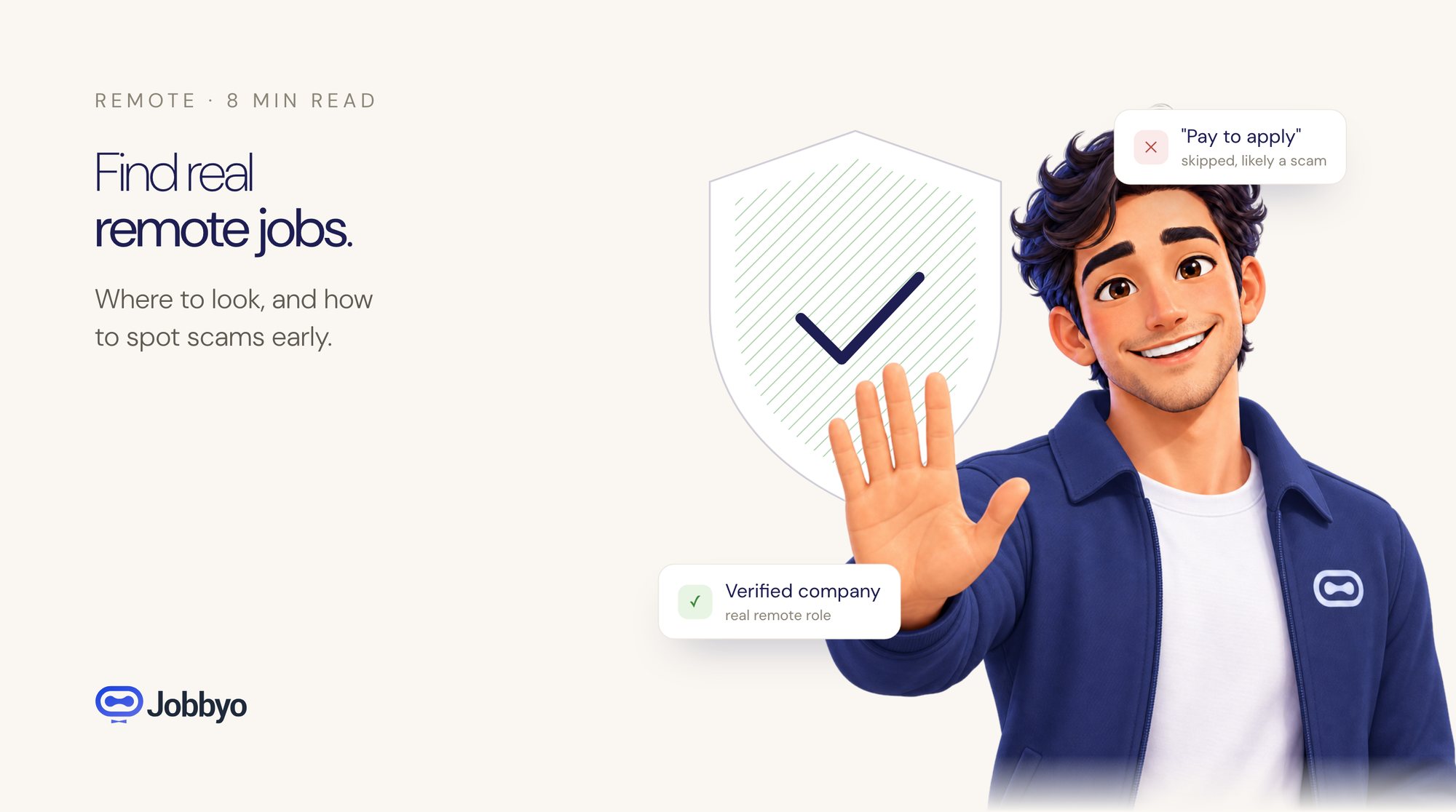
This is the part nobody wants to talk about, but it's critical. As demand for remote work has grown, so has the volume of scams targeting remote job seekers. Here's what to watch for.
Red Flags That Should Stop You Immediately
They ask for money upfront. Legitimate employers never charge you for equipment, training, or background checks. If they ask for payment at any point before or during the application process, it's a scam. No exceptions.
The salary is unrealistically high for the work described. A data entry role paying $85/hour. A customer service position offering $120K with no experience required. If the compensation doesn't match the role's market rate, something is wrong.
The interview happens only over chat. Real companies conduct video or phone interviews. If the entire hiring process takes place over Telegram, WhatsApp, or text messages, walk away.
They offer you the job immediately. Getting hired after a single chat conversation with no technical assessment, reference check, or formal interview is not a sign that you're impressive. It's a sign that the "job" doesn't exist.
The company has no online presence. Search the company name. Check LinkedIn for employees. Look for their website, social media, and reviews on Glassdoor. If you can't find any legitimate trace of the company, it's not real.
Subtler Warning Signs
Vague job descriptions. Legitimate postings describe specific responsibilities, required skills, and reporting structures. Scam postings use broad language like "help with various tasks" or "support the team with projects."
Communication from personal email addresses. Real companies use corporate email domains. If your recruiter is writing from a Gmail or Yahoo address, that's a problem.
Pressure to act quickly. "This offer expires in 24 hours" or "We need your decision today" are pressure tactics, not professional hiring practices. Real companies give you reasonable time to consider an offer.
Requests for personal information early in the process. Your Social Security number, bank account details, or copies of your ID should never be requested before you've received and accepted a formal offer. Even then, it should go through secure HR systems, not email.
How to Make Your Remote Job Application Stand Out
Finding legitimate remote jobs is only half the battle. You also need to compete effectively for them, and remote roles tend to attract more applicants than their in-office equivalents because the talent pool is geographically unrestricted.
Lead with remote work experience
If you've worked remotely before, make it prominent. Mention the tools you used (Slack, Notion, Jira, Zoom), how you managed your time, and how you communicated asynchronously. Companies hiring remote workers want to know you can be productive without someone looking over your shoulder.
Demonstrate self-management
Remote work requires discipline that in-office roles don't. Highlight instances where you managed projects independently, met deadlines without direct supervision, or proactively communicated progress to stakeholders.
Show timezone awareness
If the role specifies time zone requirements, mention your availability explicitly. "I'm based in EST and available during core hours of 9 AM - 5 PM" removes a question mark from the hiring manager's mind.
Optimize your digital presence
Your LinkedIn profile, personal website, and portfolio are even more important for remote roles because they're often the hiring manager's first impression. Make sure they're current, professional, and aligned with the type of role you're pursuing.
Build a System, Not a Routine
The biggest mistake remote job seekers make is turning their search into a daily ritual of checking boards and sending applications manually. It's draining, inconsistent, and misses opportunities that appear while you're not looking.
A better approach is building a system that works in the background. Set up your preferences once — remote only, your target roles, your salary range, your preferred industries — and let AI handle the monitoring and initial applications.
With Jobbyo, your search runs continuously. New remote postings that match your criteria are sourced, scored, and queued automatically. You review the matches, customize applications for the roles that excite you most, and let the system handle the rest.
This frees your time for the activities that actually differentiate you: networking with people at target companies, preparing for interviews, and building the skills that make you a stronger candidate.
Remote work isn't dead. But finding the right remote job requires a smarter approach than scrolling job boards and hoping for the best.
Put this to work
Let Jobbyo find your
best matches for you.