7 Job Search Mistakes That Are Costing You Interviews (and What to Do Instead)
You're qualified. You're applying. But the interviews aren't coming. These seven mistakes are the most common reasons — and each one has a fix you can implement today.
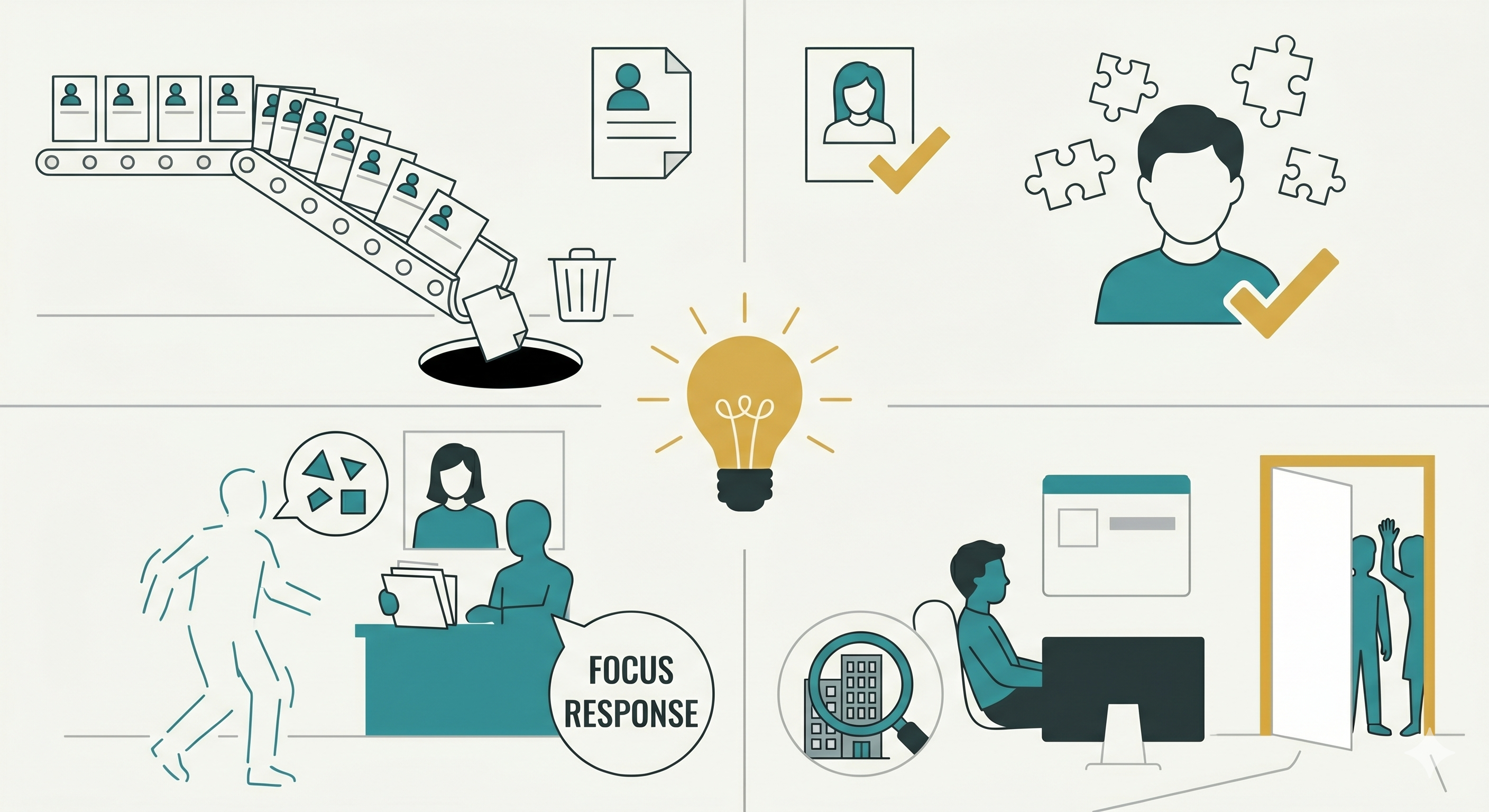
7 Job Search Mistakes That Are Costing You Interviews (and What to Do Instead)
If you're applying to dozens of jobs and getting silence in return, there's a good chance the problem isn't your qualifications. It's your process.
The modern job market is unforgiving in ways that previous generations never dealt with. Applicant Tracking Systems reject resumes before a human sees them. Recruiters spend an average of 7.4 seconds on an initial resume screen. The average corporate job posting receives 250+ applications. In this environment, small mistakes compound fast — and most candidates are making them without realizing it.
This isn't a motivational article. It's a diagnostic one. We've analyzed patterns from thousands of job seekers using Jobbyo, talked to recruiters, and reviewed hiring data to identify the seven most common mistakes that kill interview chances. Each one comes with a specific fix you can implement today.
Mistake #1: Using One Resume for Every Application
This is the most expensive mistake in job searching, and it's also the most common.
When you send the same resume to every job, you're betting that a generic document will resonate with hundreds of different hiring managers, recruiters, and ATS systems — each with different keyword requirements, priority skills, and evaluation criteria. That bet almost never pays off.
Here's what actually happens: your resume arrives at Company A, which uses an ATS that scans for specific keywords from the job description. Your generic resume mentions "project management" but the job description says "program management." Same skill, different keyword. The ATS assigns you a low relevance score. A recruiter might never see your application.
The fix: Tailor your resume for every application. This doesn't mean rewriting it from scratch — it means adjusting your summary, reordering your bullet points, and incorporating language from the job description. Focus on the first third of your resume, which is what both ATS systems and humans read most carefully.
If this sounds exhausting at scale, it is. This is exactly why tools like Jobbyo exist — to customize your resume for each role automatically while maintaining accuracy and your personal voice.
Mistake #2: Writing a Generic Cover Letter (or Skipping It Entirely)
There's a debate about whether cover letters matter. Here's the data: according to a 2025 ResumeGo study, applicants who included a tailored cover letter were 53% more likely to get an interview than those who didn't. However — and this is the important part — applicants who included a generic cover letter saw almost no benefit compared to those who sent no cover letter at all.
The cover letter only helps if it's specific. And "specific" means more than inserting the company name into a template.
The fix: A good cover letter does three things in three paragraphs:
- Opens with a hook tied to the specific company. Reference their product, a recent launch, a news article, or a specific aspect of their culture that genuinely interests you.
- Connects your experience to their needs. Pick 2-3 requirements from the job description and briefly explain how your background addresses them. Use concrete examples — numbers, outcomes, project names.
- Closes with enthusiasm and a clear ask. "I'd love to discuss how my experience with [X] could contribute to [team/goal]. I'm available at your convenience."
Total length: 150-250 words. That's it. Recruiters don't read long cover letters. They scan them for relevance and effort.
Mistake #3: Applying to Jobs You're Not Qualified For
This might sound counterintuitive — shouldn't you aim high? Yes, but there's a difference between stretching and wasting your time.
The often-cited advice that "you should apply if you meet 60% of the requirements" is misleading. What matters isn't the percentage of bullets you match — it's which bullets you match. If a job requires 5 years of experience in machine learning and you have 6 months, that's not a 60% match on one bullet point. That's a disqualifying gap.
Conversely, if you match all the core technical requirements but lack one "nice to have" skill, you should absolutely apply.
The fix: Before applying, identify the 2-3 non-negotiable requirements in the posting. These are usually listed first and described in the strongest language ("must have," "required," "minimum"). If you meet those, apply. If you don't, move on. Your time is better spent on roles where you're competitive.
Jobbyo's matching algorithm does this automatically — it scores jobs against your profile and only surfaces roles where you have an 80%+ match on core requirements, not peripheral nice-to-haves.
Mistake #4: Ignoring Your Online Presence
Recruiters Google you. This isn't speculation — according to a 2025 CareerBuilder survey, 70% of employers research candidates online before making hiring decisions. What they find (or don't find) shapes their perception before they ever speak to you.
The most common issue isn't embarrassing social media posts (though clean those up too). It's having no presence at all. If a recruiter searches your name and finds nothing — no LinkedIn profile, no portfolio, no professional footprint — that's a red flag. It suggests you're not engaged in your industry.
The fix: At minimum, optimize your LinkedIn profile:
- Headline: Don't use your current job title. Use a value statement: "Senior Engineer | Building Scalable Data Platforms | Python, Spark, AWS" is more effective than "Software Engineer at Company X."
- About section: Write 3-4 paragraphs that tell your professional story. What do you do? What are you known for? What are you looking for next?
- Experience: Don't copy-paste your resume. LinkedIn is a conversation, not a document. Write in first person, focus on outcomes, and include context that wouldn't fit on a resume.
- Activity: Post or comment at least once a week. Even a thoughtful comment on someone else's post keeps your profile active in LinkedIn's algorithm.
If you're in a field where work samples matter (design, engineering, writing, marketing), have a portfolio or GitHub profile that's current and curated. Remove old projects that don't represent your current skill level.
Mistake #5: Applying and Forgetting
The "spray and pray" approach — applying to as many jobs as possible and hoping for the best — is the default strategy for most job seekers. It's also one of the least effective.
When you apply to 50 jobs in a week without tracking them, you lose the ability to follow up strategically, prepare for interviews intelligently, or even remember which company is which when someone calls.
More importantly, you can't learn from the process. Without tracking which types of roles, companies, and application approaches generate responses, every application is a shot in the dark. You might be applying to the wrong level, the wrong industry, or the wrong geography — and you'd never know.
The fix: Track every application with at least these fields: company, role, date applied, source, and status. This can be a spreadsheet, a Notion board, or a dedicated tool.
Review your data weekly. Look for patterns: Are you getting responses from startups but not enterprises? From roles that emphasize one skill over another? From applications submitted on certain days? This data tells you where to focus.
Jobbyo does this automatically — every application is tracked with full metadata, and your dashboard shows response rates by role type, company size, and more. You can see what's working and adjust your strategy accordingly.
Mistake #6: Not Preparing for the Interview You Get
This sounds obvious, but the data says otherwise. According to a 2025 LinkedIn survey, 47% of candidates who made it to the interview stage were rejected because of poor preparation, not lack of skills.
The most common preparation failures:
- Not researching the company beyond reading the "About" page. Interviewers can tell when you've done surface-level research versus genuine homework.
- Not preparing questions. "I don't have any questions" is a candidacy-killer. It suggests you're either not curious or not invested.
- Not practicing behavioral answers. STAR format (Situation, Task, Action, Result) is the standard expectation for behavioral questions. Winging it produces rambling, unfocused answers.
- Not testing your tech setup for virtual interviews. Bad audio, frozen video, and background noise are more damaging than most candidates realize.
The fix: For every interview, spend at least 60 minutes preparing:
- 30 minutes on company research: Recent news, product launches, earnings reports, Glassdoor reviews (for culture signals), and the LinkedIn profiles of your interviewers.
- 15 minutes on questions to ask: Prepare 5-7 questions. Some about the role, some about the team, some about the company's direction. Ask about challenges, not just opportunities — it shows you're thinking like someone who already works there.
- 15 minutes on behavioral stories: Prepare 4-5 STAR stories that cover common themes: leadership, conflict, failure, technical challenge, and teamwork. You'll adapt these on the fly, but having them pre-structured prevents rambling.
Mistake #7: Giving Up Too Early
The average job search in 2026 takes 3-5 months. For senior roles, it can take 6-9 months. These numbers aren't guesses — they're based on hiring data from LinkedIn, Indeed, and the Bureau of Labor Statistics.
Most people give up or significantly reduce their effort after 6-8 weeks. This is the exact moment when many of their earlier applications are moving through the pipeline, when the compounding effect of consistent applications starts to pay off, and when market conditions shift (new quarters bring new headcount).
Job search fatigue is real. We've written about it extensively. But understanding the timeline helps you set realistic expectations and avoid interpreting normal delays as personal rejection.
The fix: Set a sustainable weekly routine — not a sprint. A consistent 5-10 applications per week for 3 months produces better results than 50 applications in one week followed by two weeks of burnout.
Automate what you can. The biggest energy drain in job searching isn't the interviews — it's the repetitive application process: tailoring resumes, writing cover letters, filling out forms. That's the grind that causes burnout. Offloading it to a tool like Jobbyo means your energy goes toward the activities that actually require human judgment: networking, interview prep, and decision-making.
The Pattern Behind All Seven Mistakes
If you look at these mistakes collectively, they share a common thread: they're all about treating the job search as a one-time event rather than a system.
The candidates who get interviews consistently aren't doing anything magical. They're applying with tailored materials, tracking their results, following up strategically, maintaining their online presence, preparing for every conversation, and sustaining their effort over months.
Each of these activities is simple. What makes them hard is doing all of them simultaneously, at scale, week after week. That's why the combination of human judgment (knowing what you want, making decisions, building relationships) and AI automation (tailoring applications, tracking results, maintaining consistency) is so powerful.
You bring the strategy. Let the system handle the grind.
Ready to fix your job search process? Start your free trial with Jobbyo and see the difference that tailored applications, automated tracking, and human oversight can make.