How to Follow Up After a Job Application (Without Being Annoying)
Most candidates either never follow up or do it wrong. Here's the exact timing, templates, and strategy that turns silence into interviews — backed by recruiter data.
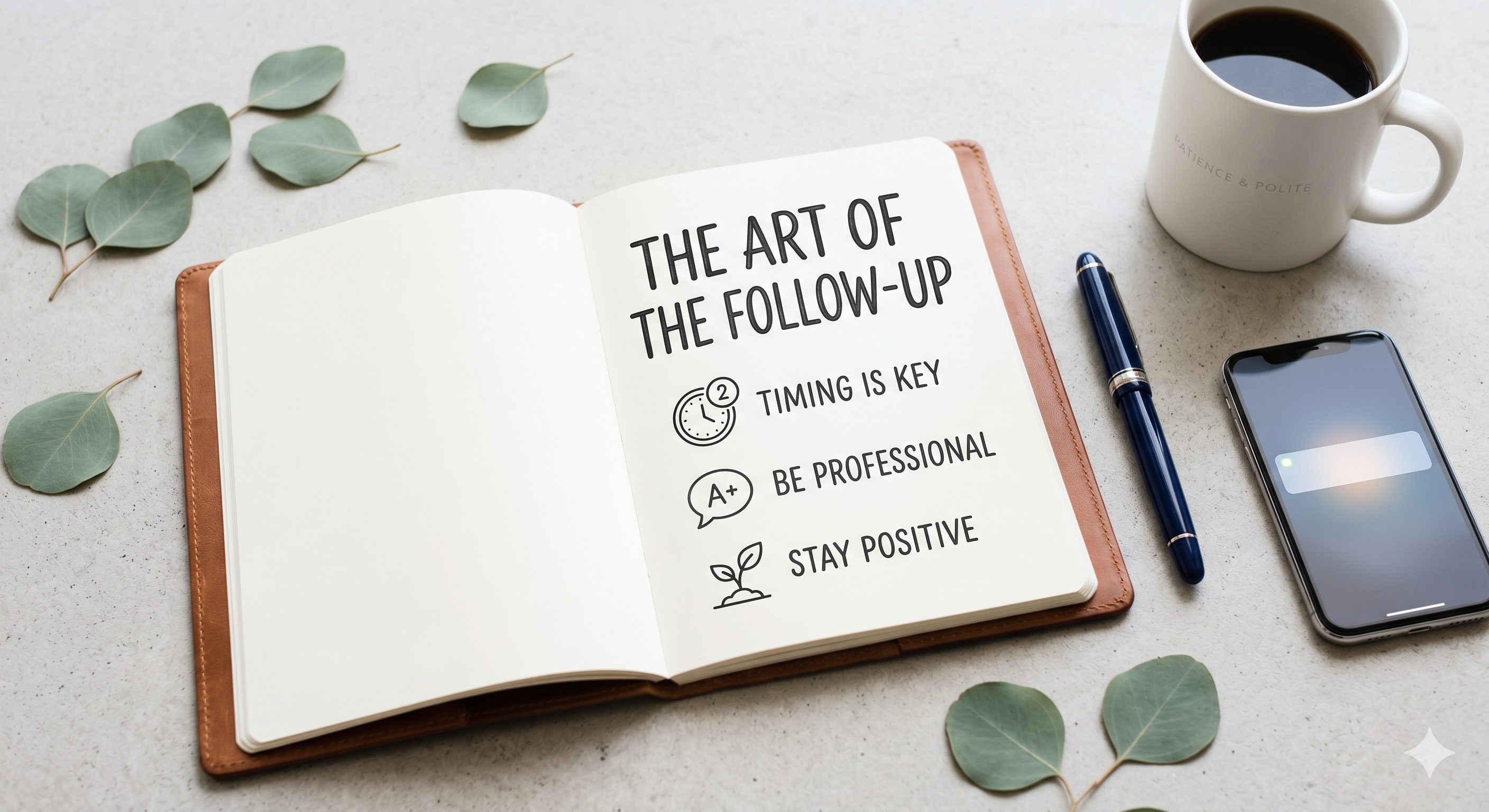
How to Follow Up After a Job Application (Without Being Annoying)
You applied. You waited. You heard nothing.
This is the most common experience in the modern job search. According to a 2025 survey by Greenhouse, 75% of job applicants never hear back from employers — not even a rejection email. The application goes into what job seekers have started calling "the black hole," and that's where most people give up.
But here's the thing: following up is one of the highest-leverage activities in a job search. Recruiters consistently report that a well-timed, well-written follow-up can move a candidate from "maybe" to "let's schedule a call." The problem isn't following up — it's following up poorly.
This guide covers the exact timing, channel, and language that works, based on what recruiters and hiring managers have told us they respond to. We'll also cover what not to do, because the line between persistent and pestering is thinner than you think.
Why Most Follow-Ups Fail
Before we get into what works, let's talk about why most follow-ups don't.
They're too early. Sending a follow-up email 24 hours after applying signals anxiety, not enthusiasm. Hiring teams often take 1-2 weeks to review initial applications, especially for popular roles that receive hundreds of applicants. Reaching out before they've had time to review your materials creates a negative first impression.
They're too generic. "Just checking in on my application" is the follow-up equivalent of "Dear Hiring Manager." It tells the recipient nothing about why they should care. It doesn't remind them who you are, what role you applied for, or why you're a strong fit.
They go to the wrong person. Following up with the company's general careers inbox is like shouting into a stadium. The people who monitor that inbox are often not the people making hiring decisions. Your follow-up needs to reach someone with context and authority.
They ask for something without offering anything. The best follow-ups aren't just requests for status updates. They add value — a relevant insight, a connection to the company's recent work, or a brief explanation of why your experience maps to their specific challenge.
The Follow-Up Timeline That Actually Works
Based on recruiter feedback and hiring data, here's the timeline we recommend:
Day 0: Application Submitted
Don't follow up yet. But do one thing: identify who you'd follow up with. Find the hiring manager or recruiter on LinkedIn. Note their name and email format (most companies use firstname@company.com or firstname.lastname@company.com). You can verify email formats using free tools like Hunter.io.
Day 5-7: The First Touch (LinkedIn)
Five to seven business days after applying, send a brief LinkedIn connection request to the hiring manager or recruiter with a note:
Hi [Name], I recently applied for the [Role Title] position and wanted to connect. I'm particularly drawn to [specific thing about the company or team] and think my experience in [relevant skill/domain] could be a strong fit. Would love to chat if the timing works.
This is soft, professional, and gives them context without asking for anything directly. About 40% of the time, this alone prompts a response.
Day 10-12: The Email Follow-Up
If you haven't heard back after the LinkedIn touch, send a brief email. Here's the template:
Subject line: Following up — [Role Title] Application
Hi [Name],
I applied for the [Role Title] position on [date] and wanted to follow up briefly. I'm genuinely excited about this opportunity because [one specific reason — tied to the company's product, mission, or a recent achievement].
My background in [relevant experience] maps directly to what you're looking for, particularly [specific requirement from the job posting]. I'd welcome the chance to discuss how I can contribute.
Happy to work around your schedule. Thanks for your time.
Best,
[Your Name]
Key principles: short (under 150 words), specific (references the actual role and company), and ends with a low-friction ask.
Day 18-21: The Final Follow-Up
If there's still no response, one more follow-up is acceptable. After this, move on.
Hi [Name],
I know things get busy — just wanted to circle back one last time on the [Role Title] role. I remain very interested and believe my experience in [area] would be valuable to the team.
If the timing isn't right, I completely understand. Either way, I appreciate your consideration.
Best,
[Your Name]
This follow-up acknowledges their time constraints, doesn't pressure, and leaves a positive impression even if the role has been filled.
After Day 21: Move On (But Don't Burn Bridges)
If you've followed up twice and heard nothing, the role is likely filled, paused, or your application wasn't selected. That's okay. The worst thing you can do is keep emailing. The best thing you can do is leave a positive last impression so that if a future role opens up, your name carries good associations.
Following Up After an Interview
The rules change significantly once you've actually spoken with someone. Post-interview follow-ups are expected — not following up after an interview is often seen as a lack of interest.
Same Day: The Thank You Email
Send a thank-you email within 2-4 hours of your interview. It should be:
- Specific — Reference something that was actually discussed. "I enjoyed our conversation about scaling the data pipeline" is infinitely better than "Thank you for your time."
- Brief — 3-5 sentences max. This is not a second cover letter.
- Forward-looking — Express enthusiasm for the next step without being presumptuous.
Hi [Name],
Thanks for taking the time to chat today. I really enjoyed hearing about [specific topic discussed] and it reinforced my excitement about the role. The challenge of [specific problem they mentioned] is exactly the kind of work I find most engaging — and I'd love to bring my experience with [relevant skill] to the team.
Looking forward to the next steps.
Best,
[Your Name]
If you interviewed with multiple people, send a personalized email to each one. Don't copy-paste — each email should reference something unique from that specific conversation.
Day 5-7 Post-Interview: The Check-In
If the recruiter told you a timeline ("we'll get back to you by Friday") and that deadline passes, wait one additional business day, then follow up:
Hi [Name],
I wanted to check in on the timeline for the [Role Title] position. I remain very excited about the opportunity and am happy to provide any additional information that would be helpful for the team's decision.
Thanks again for the great conversation.
Day 14+ Post-Interview: The Honest Ask
If two weeks have passed since your interview with no word, it's appropriate to be more direct:
Hi [Name],
I hope you're well. I wanted to follow up on the [Role Title] role — I'm still very interested and wanted to understand where things stand on your end.
I have [another opportunity / a timeline consideration] and want to make sure I'm making the best decision, but this role remains my top choice. Any update you can share would be really helpful.
Thanks,
[Your Name]
Mentioning another opportunity (if true) often accelerates the process. Companies don't like losing candidates they've invested in interviewing.
The LinkedIn Follow-Up Strategy
LinkedIn deserves its own section because it's become the most effective follow-up channel for many job seekers. Here's why: recruiters live on LinkedIn. Their email inbox might have 200 unread messages, but their LinkedIn notifications get checked multiple times a day.
Before applying: If possible, connect with the recruiter or hiring manager before you apply. When your application comes through, they'll recognize your name. This alone significantly increases your chances of getting reviewed.
After applying: Use the LinkedIn approach described in the Day 5-7 timeline above. Keep it casual and professional.
Engage with their content: If the hiring manager posts on LinkedIn, engage authentically. A thoughtful comment on their post puts your name in front of them without the awkwardness of a cold follow-up. This is especially effective at smaller companies where hiring managers have more visibility into the application pipeline.
Don't send multiple LinkedIn messages. One connection request with a note is appropriate. A follow-up message if they accept the connection is fine. Sending 3-4 messages without a response crosses into uncomfortable territory.
What NOT to Do
Let's be explicit about the follow-up behaviors that hurt your candidacy:
Don't call the company's front desk. Calling and asking to be transferred to the hiring manager is universally disliked. It puts the person on the spot and feels intrusive. Email and LinkedIn are the appropriate channels.
Don't follow up on the same day you apply. It signals impatience, not enthusiasm.
Don't use guilt or pressure. "I've been waiting for two weeks and haven't heard anything" makes you sound frustrated, not professional. Even if you are frustrated, the follow-up should be gracious.
Don't follow up more than twice for an application, or more than three times after an interview. There's a point where persistence becomes harassment. If someone isn't responding after multiple attempts, the answer is no — they just haven't said it explicitly.
Don't send the same email with "bumping this to the top of your inbox." This is widely considered annoying. If you're following up again, write a new message with a slightly different angle or additional value.
Don't connect with every employee at the company. Connecting with the hiring manager and recruiter is fine. Connecting with 15 people from the same team looks desperate and gets reported.
How Jobbyo Handles Follow-Up
One of the most underappreciated features of an AI-powered job search tool is automated tracking and follow-up timing. When Jobbyo applies on your behalf, it tracks every application — the date submitted, the company, the role, and the status.
This means you always know exactly where each application stands in the pipeline. No more spreadsheet chaos. No more forgetting which company you applied to two weeks ago.
For Max plan users, Jobbyo can also suggest optimal follow-up timing based on the application date and company response patterns. You review the suggested follow-up, customize it if needed, and send it with one click.
The combination of volume (Jobbyo submits tailored applications daily) and precision (every application is tracked and followed up on at the right time) is why our users see 3x more interview callbacks than those using manual methods or pure auto-apply tools.
The Bottom Line
Following up is a skill, not a personality trait. You don't need to be extroverted or aggressive. You need to be timely, specific, and brief.
The candidates who get interviews aren't always the most qualified — they're often the ones who stayed visible without being annoying. A thoughtful follow-up at the right time can be the difference between getting lost in the pile and getting invited to the next round.
Here's your checklist:
- Identify the right person before you apply
- Wait 5-7 business days for your first touch (LinkedIn)
- Follow up by email at Day 10-12 if no response
- Send one final follow-up at Day 18-21
- After an interview, send a thank-you within hours
- Be specific, brief, and gracious every time
The job search is a numbers game, but it's also a relationships game. Following up well is how you play both at once.