The Hidden Job Market: How to Find Jobs That Are Never Posted Online
Up to 70% of jobs are filled without ever being publicly advertised. Here's how to access the opportunities most job seekers never see — and why your current approach is probably missing most of them.
The Hidden Job Market: How to Find Jobs That Are Never Posted Online
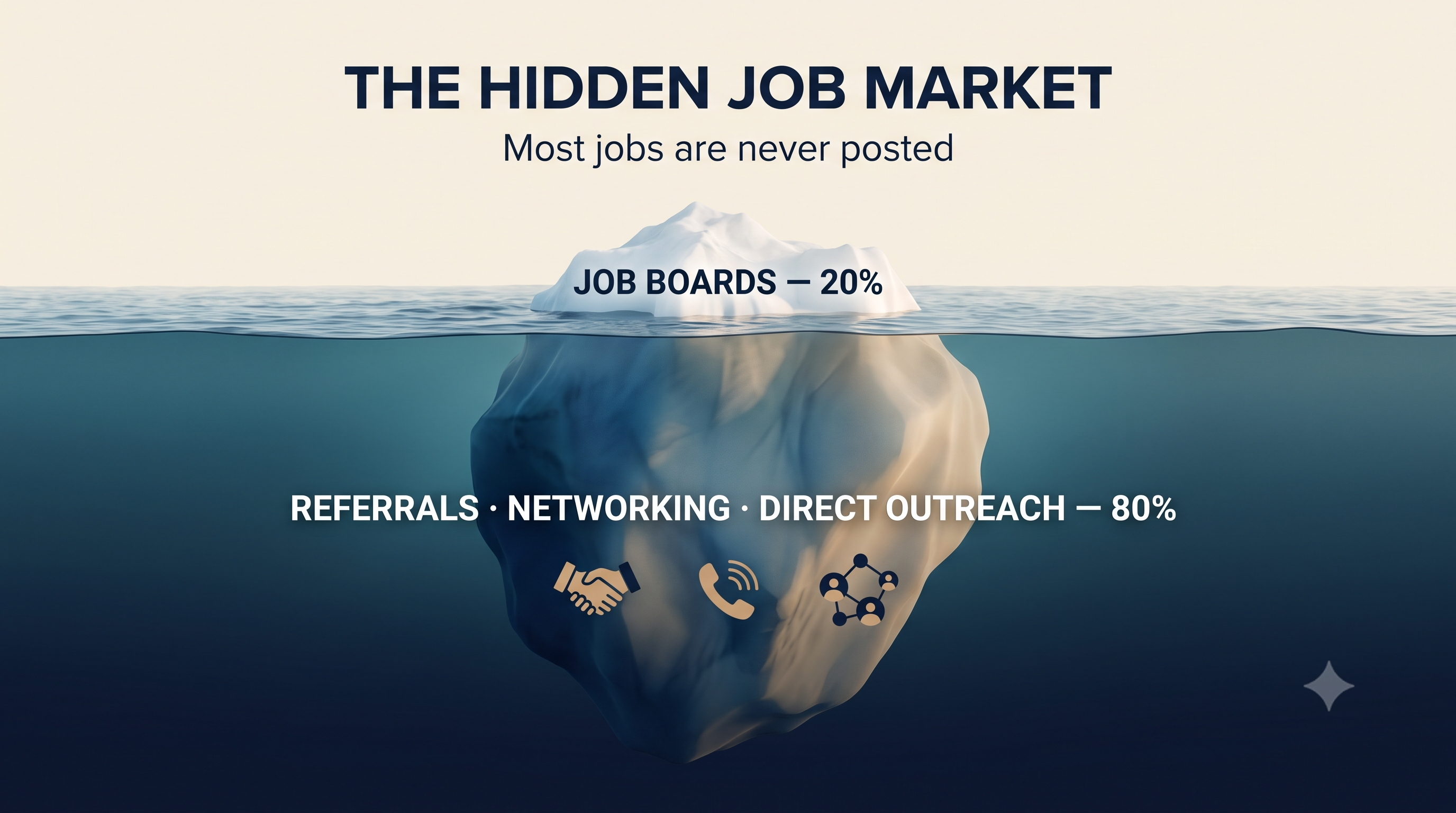
If you're only applying to jobs you find on LinkedIn, Indeed, or Glassdoor, you're competing for a fraction of the available opportunities. Research consistently suggests that between 50-80% of jobs are filled without ever being publicly listed. Some estimates put the number even higher for senior roles.
This isn't a myth or a motivational exaggeration. It's a structural feature of how companies actually hire. Most organizations prefer to fill roles through referrals, internal candidates, or direct outreach before going through the cost and time of a public job listing. By the time a job is posted on a job board, it's already been offered to someone else in a significant percentage of cases.
The good news: understanding how this works gives you a playbook to access opportunities most applicants never see.
Why So Many Jobs Are Never Posted
Companies post jobs publicly because they have to, not because they prefer it. Public postings generate volume — often 200+ applicants for a single role — which creates significant screening work for recruiters and hiring managers. Many companies would rather avoid that if they can.
They can avoid it when:
- An employee refers someone who seems like a strong fit
- A hiring manager thinks of someone they've met at an event or seen on LinkedIn
- A former colleague or vendor moves into a role that opens a slot
- A trusted recruiter or staffing agency surfaces a candidate directly
- The right candidate reaches out at the right time with the right message
This is the hidden job market. It's not a secret club — it's just the natural consequence of how professional relationships work.
Track 1: Activating Your Existing Network
Your existing connections are the fastest path to the hidden market. Most people dramatically underestimate how many people they know who could surface opportunities.
The Direct Ask (Done Right)
The mistake most people make is asking for a job. This puts your contact in an awkward position — they either know of something or they don't, and if they don't, the conversation ends there.
A better ask is specific and low-pressure:
"Hey [Name], I'm exploring new opportunities — specifically [target role] at [type of company]. If you hear of anything or know someone I should talk to, I'd love the connection. No pressure at all."
This works because:
- It's specific enough that people can match it against their network
- It's easy to say yes to — forwarding an introduction requires almost no effort
- It keeps the relationship collegial, not transactional
Follow up 2-3 weeks later if you don't hear anything. People forget. It's not awkward to remind them once.
Former Colleagues and Managers
Your best hidden-market sources are people who already know your work. Former managers who liked working with you are often happy to refer you or at minimum take a call. They can vouch for you in ways a stranger on LinkedIn cannot.
Reach out to 5-10 former colleagues with a brief, personal message. Reference something specific from your time working together. It makes the outreach feel like reconnection, not solicitation.
Track 2: Direct Company Outreach
This approach is more aggressive but can be extremely effective, especially for smaller companies where the hiring manager is easy to identify.
Identify Your Target Companies
Start with a list of 20-30 companies where you'd genuinely like to work. Use signals like:
- Companies growing fast in your space (funded startups, announced expansions)
- Companies in your city that have active hiring in adjacent roles
- Companies where people in your network currently work
- Companies whose product or culture you genuinely admire
Find the Right Person
Don't send your resume to hr@company.com. It's a black hole. Instead, find the hiring manager or the person who leads the team you'd join. LinkedIn makes this relatively easy — search for the company and filter by department.
Craft a Targeted Cold Outreach
Your message should make clear within the first two sentences that this isn't a generic pitch:
"Hi [Name], I've been following [Company]'s work on [specific product/initiative] — the approach you're taking with [specific detail] is genuinely interesting to me. I'm a [your title] with [X years] in [relevant field], and I'm actively exploring my next opportunity. I don't see an open role that's a perfect match, but I wanted to reach out directly because this seems like exactly the kind of team I'd want to be part of. Would you be open to a brief conversation?"
This message does several things:
- Demonstrates you've done actual research
- Positions you as someone with standards (you're not applying to everything)
- Makes the ask low-commitment (a conversation, not a job)
Hiring managers respond to this more than most job seekers expect — especially if your background is relevant and your message is specific.
Track 3: Industry Events and Communities
Physical proximity creates opportunities that digital channels don't. A five-minute conversation at a meetup can create a connection that months of LinkedIn messaging couldn't.
Where to Show Up
- Industry conferences and trade events: Larger events where professionals gather to talk about trends in your field
- Smaller local meetups: More intimate settings where conversations go deeper and names are more memorable
- Professional association events: Organizations specific to your function (product, finance, HR, design) often host regular gatherings
- Informal networking dinners: Often organized around conferences, these are higher-signal than the main event
How to Make It Count
Most people attend events, collect a few cards, and do nothing. That's why events feel like a waste of time.
The follow-up is where value is created. Within 24 hours:
- Connect on LinkedIn with a reference to your conversation ("Great talking about [topic] at [event]")
- Share anything relevant you mentioned (an article, a resource, a mutual connection)
- Set a calendar reminder to check in 30 days later if nothing specific is pending
You're not following up to ask for a job. You're continuing a conversation.
Track 4: Executive Recruiters and Staffing Agencies
Recruiters who work on a retained or contingency basis fill roles that are frequently never posted publicly. For mid-to-senior roles, this is a significant portion of the market.
How to Work With Recruiters
The key is to be a good candidate for recruiters to place, which means:
- Be specific about what you want. Recruiters need to know exactly where to slot you. "I'm open to anything" makes you hard to place.
- Respond quickly. Recruiters move fast. A candidate who takes three days to respond to an email is often already out of consideration.
- Build the relationship before you need it. Reach out to 5-10 recruiters in your field with a brief note introducing yourself and your background, even if you're not in active search mode. When a role comes up, they'll reach out to candidates they already know first.
Search for recruiters who specialize in your industry on LinkedIn. Many list their specialty in their headline or summary.
Track 5: Informational Interviews
Informational interviews — conversations where you ask someone about their role or company with no explicit job-seeking agenda — are one of the most underused hidden-market strategies.
The format:
- Request 20-30 minutes to learn about their career path or company
- Ask substantive questions about their work and challenges
- Express genuine interest in their experience, not just what they can do for you
What happens: they remember you. When a role opens, they think of you. When their colleague mentions they're hiring, your name comes up. When they see a job posting that fits you, they reach out.
None of this requires you to ask for a job during the informational interview. In fact, asking for a job during an informational interview is a surefire way to ensure you're never remembered positively.
Combining Hidden Market Tactics With Automated Application Volume
The hidden market requires time — building relationships and having conversations takes more effort per opportunity than clicking "Easy Apply." That's exactly why it's less competitive.
But it also means you need to be strategic about where you invest your time. Not every company deserves a personalized outreach campaign. Not every event will surface relevant contacts.
A practical framework:
- Use a tool like Jobbyo to handle the volume of publicly posted applications automatically, so you're not spending hours on job boards
- Invest the time you save into 5-10 targeted hidden-market activities per week
- Track your outreach in the same way you track applications — who you contacted, when, what the response was
The job seekers who consistently land the best opportunities are usually doing both: using automation to ensure they're not missing public listings while simultaneously accessing roles that never get listed at all.
The Bottom Line
The hidden job market isn't a myth, and accessing it doesn't require unusual connections or insider access. It requires being proactive, being specific, and building habits that most job seekers don't bother with.
Most of your competition is doing the same thing — applying to the same jobs on the same platforms and waiting. Every step you take into the hidden market moves you into a smaller, less crowded pool.
Jobbyo handles the public-facing search. The relationship-building is yours to own — and it's where the best opportunities live.