Getting Interviews But No Offers? Here's Why — and How to Fix It
Making it to interviews but not getting offers is a specific problem with specific causes. It's not about your qualifications — it's about what happens in the room. Here's how to diagnose and fix it.
Getting Interviews But No Offers? Here's Why — and How to Fix It
If you're consistently getting to the interview stage but not moving forward, there's both good news and bad news.
The good news: your resume is working. Your qualifications are sufficient. You're clearing the first filter that stops most applicants cold. That's meaningful.
The bad news: something is happening in the interview itself that's preventing you from crossing the finish line. And unlike ATS optimization or resume formatting, interview performance is harder to diagnose on your own — because you're inside the conversation when it happens.
This guide is a structured diagnostic for candidates who are stuck at the interview-but-no-offer stage.
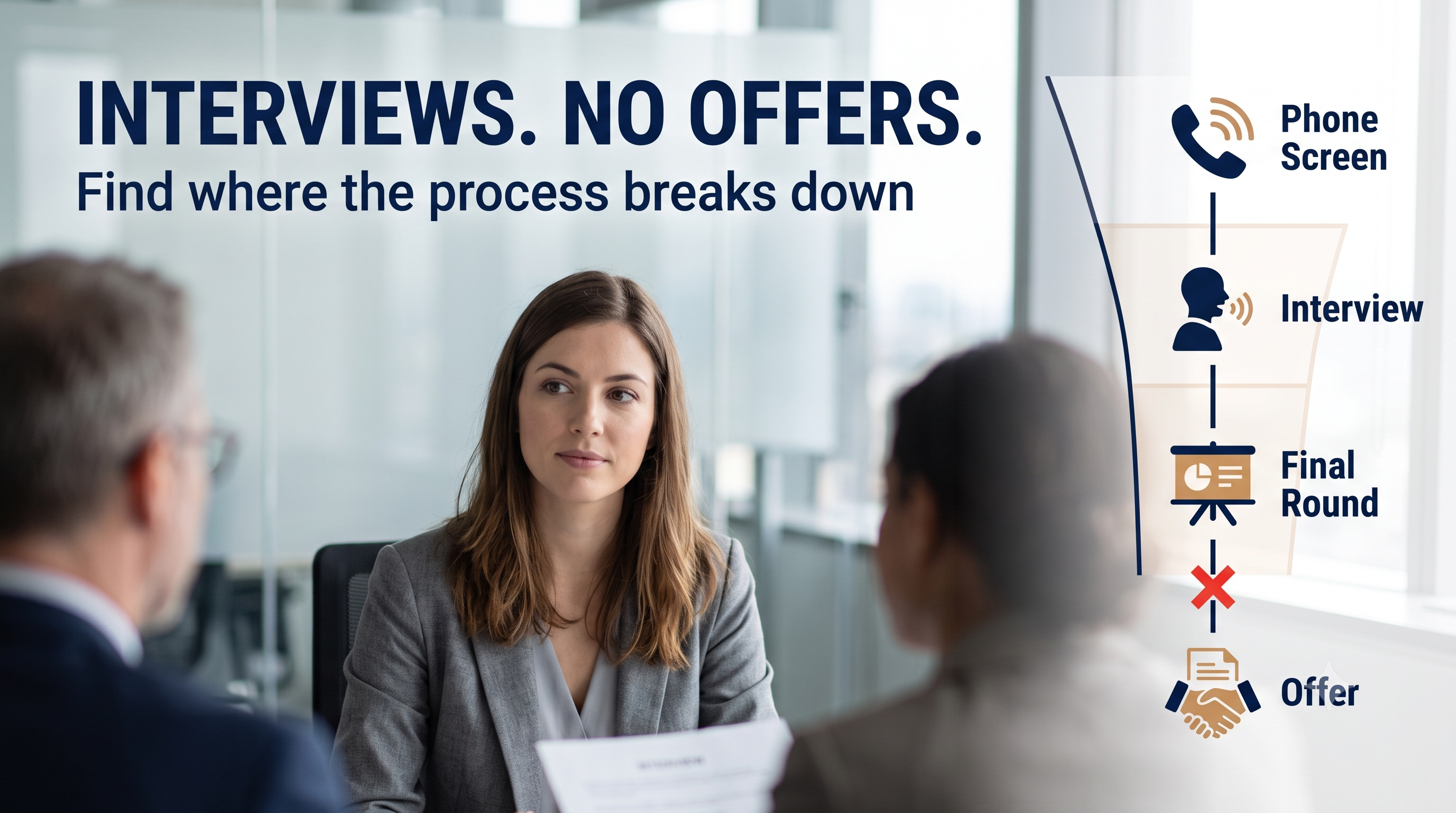
First: Identify Where You're Being Cut
The first step is to figure out where in the process you're losing people. This matters because the fix is different depending on the stage.
Losing After the Phone Screen
If you consistently clear the resume review but get cut after a recruiter call, the likely issues are:
- Compensation misalignment: Your salary expectations are outside what the company planned to pay, and it came up on the call
- Communication style: Something in how you present verbally — clarity, pace, energy — doesn't match the image your resume created
- Basic qualification gaps: The recruiter confirmed something that looks good on paper but doesn't hold up under direct questioning
- Unclear positioning: Your story about why you're interested and why you're the right fit isn't crisp
Losing After First-Round Interviews
If you get to hiring manager or panel interviews but don't advance, the issues are usually:
- Weak behavioral answers: You're describing responsibilities rather than specific actions and outcomes
- Poor question preparation: Your answers to "Why this company?" or "What do you want in your next role?" don't feel genuine
- Cultural misalignment: Something about your style, values, or approach doesn't fit the team — and it's surfacing in the conversation
- Technical gaps: For roles with a skills component, your depth didn't match expectations
Losing After Final Rounds
If you're consistently making it to final rounds but losing there, the picture is different:
- You're competitive enough to reach the finals — so the gap is often small
- Final decisions frequently come down to narrative: which candidate's story fits best, who seemed most engaged, who the team could imagine working with every day
- Reference checks occasionally surface concerns — worth auditing if this pattern is consistent
- Compensation negotiation sometimes derails offers at the last stage
Knowing which category you're in determines where to focus your energy.
The Most Common Interview Failure Modes
Failure Mode 1: Talking About Responsibilities Instead of Impact
This is the single most consistent way candidates underperform in interviews.
What it sounds like:
"In that role, I was responsible for managing the marketing team and overseeing our campaign calendar."
What interviewers want:
"I led the marketing team through a complete rebrand during a company pivot. We launched a new campaign in six weeks that increased qualified leads by 38% in the first quarter."
The difference is the difference between a job description and an accomplishment. Interviewers have read your resume. They want evidence that the experience on paper translated into actual results.
Every answer should have a measurable outcome attached. If you can't quantify it, be specific about what changed: "The team's response time dropped from three days to same-day." "We went from two pipeline meetings a month to eight." Specificity in the absence of hard numbers is still far better than vague responsibility claims.
Failure Mode 2: Poor "Why This Company?" Answers
"I've heard great things about your culture" and "I love your product" don't cut it. Interviewers ask this question because they want to know if your interest is real and if you've done the work to understand what they do.
A strong answer references something specific:
"The work your team published last year on how you're approaching [specific initiative] is directly relevant to what I've been doing in [your area]. Most companies in this space are still doing [old approach] — you're clearly thinking about this differently, and I'd want to be part of a team that's ahead of that curve."
This requires actual research. Not a scan of the homepage — reading recent blog posts, announcements, press coverage, LinkedIn posts from the team, or industry analysis about the company's position.
Failure Mode 3: Weak Answers to "Tell Me About Yourself"
This is the most asked question in interviews and the most botched. Most candidates either go too long (a chronological resume recitation) or too vague ("I'm a passionate people-person who loves challenges").
A strong answer has three parts and takes about 90 seconds:
- Where you've been: 1-2 sentences on your professional arc
- Where you are now: What you're doing and what you're good at
- Why here, why now: Connect it directly to the role and the company
Practice this until you can deliver it naturally without thinking about it. It sets the tone for the entire conversation.
Failure Mode 4: Not Asking Good Questions
"Do you have any questions for us?" is not a routine courtesy — it's an opportunity that most candidates waste.
Questions that signal engagement:
- "What does success look like in this role at 90 days? At one year?"
- "What are the biggest challenges the team is currently navigating?"
- "What's something about working here that surprised you after you joined?"
- "How has this role evolved over the past year?"
Questions that signal disengagement or poor prep:
- "What does your company do?" (should have researched this)
- "How much PTO do I get?" (fine eventually, but wrong timing for first round)
- "What are the advancement opportunities?" (better asked after you have an offer)
Prepare 4-5 specific questions for every interview. You usually only need 2-3, but having extras prevents the awkward silence when a previous answer covered one of your planned questions.
Failure Mode 5: Nervousness That Reads as Disinterest or Evasion
This one is common and hard to self-diagnose. Nervousness in an interview often manifests as:
- Flat, quiet voice with little variation
- Very short answers that don't invite follow-up
- Avoiding eye contact (or, in video, looking at the screen instead of the camera)
- Overly formal language that sounds stiff and scripted
Interviewers often interpret these signals as lack of interest or difficulty communicating — even when neither is true.
The fix is practice in a simulated interview environment — video call mock interviews, recorded self-practice, friends playing interviewer. The nervousness doesn't go away immediately, but it does become manageable with enough repetitions. And what reads as competence in an interview is often just familiarity.
How to Get Feedback
Most companies won't give detailed feedback on rejected candidates. But some will, and asking for it is worth doing.
After a final round: "Thank you for letting me know. I genuinely enjoyed the process and learned a lot. If there's any feedback about areas where I could improve my candidacy for similar roles, I'd appreciate it — I understand completely if that's not something you're able to share."
The framing matters. You're not challenging the decision. You're asking a genuine question in a way that makes it easy to answer honestly. Some recruiters and hiring managers will share something real if approached this way.
When you do receive feedback, take it seriously — even if you disagree with it. You're getting a view from the other side of the table, which you almost never get to see otherwise.
Run More Interviews to Fix Interview Performance
The fastest way to improve interview performance is to interview more. Not just for any role — for real roles you want, where the stakes feel real and the pressure is genuine.
This creates a counterintuitive but important insight: being in more conversations speeds up your improvement as an interviewer, which increases your conversion rate, which leads to more offers from a smaller pool of applications.
A tool like Jobbyo helps by maintaining the application volume that keeps multiple conversations in motion simultaneously. When you have five first-round interviews in a given month instead of one, each one becomes a data point rather than a referendum.
The pattern changes. You start to notice which answers land well and which don't. You calibrate your stories to different audiences. You find your natural register in a conversation instead of performing a scripted version of professionalism.
Building a Self-Review Practice
After every interview, spend 10 minutes answering three questions while the conversation is fresh:
- Which questions did I answer well? What made those answers effective?
- Which questions did I struggle with? What would I say differently?
- What was the energy of the conversation? Did it feel like a genuine exchange or one-sided?
Over time, this practice reveals patterns. You'll notice the same questions catching you off-guard, or the same transition points where the energy shifts. Awareness is the precondition for change.
Getting to the interview is the hardest part of the funnel to clear. Candidates who reach that stage are genuinely qualified. The gap between qualified and hired is usually narrow — and it's almost always about how you communicate, not what you know.
Diagnose where you're losing. Fix the specific failure mode. Keep the application volume high with Jobbyo so you have enough repetitions to improve quickly.
The offers are there. The path to them is clearer than it feels when you're in the middle of it.