How to Prepare for Behavioral Interview Questions Using the STAR Method
Behavioral questions are in almost every interview. Most candidates answer them too vaguely or too briefly. Here's how to structure compelling, specific answers that make interviewers remember you.
How to Prepare for Behavioral Interview Questions Using the STAR Method
Behavioral interview questions are the most consistent part of the modern hiring process. Whether you're interviewing at a Fortune 500 company or a 20-person startup, you will almost certainly be asked some variation of "Tell me about a time when you..."
These questions are based on a simple idea: past behavior predicts future behavior better than hypothetical questions. Interviewers have decades of evidence to support this. What you did in a specific situation reveals more about how you'll perform than what you say you would do.
Most candidates answer behavioral questions in one of two ways:
- Too vague: "I'm really good at handling conflict. I always try to listen and find common ground."
- Too scattered: A rambling five-minute story with no clear point that leaves the interviewer unsure what you actually did.
The STAR method solves both problems. Here's how to use it well.
What STAR Actually Is
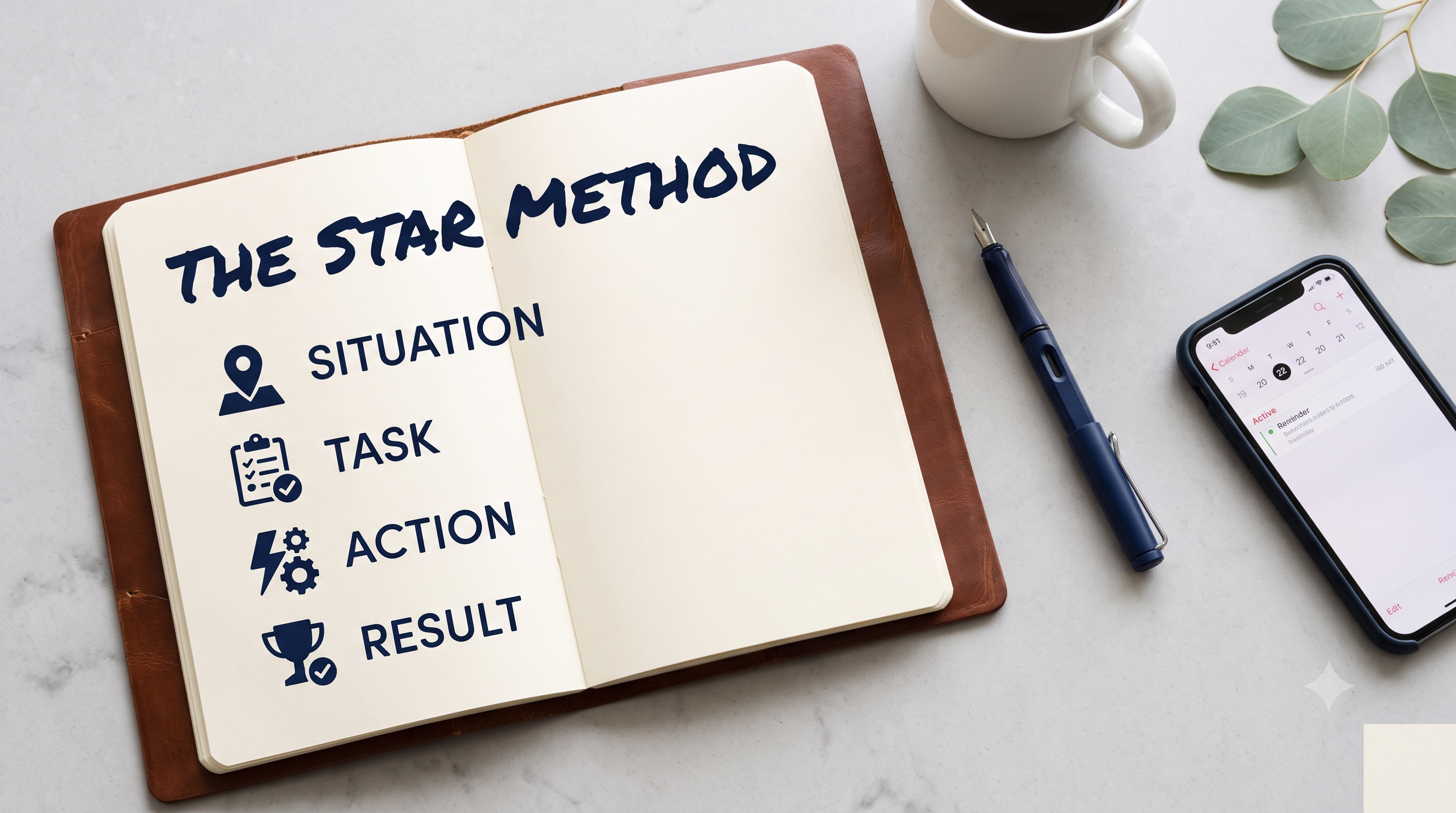
STAR is an acronym for the four components of a well-structured behavioral answer:
- S — Situation: The context. Where were you, what was happening, why did it matter?
- T — Task: What were you specifically responsible for doing in that situation?
- A — Action: What did you actually do? (This is the most important section.)
- R — Result: What was the outcome? What changed because of your actions?
The formula sounds mechanical, but when applied naturally, it produces answers that are specific, clear, and memorable. The goal isn't to announce that you're using STAR — it's to tell a story that has all four elements embedded in it.
The Most Common Behavioral Questions (and What They're Really Testing)
"Tell me about a time you dealt with a difficult coworker or conflict."
What they're testing: Emotional intelligence, professionalism, communication skills, your ability to maintain relationships under pressure.
What they don't want to hear: A story where you won and the other person was just wrong. Stories where the "result" is "I reported them to HR" without any attempt at direct resolution.
"Describe a time you failed or made a significant mistake."
What they're testing: Self-awareness, accountability, the ability to learn and grow.
What they don't want to hear: A "humble brag" failure ("I worked too hard"). A failure where you blame external factors. A failure with no lesson or growth.
"Tell me about a time you had to manage competing priorities or a heavy workload."
What they're testing: Organization, time management, judgment about what matters most.
What they don't want to hear: "I just worked late until everything was done." (Signals poor boundaries and no strategic thinking.)
"Give me an example of a time you led a team through change."
What they're testing: Leadership, change management, communication, empathy.
What they don't want to hear: A story where you just announced the change and assumed people would follow. Stories with no mention of how you managed resistance or uncertainty.
"Tell me about a project you're most proud of."
What they're testing: What you value, what you define as success, how you talk about your own work.
What they don't want to hear: A vague answer with no specific outcome. An answer that doesn't connect to the skills the role requires.
Building Your Story Bank
The most effective way to prepare for behavioral interviews is to build a library of 8-10 detailed stories from your career before the interview, and then practice adapting them to different question types.
A good story bank has examples that cover:
- A significant achievement with measurable impact
- A leadership moment (formal or informal)
- A conflict or difficult interpersonal situation and how you handled it
- A failure or mistake and what you learned
- A time you worked under pressure or with tight constraints
- A time you had to persuade or influence someone who disagreed with you
- A time you took initiative without being asked
- A time you adapted to significant change or ambiguity
For each story, document:
- The context (company, team size, your role)
- The specific situation (1-2 sentences)
- Your specific actions (the center of the story — what did YOU do?)
- The measurable result (numbers whenever possible)
Quantify results wherever possible. "Reduced onboarding time by 30%" is more compelling than "improved the process." "Increased team retention from 64% to 88% in six months" is specific and verifiable. "Improved morale" is neither.
How to Tell a STAR Story Well
Keep the Situation Brief
Candidates often spend too long on setup. The situation and task together should take 20-30 seconds. The point isn't the backstory — it's what you did.
Too long:
"So this was back in 2023, at my previous company — I had been there about two years at that point, and things were actually going pretty well in most areas, but we had this product launch that had been delayed three times already, and the team was frustrated, and my manager at the time was dealing with some personal stuff so she wasn't really available, and..."
Right length:
"At my previous company, we had a product launch that had been delayed three times. The team was demoralized, we had a hard external deadline coming up, and I was the lead responsible for getting us across the line."
Make Your Actions Specific
This is where most candidates fall short. "I helped facilitate better communication" is not an action. "I set up a daily 15-minute standup with the cross-functional leads, created a shared doc with the three open blockers, and personally walked the engineering lead through each business dependency" — that's an action.
The interviewer is trying to understand how you think and how you work. Generic actions don't tell them either.
Lead With the Impact in Your Result
Don't bury the outcome. If the result was strong, say it clearly and early:
"We shipped on time for the first time in three attempts. The launch exceeded first-week targets by 22%, and I was asked to lead the next two launches based on the result."
Then you can add the softer outcomes: "The team felt more confident, the cross-functional relationships improved, and we used the same process for the next six months."
The 90-Second Rule
A well-told behavioral answer should be 90 seconds to 2 minutes long. Practice yours out loud and time them.
Shorter than 60 seconds usually means you're being too vague. Longer than 2.5 minutes and you're losing the interviewer.
After you finish, stop. Don't fill silence with "Yeah, so that's basically the situation" or "I hope that answers your question." End the story and let it land.
Adapting One Story to Multiple Questions
A good story can often serve multiple question types. A story about navigating a difficult stakeholder relationship, for example, might answer:
- "Tell me about a time you handled conflict"
- "Tell me about a time you had to influence someone without authority"
- "Describe a situation where communication was challenging"
- "Tell me about a project that didn't go as planned"
The core facts of the story stay the same. What you emphasize shifts depending on what the question is asking. In the conflict version, you focus on how you navigated the interpersonal dynamic. In the influence version, you focus on what you did to build credibility and alignment.
What to Do When You Can't Think of an Example
This happens even to well-prepared candidates. In the moment, your mind goes blank. A few strategies:
Buy time gracefully: "That's a good question — could I have a moment to think of the best example?" This is completely acceptable. Most interviewers prefer a brief pause over a rushed, weak answer.
Draw from adjacent experience: If you can't think of a direct work example, consider volunteer work, school projects, or parallel situations. "I don't have a direct work example that comes to mind, but in my role running the volunteer team at [organization]..." — this is fine, especially earlier in your career.
Be honest about limitations: "I haven't had a direct experience managing that kind of situation yet, but here's how I would approach it based on..." — this signals self-awareness, which is itself valuable information. But use it sparingly. For most questions, you should be able to find a real example.
Practicing Without Sounding Rehearsed
Rehearsed answers sound robotic and lose the natural warmth that makes a good interview feel like a conversation. The goal is prepared, not memorized.
Practice by:
- Recording yourself answering questions and watching the playback
- Running mock interviews with a friend who asks follow-up questions
- Using different question phrasings for the same underlying question — it forces you to think about the story, not the exact words
What you're practicing is access to the story, not a script. You should be able to start the same story from three different angles depending on how the question is framed.
Behavioral interview prep is one of the most high-leverage investments in a job search. A handful of well-built, well-practiced stories that you can adapt flexibly will serve you across every interview you take.
Combined with a system that creates consistent interview opportunities — like Jobbyo — you'll have more chances to practice, more chances to land the offer, and more control over where you end up.
Try Jobbyo free and build the application volume that gets you into more rooms.