8 min read
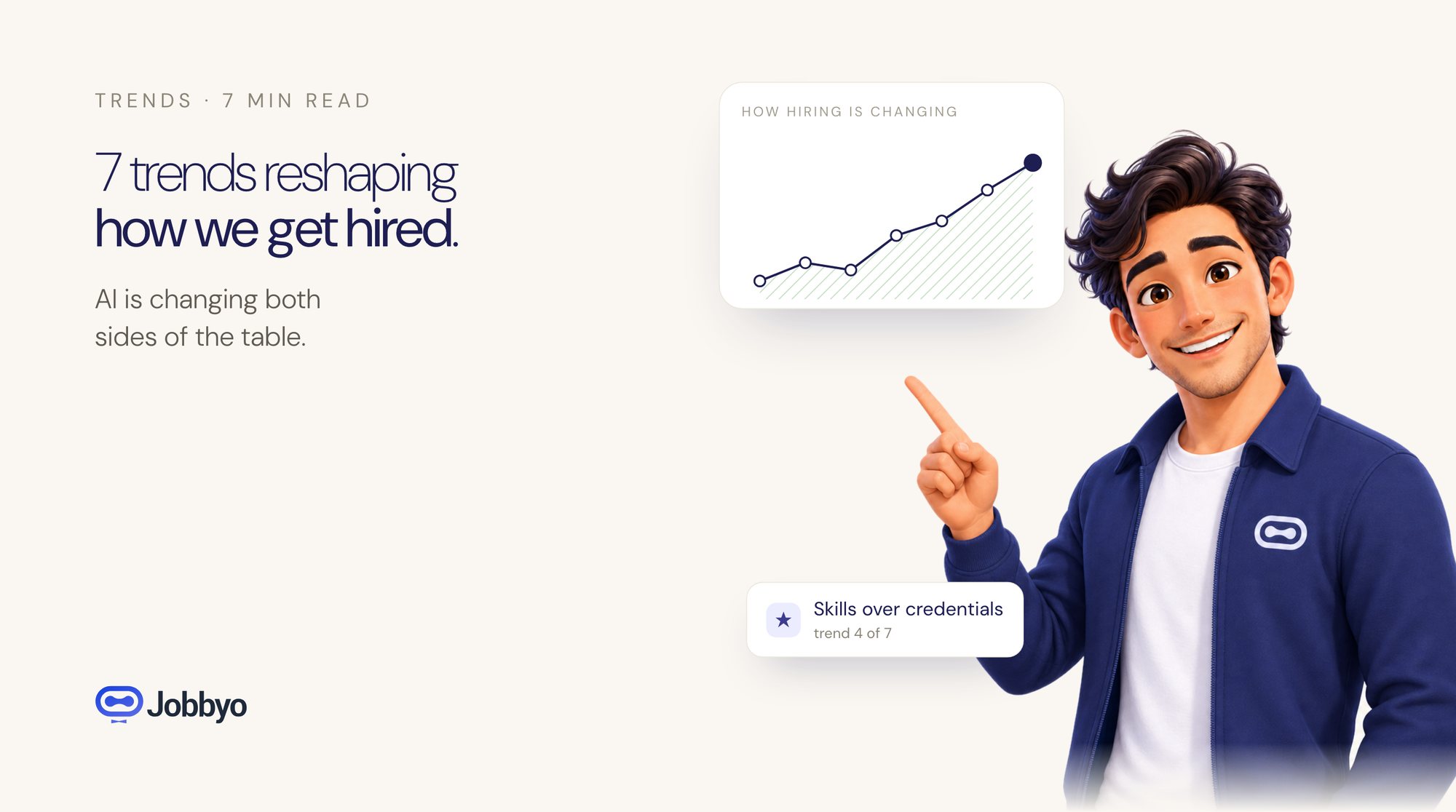
AI Job Search in 2026: 7 Trends Reshaping How People Get Hired
The job market has fundamentally shifted. AI isn't just helping companies hire — it's changing how candidates find, apply for, and land roles. Here are the 7 trends that matter most in 2026.
If you searched for a job in 2024, you probably remember the grind. Scrolling through boards, tailoring resumes one by one, writing cover letters that felt like shouting into the void. Maybe you sent 200 applications and heard back from three.
That experience hasn't disappeared in 2026, but the tools available to job seekers have changed dramatically. AI has moved from a novelty to an essential part of the hiring process — on both sides of the table.
The problem is that most job seekers are still playing the 2023 game. They're manually doing what machines can now handle in seconds, and they're ignoring the shifts that have quietly reshaped what actually gets people hired.
Here are seven trends we've been tracking that are defining the job search landscape right now.
1. AI-Optimized Resumes Are Now the Baseline
A year ago, having an ATS-optimized resume gave you an edge. In 2026, it's table stakes.
Applicant Tracking Systems have gotten smarter. They don't just scan for keywords anymore — they evaluate context, relevance, and even the structure of your achievements. A resume that says "responsible for managing a team" scores significantly lower than one that says "led a cross-functional team of 12, delivering a $2.4M product launch 3 weeks ahead of schedule."
The shift means that a generic, well-formatted resume is no longer enough. Every application needs to demonstrate specific alignment with the role's requirements, and AI tools have made that process dramatically faster.
At Jobbyo, we've seen users go from a 4% interview rate to nearly 15% simply by running their resumes through our ATS grader and implementing the suggestions before applying. The tool identifies exactly which keywords are missing, which accomplishments need quantifying, and where formatting issues might cause parsing errors.
The takeaway isn't that AI writes your resume for you. It's that AI shows you exactly what's wrong with it and how to fix it — in minutes instead of hours.
2. Automated Outreach Has Replaced "Spray and Pray"
The old volume game was broken. People would send the same resume to 500 jobs and hope something stuck. The interview rate was terrible, and the burnout was worse.
What's replaced it is something fundamentally different: targeted automation. Instead of blasting a generic application everywhere, AI systems now match your profile against job requirements and only apply where there's genuine alignment.
This is a critical distinction. The goal isn't to apply to more jobs — it's to apply to the right jobs, consistently, without the manual effort that burns people out.
Think about what happens when you automate the repetitive parts of your search. You're no longer spending two hours every morning scrolling job boards. Instead, you wake up to a dashboard showing which roles you've been matched with, which applications have been sent, and where you should focus your human effort — like networking or interview prep.
The candidates who are winning right now aren't the ones working the hardest. They're the ones working the smartest, using automation to handle coverage while they handle connection.
3. AI-Generated Cover Letters Are Getting Good (But Context Still Wins)
Let's be honest — most cover letters in 2025 were either painfully generic or obviously AI-generated. Hiring managers could spot them immediately, and many stopped reading cover letters altogether.
In 2026, the technology has improved significantly. AI can now generate cover letters that reference specific company initiatives, mirror the tone of the job posting, and weave in your actual accomplishments in a way that feels natural.
But here's the catch: the best cover letters still require human input. The AI doesn't know about the conversation you had with someone at the company last week. It doesn't know that you're passionate about their sustainability initiative because you volunteered with a similar organization for three years.
The winning formula we've seen is using AI to handle the structure and optimization — making sure the letter hits the right keywords, is the right length, and follows a compelling format — while you add the personal details that make it uniquely yours.
The people who are getting callbacks aren't the ones who let AI write everything. They're the ones who use AI as a starting point and then add the context that no machine could know.
4. Skills-Based Hiring Is Overtaking Credential-Based Hiring
This trend has been building for years, but 2026 is the tipping point. More companies are evaluating candidates based on demonstrated skills rather than degrees and job titles.
The reason is practical. When AI handles the initial screening, it can assess skill alignment with far more nuance than a human scanning resumes for 6 seconds each. An AI system can evaluate whether your project management experience at a 50-person startup translates to the requirements of a Fortune 500 PMO role — even if the job titles don't match.
For job seekers, this means two things:
- Your resume needs to lead with skills and outcomes, not titles and tenure. Instead of listing where you worked and for how long, emphasize what you actually did and the measurable results you achieved.
- Portfolio evidence matters more than ever. Links to projects, case studies, or quantified results carry more weight than a prestigious employer name.
This is actually great news for career changers and non-traditional candidates. If you can demonstrate the skills, the path you took to get them matters less than it used to.
5. Video Interview Prep Has Become AI-Powered
The interview process itself has shifted. More companies are using asynchronous video interviews as a first screen, and AI tools are now helping candidates prepare for these in ways that weren't possible before.
Modern interview prep tools can simulate realistic interview scenarios based on the actual job description, provide real-time feedback on your delivery, and identify patterns in your responses that might raise red flags.
For example, if you tend to give overly long answers or frequently use filler words, an AI coach can flag that pattern after a single practice session. If your STAR-method stories lack quantified results, it'll point that out.
The candidates who are converting interviews into offers in 2026 aren't necessarily the most experienced — they're the most prepared. And preparation at this level used to require expensive career coaches. Now it's accessible to anyone with an internet connection.
6. The "Hidden Job Market" Has Gotten Even More Hidden
Here's a trend that might surprise you: despite the rise of AI and automation, the percentage of jobs filled through networking and internal referrals has actually increased.
Companies are posting fewer roles publicly and relying more on employee referrals, internal mobility, and direct outreach from recruiters. Some estimates suggest that up to 70% of positions are now filled before they ever appear on a job board.
This doesn't mean job boards are useless — they're still where the majority of candidates start their search. But it does mean that applying online should be just one part of your strategy, not your entire strategy.
The most effective approach we've seen combines automated applications (to cover the public market) with deliberate networking (to access the hidden market). Your Jobbyo dashboard becomes a trigger for networking: when you see that an application has been sent to Company X, that's your cue to find and connect with someone on that team on LinkedIn.
You're not networking blindly. You're networking with context, which makes every conversation more relevant and more likely to lead somewhere.
7. Job Search Analytics Are Changing How People Make Decisions
The final trend is one of the most underrated: data-driven job searching.
In the past, job seekers had almost no visibility into their own performance. You'd send out applications and hope for the best. Maybe you'd track things in a spreadsheet, but you had no real way to know whether your resume was the problem, your targeting was off, or you were just unlucky.
In 2026, AI-powered job search platforms provide real-time analytics on your search. You can see your application-to-interview conversion rate, which types of roles you're most competitive for, how your resume scores against specific job descriptions, and where in the funnel you're losing momentum.
This changes the game entirely. Instead of making emotional decisions ("I'm not getting interviews, so I must be unqualified"), you make data-driven decisions ("My conversion rate is 3% for senior roles but 12% for mid-level roles — I should adjust my targeting").
The job seekers who treat their search as a measurable, optimizable process consistently outperform those who treat it as a guessing game.
What This All Means for You
The common thread across all seven trends is this: the job search has become a system, and the people who succeed are the ones who build and optimize their system.
That doesn't mean removing the human element. If anything, the opposite is true. By automating the repetitive, draining parts of the search — the scrolling, the form-filling, the basic tailoring — you free up your time and energy for the things that actually get you hired: meaningful conversations, thoughtful preparation, and strategic decision-making.
The technology exists to make your search dramatically more efficient. The question is whether you'll use it or keep grinding through the old playbook.
The math has changed. The market has changed. Your approach should too.
Put this to work
Let Jobbyo find your
best matches for you.